
Close
Back


From now on you can download videos from our website
If you would also like to subscribe to the newsletter and receive our latest updates, click on the button below.
Enter the email address you registered with and we will send you a code to reset your password.
The password must be at least 12 characters long, no spaces, include upper/lowercase letters, numbers and symbols.
Click the button to return to the page you were on and log in with your new password.
21 November 2001
1 MIN READ
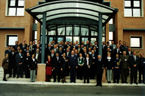
The Fourth Mediterranean Dialogue International Research Seminar was held at the NATO Defence College in Rome from 21 to 24 November 2001. This year, the focus was on ''Shaping a new security agenda for the future of regional co-operation in the Mediterranean region''
The seminar worked from a broad definition of security, extending beyond solely military considerations and therefore highlighted the various aspects of security in the region, including the concern arising from the proliferation of Weapons of Mass Destruction and their means of delivery. Issues with a direct impact on populations such as uncontrolled migration, economic underdevelopment, environmental degradation and competition for access to vital resources (water, food, and energy) were also addressed, as well as efforts to develop regional co-operation, such as the creation of a Euro-Mediterranean area of economic development by the European Union.
The seminar also focused on NATO's Mediterranean Dialogue, with a keynote address given by the NATO Deputy Secretary-General, Ambassador Alessandro Minuto Rizzo. Morocco gave an assessment of its current experience in supporting NATO-led operations in the Balkans. It concluded that, from this experience, NATO could consider ways to upgrade the practical dimension of the Mediterranean Dialogue. In this connection, several speakers proposed practical avenues to be explored for a better North-South co-operation, for instance in the area of disaster relief and maritime co-operation in the military and civilian fields.
The seminar was attended by 76 officials -of which 33 came from Mediterranean countries- and was co-sponsored by Le Centre d'Etudes Strategiques de l'Universite Mohamed V, Rabat (Morocco), with the participation of the Italian Higher Defence Studies Institute. The NATO Defense College will publish the proceedings of this year's seminar; Algeria has offered to co-sponsor the 2003 Seminar.