
Close
Back


From now on you can download videos from our website
If you would also like to subscribe to the newsletter and receive our latest updates, click on the button below.
Enter the email address you registered with and we will send you a code to reset your password.
The password must be at least 12 characters long, no spaces, include upper/lowercase letters, numbers and symbols.
Click the button to return to the page you were on and log in with your new password.
13 July 2021
1 MIN READ
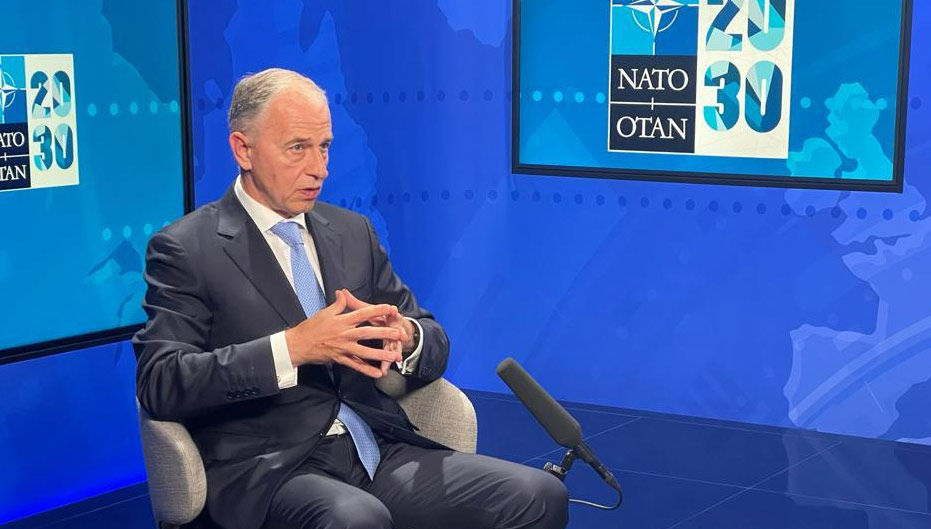
In a panel discussion at the US National Security Commission on Artificial Intelligence (NSCAI) Global Emerging Technology Summit on 13 July 2021, NATO’s Deputy Secretary General Mircea Geoană stressed the importance of international cooperation on Artificial Intelligence (AI) as the most pervasive emerging and disruptive technology, especially when combined with other technologies such as big data, autonomy or biotechnologies.
The panel brought together newly appointed OECD Secretary General Mathias Cormann and EU Ambassador to Washington, Stavros Lambrinidis. Mr. Geoană stressed that the NATO Brussels Summit decisions to launch a transatlantic innovation accelerator and a related Trust Fund opened new perspectives of cooperation with external partners, including with the EU and the OECD. Enhanced international cooperation will help retain our technological edge and strengthen our industrial base, he said, while protecting ourselves against adversarial technology transfers.
NATO is currently finalizing its first landmark strategy on AI. Principles of responsible use of AI in defence will be at the core of this strategy. At the NATO London Leaders’ meeting in 2019, Allies agreed to focus on seven Emerging and Disruptive Technologies (EDTs): artificial intelligence, data and computing, autonomy, quantum-enabled technologies, biotechnology, hypersonic technology, and space. Individual strategies for each of these focus areas will be developed, along the same lines as the NATO AI strategy.