
Close
Back


From now on you can download videos from our website
If you would also like to subscribe to the newsletter and receive our latest updates, click on the button below.
Enter the email address you registered with and we will send you a code to reset your password.
The password must be at least 12 characters long, no spaces, include upper/lowercase letters, numbers and symbols.
Click the button to return to the page you were on and log in with your new password.
29 April 2021
1 MIN READ
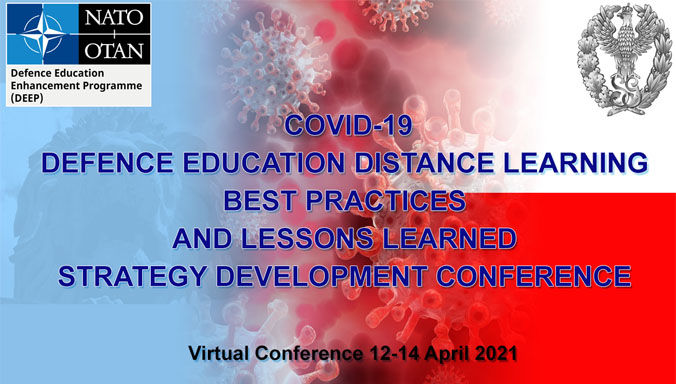
Responding to the challenges of the pandemic, many NATO Allies and partners participated in a virtual meeting of the ‘COVID-19 Defence Education Distance Learning Best Practices and Lessons Learned – Strategy Development Conference’ from 12-14 April 2021. Organised by NATO’s Defence Education Enhancement Programme (DEEP) and the War Studies University in Warsaw, the conference suports the adaptation and development of professional military education with online platforms.
A total of 241 participants from 136 different defence education institutions shared lessons learned since the start of the pandemic, and discussed the best ways to adapt education from residential learning to distance learning. They also exchanged views about the training and technology required to make distance-learning courses more effective.
The conference focused on topics such as language and faculty training and the adaptation of curricula in order to develop a strategy in support of professional military education with online platforms. The conference identified specific courses of action that the DEEP programme will employ to best support the implementation of best practices and lessons learned in the three areas of curriculum development (what to teach), faculty development (how to teach), and institution support (administrative and managerial processes).
NATO’s Defence Education Enhancement Programme will continue to help participating partner countries to build, develop and reform military educational institutions through dialogue, cooperation and consultation between institutions and experts.
Currently, there are 16 partner nations that participate in the DEEP Programme: Afghanistan, Armenia, Azerbaijan, Bosnia and Herzegovina, Georgia, Iraq (as part of the NATO Mission in Iraq), Jordan, Kazakhstan, Kyrgyzstan, Mauritania, the Republic of Moldova, Mongolia, Morocco, Serbia, Tunisia, and Ukraine.