
Close
Back


From now on you can download videos from our website
If you would also like to subscribe to the newsletter and receive our latest updates, click on the button below.
Enter the email address you registered with and we will send you a code to reset your password.
The password must be at least 12 characters long, no spaces, include upper/lowercase letters, numbers and symbols.
Click the button to return to the page you were on and log in with your new password.
03 March 2020
1 MIN READ
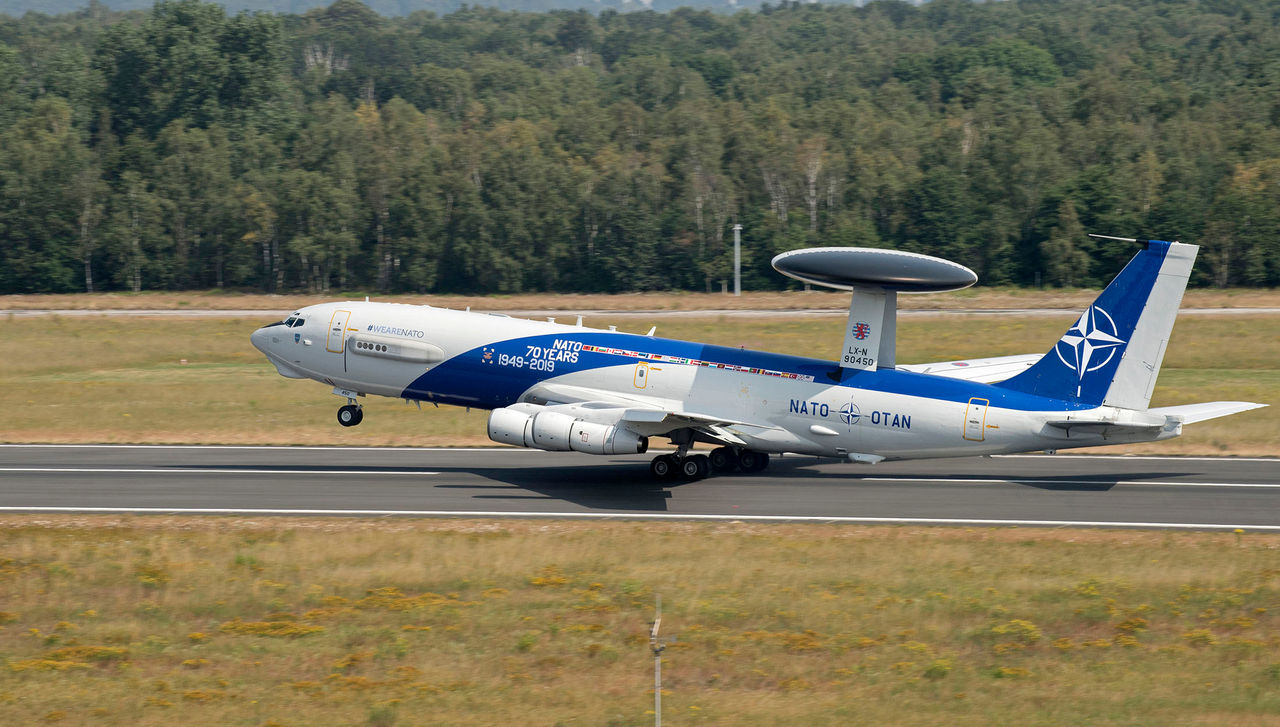
More than 100 industry experts met at NATO Headquarters on Tuesday (03 March 2020) to consider emerging technologies and concepts to meet NATO’s future surveillance and command and control requirements.
In 2019, NATO committed 1 billion US dollars to modernize the Alliance’s fleet of AWACS surveillance aircraft, ensuring they continue to support NATO’s missions to 2035. Under the Alliance Future Surveillance and Control initiative, all 29 Allies are working together to study options to replace the AWACS after 2035.
Organized by the NATO Support and Procurement Agency, the event featured more than 60 companies across 16 Allied nations, with expertise not only from traditional defence sectors, but also technology, e-commerce, and telecommunications.
While NATO’s fleet of 14 AWACS aircraft currently monitor the skies over Allied territory, they could be replaced with different combinations of systems in the air, on land, in space, or even in the cyber domain. Industry experts exchanged views on a variety of topics, such as fusing and sharing large amounts of data, microsatellites, cloud computing, and artificial intelligence.
Addressing industry and national representatives, Camille Grand, NATO’s Assistant Secretary General for Defence Investment, praised the initiative for embracing innovation. “Integrating innovative thinking and disruptive technology into the solution space for Alliance Future Surveillance and Control is not an option, but an imperative,” he said.
The NATO Support and Procurement Agency recently awarded six contracts to develop a first round of high-level industry concepts. At Tuesday’s event, the agency provided industry insights into the next steps, where the high-level concepts will be further developed and analysed in a second round of more intensive studies.