
Close
Back


From now on you can download videos from our website
If you would also like to subscribe to the newsletter and receive our latest updates, click on the button below.
Enter the email address you registered with and we will send you a code to reset your password.
The password must be at least 12 characters long, no spaces, include upper/lowercase letters, numbers and symbols.
Click the button to return to the page you were on and log in with your new password.
12 December 2019

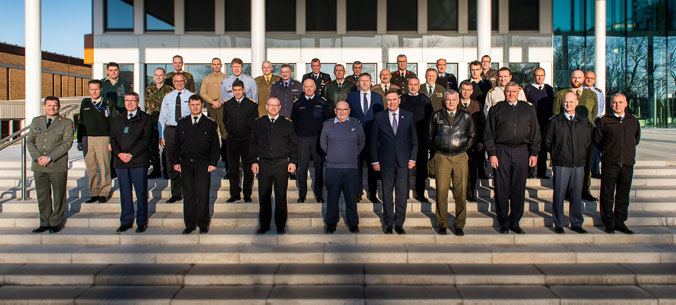
On 12 December, the NATO Military Committee visited the NATO Communications and Information Agency (NCI Agency) in The Hague. The programme focused on innovation, NATO’s digital transformation, and the NCI Agency’s current and future work strands.
The Chairman of the NATO Military Committee, Air Chief Marshal Sir Stuart Peach and the NATO Military Representatives were welcomed to the NCI Agency’s facilities in The Hague by the General Manager of the Agency, Mr Kevin J. Scheid and the Chief of Staff, Major General Göksel Sevindik.
On arrival, Air Chief Marshal Sir Stuart Peach said: “As part of the NATO family and a vital element of the NATO capability, our ability to command, control, inform and connect is as vital today as it has been during the 70 years of our Alliance. From the Cold War through missions in the Balkans, Afghanistan and Iraq, to our commitment to collective defence and deterrence requires secure, adaptable and affordable technology with modern, resilient systems. The Military Committee will play its full and proper role in understanding and agreeing future requirements – that is why we are here today”.
Mr Scheid added that “our mission is to ensure a fully digital NATO enterprise. As part of the Alliance, we support NATO by providing the systems, services and expertise to ensure that the Alliance can work together to safeguard peace and security for nearly 1 billion citizens. Amongst other things, we defend NATO networks 24/7, provide critical technology for air command and control and ballistic missile defence, and help NATO explore emerging technologies like artificial intelligence”. The NCI Agency also actively supports NATO and Allies during exercises providing the technology needed to work together, and supporting their efforts to test allied capabilities.
The NATO Military Representatives received updates on the NCI Agency’s current and future work, including its support to the Alliance Ground Surveillance System, which reached a significant milestone last month with the delivery of the first remotely piloted aircraft. “Alliance Ground Surveillance will be collectively owned and operated by all NATO Allies and will be a vital capability for NATO operations and missions. It will provide access to vital information that will ultimately inform crucial decisions”, underlined the Chairman.
The NCI Agency also updated the Military Representatives on its intentions to train 10,000 cyber defenders over five years, and to stand up a NATO Space Technology Centre. The Agency has supported NATO with its expertise on space and satellite communications since the 1970s, and will continue to do so now that Space has been recognized as an operational domain.
The representatives were also briefed on the Polaris Programme, one of the Agency’s flagship initiatives to lead NATO’s digital transformation. It will modernize, consolidate and optimize NATO’s IT infrastructure and improve IT services across the Alliance. “Allies recognise the importance of maintaining NATO’s technological superiority, we are making significant investments in cutting-edge technologies with 1.4 billion euros investment in new technologies in areas ranging from cyber security, to surveillance and reconnaissance. The NCI Agency is a strategic asset in this effort, and will be leading projects and helping the Alliance to prepare the Alliance for the future”, emphasised Air Chief Marshal Peach.
The NCI Agency’s NATO Cyber Security Centre works closely with Allied Command Operations (ACO) Cyberspace Operations Centre, providing critical technical information about mission networks that supports ACO's objective of mission assurance.
With more than 30 locations across the Alliance, the NCI Agency acquires, deploys and defends communications and information systems supporting NATO's Command and Control from the political and military structures to deployed missions and operations.