
Close
Back


From now on you can download videos from our website
If you would also like to subscribe to the newsletter and receive our latest updates, click on the button below.
Enter the email address you registered with and we will send you a code to reset your password.
The password must be at least 12 characters long, no spaces, include upper/lowercase letters, numbers and symbols.
Click the button to return to the page you were on and log in with your new password.
28 November 2019
1 MIN READ
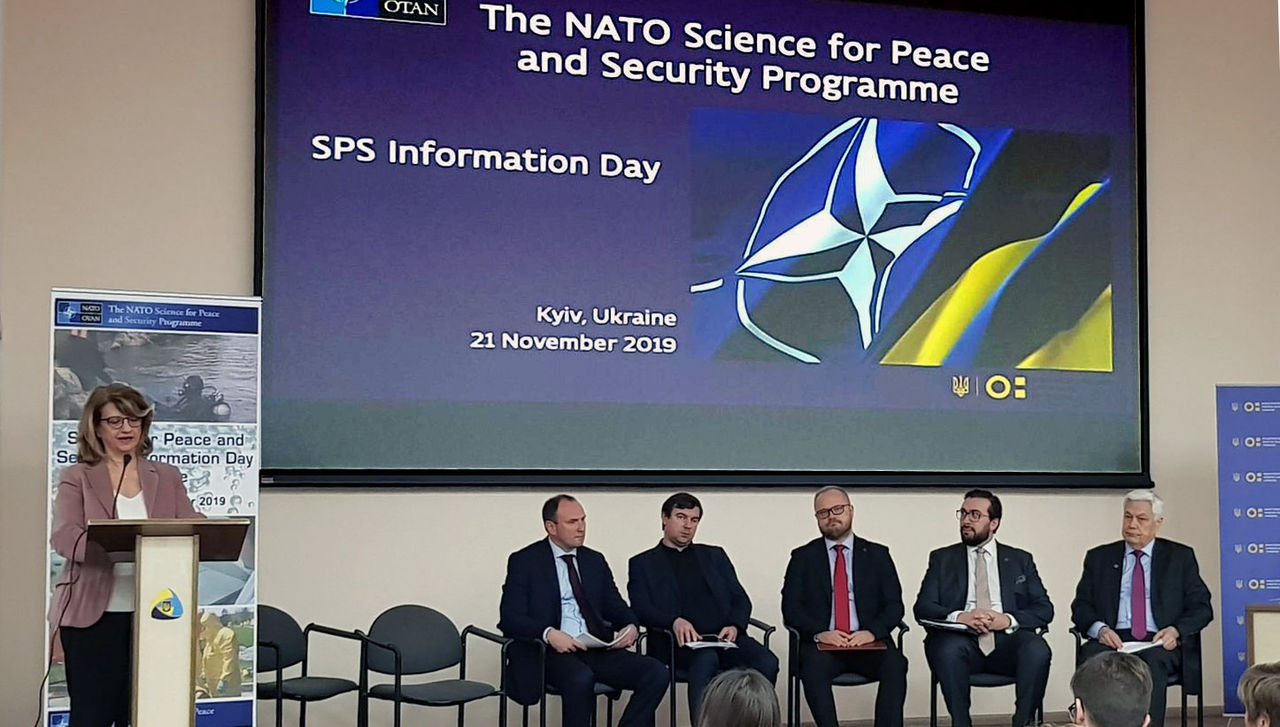
Ukrainian scientists, experts and government representatives took stock of Ukraine’s cooperation with NATO’s Science for Peace and Security (SPS) Programme during an Information Day held at the Ministry of Education and Science in Kyiv on 21 November.
The SPS Information Day was organised with support from the Ministry of Education and Science and the Mission of Ukraine to NATO. Over 200 members of the Ukrainian scientific community participated in the event, which took place on Ukraine’s Day of Dignity and Freedom. “Scientific cooperation is actively contributing to dignity and freedom not only in Ukraine, but globally for the benefit of all,” said Dr. Deniz Beten, Senior NATO SPS and Partnership Cooperation Advisor.
The event was an opportunity to review the key achievements of Ukraine’s participation in SPS, which intensified following Russia’s illegal annexation of Crimea in 2014. Currently, Ukraine is involved in 28 ongoing SPS activities, making the country the largest beneficiary of the programme. Advanced technologies, counter-terrorism, and defence against chemical, biological, radiological and nuclear agents are the focus of most ongoing activities. Priorities for practical scientific cooperation are also regularly reviewed by the NATO-Ukraine Joint Working Group on Scientific and Environmental Cooperation.
The event highlighted SPS’ contributions to the Comprehensive Assistance Package for Ukraine, including the establishment of a multinational telemedicine system, and enhancing the humanitarian demining capacity of the State Emergency Service of Ukraine (SESU). SPS projects have brought real benefits to the Ukrainian scientific community, providing state-of-the-art equipment and support to research laboratories, and engaging young researchers.
Ukrainian scientists benefit not only from the results of SPS projects, but also from their integration in the international scientific community. This is good for both Ukraine and NATO, as emphasised by Professor Sergiy Pirozhkov, Vice-President of the Ukraine’s National Academy of Sciences. Since the beginning of Ukraine’s participation in the SPS Programme, more than 721 Ukrainian experts have participated in its activities, and engaged with counterparts from more than 38 NATO and partner nations.
For more information on Ukraine’s participation in the NATO SPS Programme, download the Information Day brochure here