
Close
Back


From now on you can download videos from our website
If you would also like to subscribe to the newsletter and receive our latest updates, click on the button below.
Enter the email address you registered with and we will send you a code to reset your password.
The password must be at least 12 characters long, no spaces, include upper/lowercase letters, numbers and symbols.
Click the button to return to the page you were on and log in with your new password.
27 November 2019
1 MIN READ
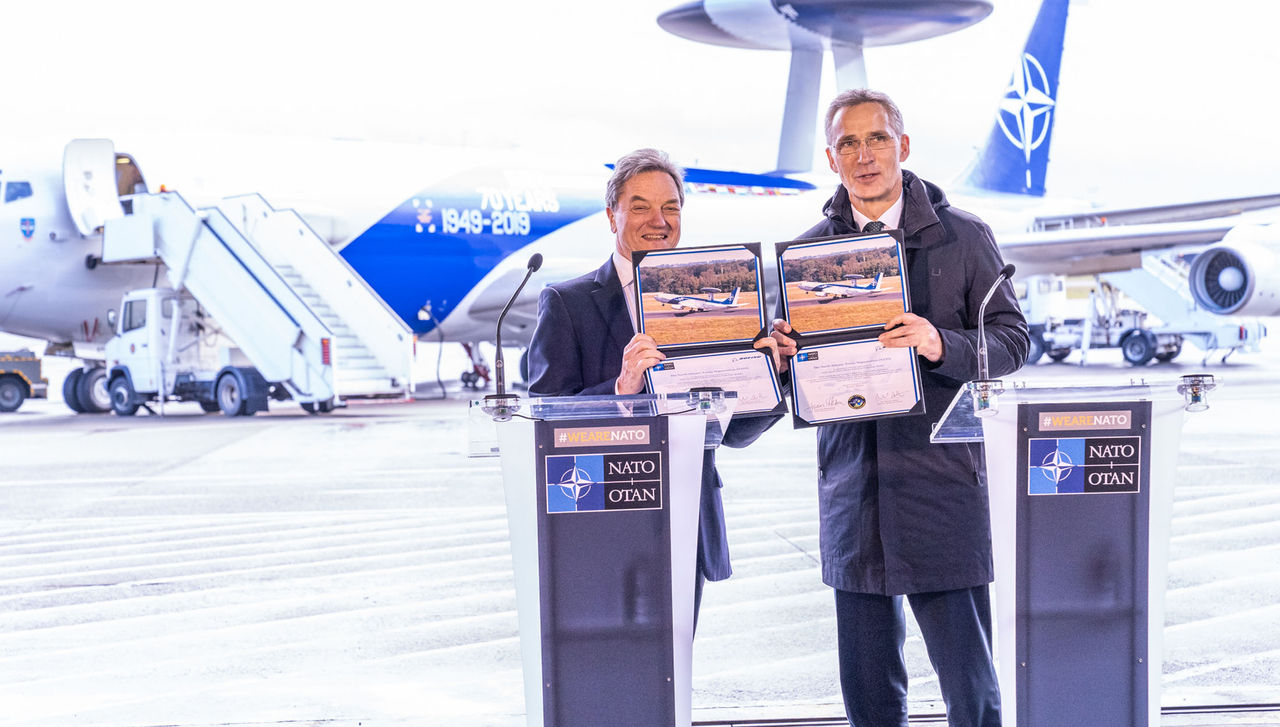
NATO Secretary General Jens Stoltenberg and the President of Boeing International, Sir Michael Arthur, met at Melsbroek Airport in Brussels on Wednesday (27 November 2019) to mark a major investment in the Alliance’s fleet of AWACS surveillance aircraft. NATO’s 1 billion dollar contract with Boeing will modernise the AWACS fleet, ensuring they continue to support the Alliance’s missions to 2035.
“NATO AWACS have been our eyes in the sky, supporting our operations for decades, from patrolling American skies after 9/11, to our operations in Afghanistan, and as part of the Global Coalition against ISIS,” said the Secretary General. He welcomed the contract with Boeing, which will provide NATO’s 14 AWACS aircraft with sophisticated new communications and networking capabilities. 16 NATO Allies, on both sides of the Atlantic, are funding this modernisation, and companies from Europe and North America are working together to provide high-tech capabilities. “NATO AWACS is a symbol of trans-Atlantic excellence, in terms of technology and partnership between Boeing, NATO and Europe. This modernisation programme will ensure the aircraft continue to thrive,” noted Sir Michael Arthur.
The Secretary General underlined that NATO continues to adapt, and is already planning for the replacement of the AWACS in 2035. “NATO will work closely with industry. We will consider how technologies – like artificial intelligence, autonomous systems and big data – can help NATO keep its edge,” he said. The Secretary General added that NATO is an important platform, where Allies can join forces and invest in new capabilities for shared security. “We will continue to modernise and adapt our Alliance, both now and in the future,” he said.