
Close
Back


From now on you can download videos from our website
If you would also like to subscribe to the newsletter and receive our latest updates, click on the button below.
Enter the email address you registered with and we will send you a code to reset your password.
The password must be at least 12 characters long, no spaces, include upper/lowercase letters, numbers and symbols.
Click the button to return to the page you were on and log in with your new password.
22 November 2019
2 MIN READ
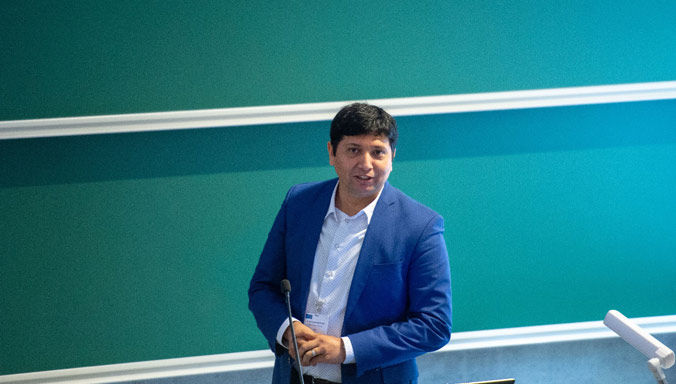
Five questions to a scientist who aims to reduce the response time in case of terrorist attacks.
What do you do?
“I have international experience that encompasses digital signal processing and wireless communication. I have worked in Denmark, France, Qatar, and nowadays I am working at Tallinn University of Technology in Estonia, where I am Cognitive Electronics (COEL) European Research Area (ERA) Chair holder.
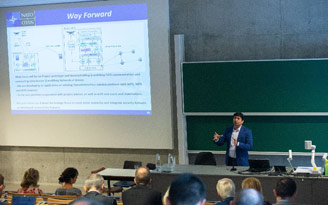
Today, one of my focuses is on wireless connectivity in disaster scenarios, such as terrorist attacks. I lead a NATO Science for Peace and Security (SPS) Programme Multi-Year Project on communication in the context of terror attacks. The aim is to reduce the response time of rescue teams and law enforcement agencies following a terrorist attack in public spaces, such as transport hubs, stations or shopping malls, and consequently protect lives and save critical infrastructure.
To achieve this objective, we are developing technologies able to transmit critical information, such as the number of trapped people inside the terror zone, their identity and location, the number of terrorists, using available devices, for instance smartphones and other on-scene available devices.
Launched in June 2018, the project is led by scientists and experts from Estonia, Italy and Pakistan. The goal is to develop a hardware prototype to be tested in a live experimentation.”
What is your biggest challenge in this field of research?
“Enabling connectivity in difficult situations is one of the biggest challenges. For instance, when telecommunication infrastructure, such as a cellular base station, is damaged or disabled. This involves optimising radio-frequency resource utilisation, managing/cancelling interference, managing key performance indicators such as energy efficiency, data rates and delays.”
What is the value of the NATO SPS Programme?
“The NATO SPS Programme is an excellent platform to conduct research projects that have a direct impact on real life, addressing significant societal issues.
The Programme also enables collaboration with both NATO member and partner countries. This not only allows sharing and developing new scientific and technical knowledge, skills and competencies, but also developing a better understanding of various cultures, such as a natural step towards tolerance and peace.”
What is your favourite part of your job?
“I truly enjoy having deep scientific and technical discussions with team members and peers.
I pay attention to the impact of my research both from the point of view of excellence and society.”
What don’t your colleagues know about you?
“I love to cook delicious spicy food.”
Professor Alam is NATO Project Director in the Multi-Year Project "Public Safety Communication in Context Related to Terror Attacks" (dubbed Counter Terror). Through this NATO Science for Peace and Security (SPS) Programme activity, scientists from Estonia, Italy and Pakistan are studying innovative solutions to the challenges of ensuring reliable communication in crisis situations and reducing response times by security forces.
"Scientists of NATO" introduces some of the experts involved with the SPS Programme. The Programme promotes dialogue and practical cooperation between NATO member and partner nations based on scientific research, technological innovation and knowledge exchange. It offers funding, expert advice and support to tailor-made, security-relevant activities that respond to NATO's strategic objectives.