
Close
Back


From now on you can download videos from our website
If you would also like to subscribe to the newsletter and receive our latest updates, click on the button below.
Enter the email address you registered with and we will send you a code to reset your password.
The password must be at least 12 characters long, no spaces, include upper/lowercase letters, numbers and symbols.
Click the button to return to the page you were on and log in with your new password.
17 October 2019
1 MIN READ
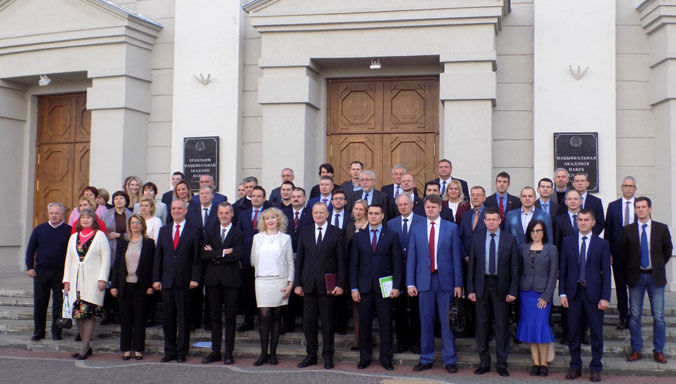
Belarusian scientists and experts discussed opportunities for cooperation through NATO’s Science for Peace and Security (SPS) Programme during an Information Day held at the National Academy of Sciences in Minsk on 16 October.
The event, organised in cooperation with the National Academy of Sciences and the State Committee for Science and Technology, and with support from the Ministry of Foreign Affairs of Belarus, welcomed the participation of over 50 members of the Belarusian scientific community. Belarusian researchers involved in SPS activities showcased their achievements and the benefits of cooperation and knowledge-sharing with experts from NATO and partner nations. In particular, speakers highlighted successful SPS workshops and trainings in the fields of nano-photonics and its applications, as well as nano-electromagnetics.
Addressing participants, NATO Assistant Secretary General for Emerging Security Challenges, Dr. Antonio Missiroli, noted that the benefits of scientific cooperation are shared among NATO and partner nations. He encouraged Belarus to further engage in NATO partnership activities and underlined SPS as “an excellent opportunity for Belarusian scientists and experts to work alongside their peers from NATO and partner nations to deliver tangible, security-related results.”
In his welcome address, Belarusian Deputy Foreign Minister Andrei Dapkiunas emphasised the importance of the SPS Programme as platform for non-military scientific cooperation. He further stressed that “the Information Day will give new impetus to cooperation in the scientific field between Belarus and NATO, its members and partner nations, and will contribute to bridge-building, strengthening mutual understanding and trust in the region.”
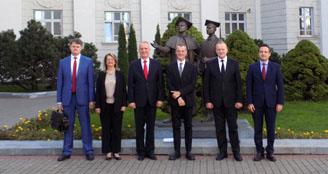
The Information Day enabled participants to discuss Belarus’ priority research areas, and explore their alignment with SPS’ priorities. The discussions and presentations addressed potential cooperation initiatives, including in the fields of advanced technology, defence against chemical, biological, radiological and nuclear agents, environmental security, and biotechnology.
Since participation in the SPS Programme was opened to Belarus in 1992, Belarusian scientists have been involved in 36 activities and cooperated with peers from 42 NATO and partner nations. Dr. Missiroli’s visit to Minsk on the occasion of the SPS Information Day represented NATO’s highest ranking senior official to visit Belarus in 27 years.