
Close
Back


From now on you can download videos from our website
If you would also like to subscribe to the newsletter and receive our latest updates, click on the button below.
Enter the email address you registered with and we will send you a code to reset your password.
The password must be at least 12 characters long, no spaces, include upper/lowercase letters, numbers and symbols.
Click the button to return to the page you were on and log in with your new password.
05 March 2019
2 MIN READ
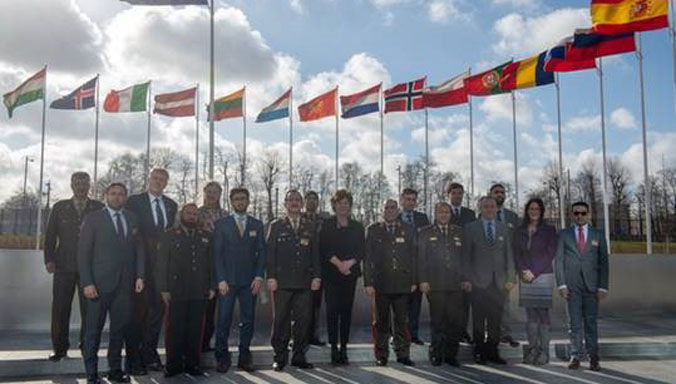
Experts in defence education gathered from 19 to 21 February, 2019 at NATO Headquarters, Belgium to conduct the annual review of NATO’s Defence Education Enhancement Programme (DEEP) with Afghanistan. Participants took stock of progress achieved, addressed challenges faced and set future objectives for military education and training.
Enhancing Military Education
The Programme has several objectives. These include contributing to the creation of a Professional Military Education (PME) policy, the development of specific curriculum subjects such as the Civilian Oversight of the Armed Forces, the Interagency Coordination or Leadership, and the development of faculties by bringing together defence and military experts from Allied countries and partners to exchange experience in modern teaching methodologies. DEEP also facilitates efforts to foster cooperation between similar military educational institutions from around the world.
Military education is considered by Afghan authorities as a key element to bring forward more concrete cooperation with NATO. This leads to sustainable national armed forces in Afghanistan capable of maintaining peace and security.
“We appreciate NATO’s tremendous efforts in Afghanistan. The capacity-building support provided by NATO is highly crucial and we would like to expand our cooperation further. We will soon be shouldering the full responsibility of our country’s security thanks to the valuable training we have received from our great friends and Allies,” explained Major General Sayed Rahim Sayed, Director of Defence and Security of the Administrative Office of the President of Afghanistan.
DEEP enhances the ability of participants and their respective services to plan strategically, to coordinate across ministries in order to improve security and stability and to further develop the culture of strategic thinking.
Mrs Frédérique Jacquemin, NATO Senior Programme Manager DEEP Afghanistan stressed that, “under DEEP, we must cement Afghan self-sustainability in achieving their Professional Military Education objectives, taking into account the strategic context and the specificities of Afghanistan”.
Common goals
This review is timely in devising future cooperation. The maturation of the NATO-Afghanistan relationship regarding PME sets the stage for the Afghan National Security Force to continue building capacity, contributing directly to shaping the future of the Afghan armed forces and the stability of the country. Based on the lessons learned and shared practices, participants agreed on a joint action plan for activities for the upcoming year and beyond was developed and identified effective mechanisms to articulate common goals.
Professor Harry Tomlin, from the United States War College, described the discussions as “a unique manifestation of a ‘comprehensive approach’ and whole of government and society mentality”.
Participants included Afghan high officials from the Ministries of Defence, Foreign Affairs and Interior, as well as from the Office of the National Security Council, the Office of the President and the Marshal Fahim National Defense University. Representatives from NATO Headquarters and Commands, as well as academics and practitioners from NATO Allies also attended.
DEEPs are tailored programmes through which the Alliance advises partners on how to build, develop and reform educational institutions in the security, defence and military domain. In March 2019, there were 15 individual country DEEP initiatives, with different focus and at different stages of development, engaging Afghanistan, Armenia, Azerbaijan, Bosnia Herzegovina, Georgia, Iraq (as part of the NATO Mission in Iraq), Kazakhstan, Kyrgyzstan, Mauritania, the Republic of Moldova, Mongolia, the Republic of North Macedonia, Serbia, Tunisia, and Ukraine.