
Close
Back


From now on you can download videos from our website
If you would also like to subscribe to the newsletter and receive our latest updates, click on the button below.
Enter the email address you registered with and we will send you a code to reset your password.
The password must be at least 12 characters long, no spaces, include upper/lowercase letters, numbers and symbols.
Click the button to return to the page you were on and log in with your new password.
26 November 2018
1 MIN READ

Polish scientists and experts from NATO and partner countries discussed future cooperative activities within NATO’s Science for Peace and Security (SPS) Programme during the SPS Information Day held in Warsaw on 22 November 2018.
At the event, 250 experts and scientists from Allies and partner countries, such as Finland, Ireland, Israel, the Republic of Moldova and Morocco, debated potential applications for SPS activities. Areas of discussion included cyber security, chemical, biological, radiological and nuclear (CBRN) defence, advanced technologies, and the Women, Peace and Security (WPS) agenda.
“We want more Polish experts in the NATO SPS Programme,” said Barosz Cichocki, Vice Minister of the Polish Ministry of Foreign Affairs during the opening session. Dr Piotr Dardziński, Secretary of State at the Polish Ministry of Science and Higher Education, stressed the importance of the internationalisation of Polish research activities. He identified the SPS Programme as a key tool in promoting transnational scientific collaboration to strengthen not only peace and security within the Alliance but also with partner countries.
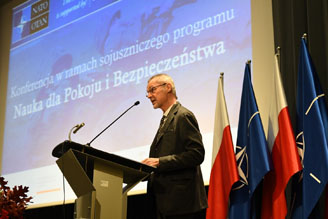
“I look forward to continuing and deepening our good work with Polish scientists and experts. I sincerely hope that we will use this SPS Information Day to encourage and identify new collaboration opportunities in the fields of science, research, technology and beyond,” stated Dr Antonio Missiroli, NATO Assistant Secretary General for Emerging Security Challenges.
Poland is currently contributing to an SPS project monitoring chemical ammunition dumpsites in the Baltic Sea using autonomous underwater vehicles. The chemical warfare agents not only present a significant risk to fishermen and larger ships but also threaten marine biota.
The SPS Information Day was organised in cooperation with the Permanent Representation of Poland to NATO, the Polish Ministry of Science and Higher Education, the Polish Ministry of Foreign Affairs and the Polish Ministry of Defence.