
Close
Back


From now on you can download videos from our website
If you would also like to subscribe to the newsletter and receive our latest updates, click on the button below.
Enter the email address you registered with and we will send you a code to reset your password.
The password must be at least 12 characters long, no spaces, include upper/lowercase letters, numbers and symbols.
Click the button to return to the page you were on and log in with your new password.
19 May 2017
2 MIN READ
Scientists and other experts from Bosnia and Herzegovina offered their insights into new ways of addressing emerging security challenges during a Science for Peace and Security (SPS) Programme Information Day held in Sarajevo on 19 May 2017. Fruitful cooperation between the country and NATO’s SPS Programme has led to exploring common solutions to security challenges in the areas of cyber defence, counter-terrorism and unexploded ordnance (UXO) detection.
Organised in cooperation with the Mission of Bosnia and Herzegovina to NATO and the Ministry of Foreign Affairs of Bosnia and Herzegovina, a recent SPS Information Day provided an opportunity to build networks and explore options for further joint cooperative projects. Current and past SPS grantees from Bosnia and Herzegovina, the Netherlands and the United States were also able to speak about their projects and experience with the SPS Programme.
“Since 2006 when Bosnia and Herzegovina joined Partnership for Peace, the cooperation is on a constant rise. Bosnia and Herzegovina has been involved in using available mechanisms for partner countries to the maximum extent,” said Mr Edin Sehic, Minister-Counsellor of the Bosnian Ministry of Foreign Affairs.
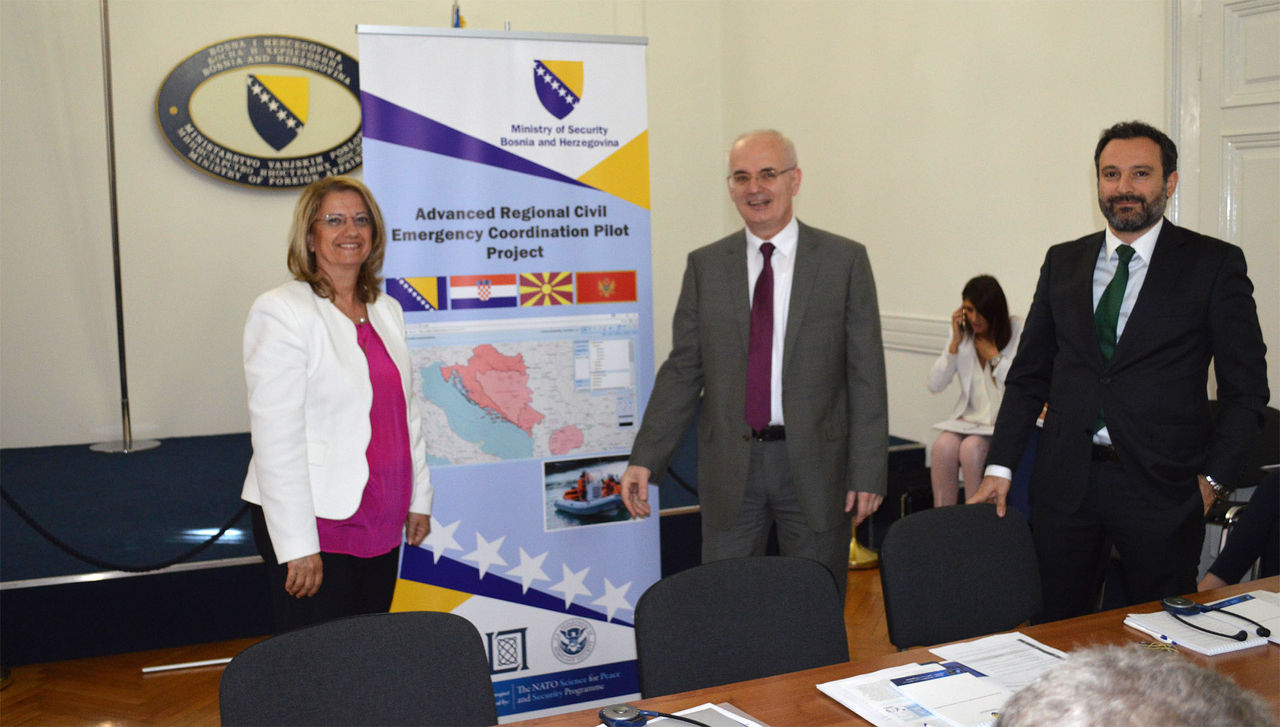
Bosnia and Herzegovina is currently part of a NATO SPS key flagship project which is supporting capacity-building in the area of emergency response and management in the Western Balkans region. The participating partner nations will acquire, deploy and customise an incident command system to facilitate real-time coordination among first responders in case of natural or man-made disasters. Taking into account that getting the right information into the right hands as quickly as possible is key to a successful emergency response, this system will have the potential to save lives and property.
The technology has initially been developed by the Massachusetts Institute of Technology Lincoln Laboratory (MIT LL), in collaboration with the United States Department of Homeland Security Science and Technology Directorate (DHS S&T) and will now be tailored to the needs of the participating countries in the Western Balkans, enhancing their situational awareness. Bosnia and Herzegovina is the leading partner country of this SPS project that also involves experts from the United States, Croatia, Montenegro and the former Yugoslav Republic of Macedonia1.
Scientists from Bosnia and Herzegovina have also been cooperating with the NATO SPS Programme in areas such as cyber defence and advanced technologies with security applications.