
Close
Back


From now on you can download videos from our website
If you would also like to subscribe to the newsletter and receive our latest updates, click on the button below.
Enter the email address you registered with and we will send you a code to reset your password.
The password must be at least 12 characters long, no spaces, include upper/lowercase letters, numbers and symbols.
Click the button to return to the page you were on and log in with your new password.
14 October 2016
1 MIN READ
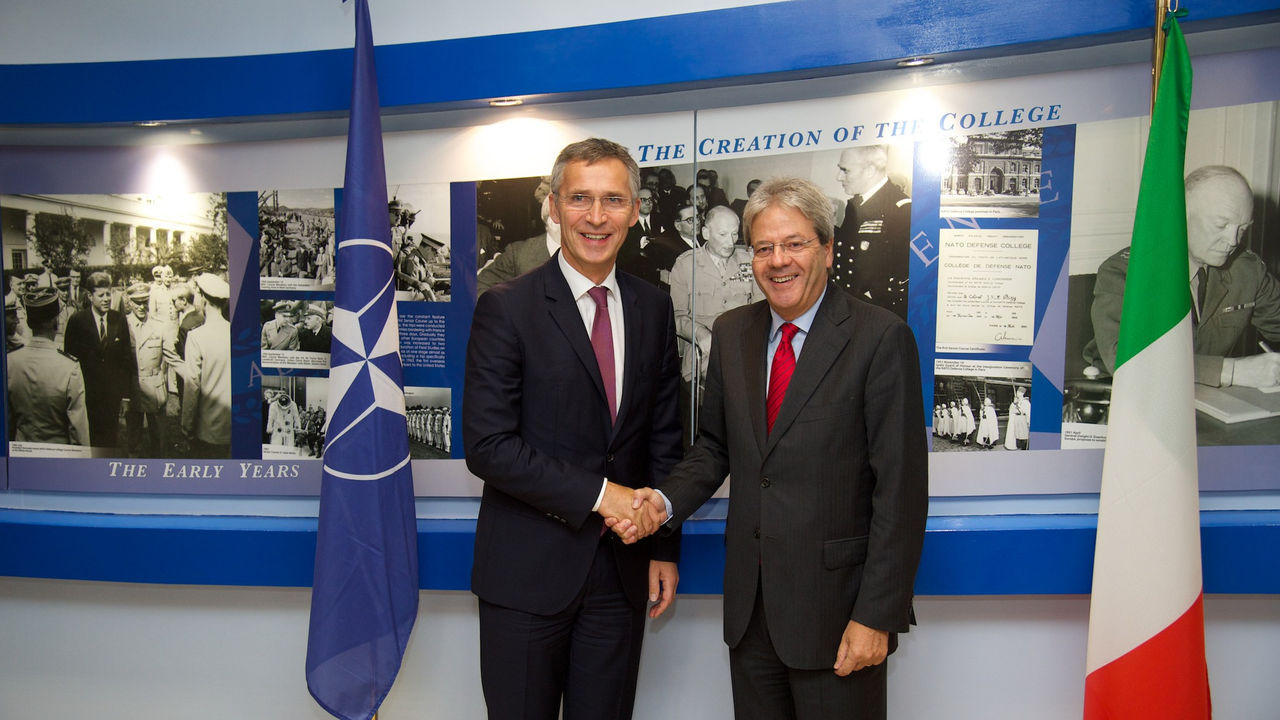
At the end of a two-day visit to Rome, NATO Secretary General Jens Stoltenberg underlined Italy’s essential role in strengthening NATO’s collective defence and projecting stability beyond Allied borders.
Meeting with Italian Foreign Minister Paolo Gentiloni, Mr. Stoltenberg thanked Italy for hosting important NATO assets, such as the NATO Defense College, AWACS surveillance planes and, shortly, cutting-edge Alliance Ground Surveillance aircraft in Sicily. Addressing NATO’s cooperation with the European Union, the Secretary General outlined how the Alliance could support Operation Sophia: with logistics and with escort for ships diverted for suspicious activities.
Turning to Russia, the Secretary General expressed concern over Russia’s continued bombing of Aleppo and its pattern of large-scale military activities close to NATO’s borders. “Allies are deeply concerned about this behaviour. We will continue pursuing our policy of strong defence combined with political dialogue,” he added.
Earlier today, the Secretary General participated in a conference on NATO’s cooperation with partners in the Mediterranean and the Middle East at the NATO Defense College in Rome. He highlighted the importance of NATO’s Mediterranean Dialogue and Istanbul Cooperation Initiative (ICI) programs. He also stressed that the establishment of the NATO-ICI Regional Centre in Kuwait this December will take the Alliance’s partnership with Gulf countries to a new level. It will provide a platform to boost cooperation in key areas, including civil emergency planning, crisis management and public diplomacy.