
Close
Back


From now on you can download videos from our website
If you would also like to subscribe to the newsletter and receive our latest updates, click on the button below.
Enter the email address you registered with and we will send you a code to reset your password.
The password must be at least 12 characters long, no spaces, include upper/lowercase letters, numbers and symbols.
Click the button to return to the page you were on and log in with your new password.
30 September 2016
2 MIN READ
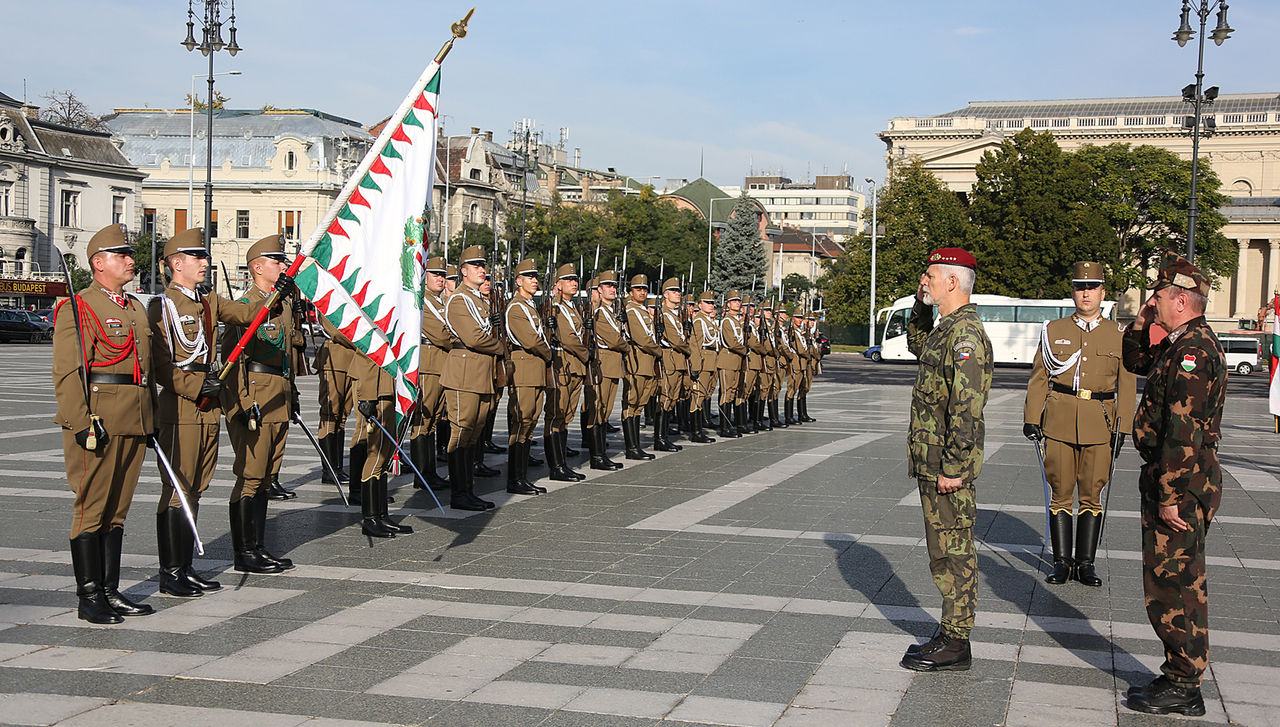
The Chairman of the NATO Military Committee General Petr Pavel visited Hungary and met with President János Áder, Minister of Defence Mr. István Simicskó, Minister for Foreign Affairs and Trade Mr. Péter Szijjártó, and Chief of Defence General Tibor Benkö during his visit from 28 to 30 September. During his visit, he witnessed a static and dynamic display of Exercise Brave Warrior and delivered a speech at the National Public Service University’s Ludovika Campus.
Speaking with President János Áder, General Pavel stressed NATO’s appreciation for Hungary’s continued support for NATO and its adaptation in a time when there is an arc of insecurity and instability along NATO’s periphery and beyond. During the meeting, the Chairman stated “Hungary is a strong and committed member of the Alliance and we are grateful for the continued contributions you make to our shared community”.
General Pavel visited the Ministry of Foreign Affairs and Economy to meet with the Minister for Foreign Affairs and Trade Mr. Péter Szijjártó where discussions focused on both migration and security challenges. “I appreciate Hungary’s involvement in the European Union and United Nations missions as, in an ever changing security environment, practical and effective cooperation with other institutions and organizations can only add to a secure and stable Euro-Atlantic region,” said the Chairman.
The Chairman also had the pleasure of visiting Minister of Defence Mr. István Simicskó. He took the opportunity to thank Hungary for playing its part in response to recent security challenges by hosting a Force Integration Unit (NFIU) to facilitate the rapid deployment of Allied forces in the region, if needed. The Hungarian NFIU is expected to be have initial operating capability by January 2017. The Chairman also welcomed Hungary’s plans to contribute next year to the Very High Readiness Joint Task Force, its contributions to the NATO Response Force and expressed gratitude for Hungary’s valued role as a Host Nation for NATO’s Strategic Airlift Capability.
Following an official ceremony with military honours in the Heroes Square, General Pavel met with General Tibor Benkö to discussion NATO’s current Operation, Missions and Activities and the decisions taken at the Warsaw Summit. The Chairman praised Hungary’s continued participation in NATO’s missions in Kosovo and Afghanistan, and its participation in NATO’s air policing mission in the Baltic States.
General Pavel also received briefings from the Hungarian Armed Forces Staff where discussions centred on Hungary’s contributions to the Readiness Action Plan and its commitments following the results of the Warsaw Summit. The briefings also examined the current security situation in Europe.
While in Hungary, General Pavel had the opportunity to visit Exercise Brave Warrior, a multinational exercise that enhances NATO’s allied interoperability while training command and control capabilities. General Pavel noted that forces from Hungary, Croatia, Romania, Slovakia, Slovenia and the United States will “use the experience and lessons learnt over the past weeks to improve their ability to work and train together. This benefits each Ally but also feeds back into NATO when these forces are deployed together.”
The Chairman concluded his visit to Hungary at the National Public Service University, where he provided students with a Post-Warsaw Summit review of key issues for the alliance, his reflections on the previous and current adaptations of NATO, and the future of NATO. He emphasized that “Just as no one nation could have maintained the peace in Europe during the Cold War, no one nation can stop terrorism or project stability to nations in need of security assistance or democratic reforms. Our future plans must account for the fact that NATO cannot do this alone. Tailored cooperation with bilateral and multilateral organizations is the future of NATO.”