
Close
Back


From now on you can download videos from our website
If you would also like to subscribe to the newsletter and receive our latest updates, click on the button below.
Enter the email address you registered with and we will send you a code to reset your password.
The password must be at least 12 characters long, no spaces, include upper/lowercase letters, numbers and symbols.
Click the button to return to the page you were on and log in with your new password.
20 April 2016
2 MIN READ
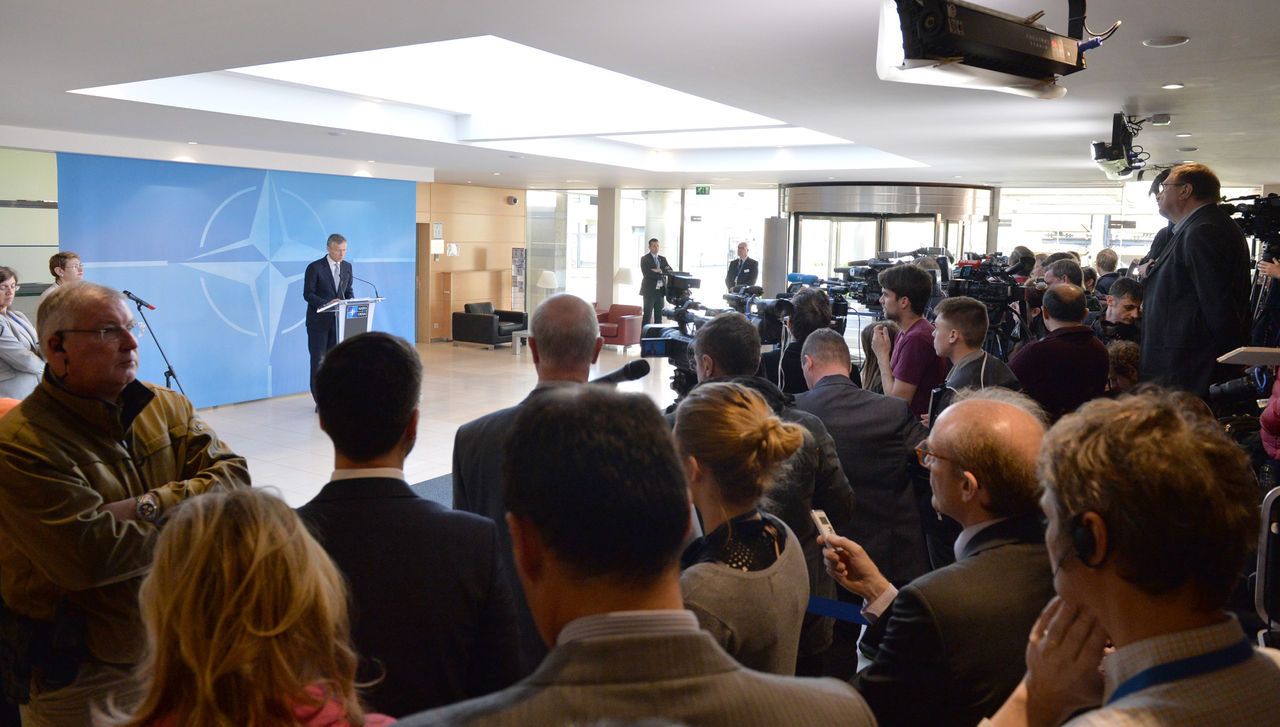
Speaking at the press point following the NATO-Russia Council today (20 April), NATO Secretary General Jens Stoltenberg underlined that “political dialogue among nations that share the same Euro-Atlantic area is both necessary and useful, especially in times of tension as we experience now. However, this does not mean that we are back to business as usual”.
During the meeting of the NATO-Russia Council, NATO Allies made clear that they stand firm in their support for Ukraine’s sovereignty and territorial integrity. “Allies do not recognize Russia’s illegal annexation of Crimea. We stressed that the increase in ceasefire violations in eastern Ukraine in recent days is deeply disturbing. As are the recent incident targeting OSCE monitors”, Mr. Stoltenberg said.
The NATO Secretary General added that “All 29 members of the NATO- Russia Council agreed today on the need for a full and rapid implementation of the Minsk agreements”.
Transparency and risk reduction was also a topic of discussion in the NATO-Russia Council. NATO Allies expressed concern about last week’s incidents in the Baltic region involving Russian military aircraft. “It is important to consider what steps we can all take to increase transparency and predictability. In the OSCE, all NATO Allies and Russia have agreed on rules governing military activities in Europe, including the observation and notification of exercises. Those rules must be respected”, the NATO Secretary General said. Mr. Stoltenberg said that a number of NATO nations have tabled concrete proposals on how to modernise the Vienna Document on military transparency. “It is important that everyone participates constructively in that work. More military transparency can contribute to more security in Europe. This is in both NATO’s and Russia’s interest”, he added.
The third item on the NATO-Russia Council agenda was Afghanistan. Mr. Stoltenberg highlighted that NATO remains committed to supporting the Afghan security forces. “All nations should do their part to support Afghanistan in reaching its goal of stability and security”, he said.
The NATO Secretary General underlined that “NATO and Russia have profound and persistent disagreements” and “today’s meeting did not change that”. He also stressed that “NATO Allies remain firm that there can be no return to practical cooperation until Russia returns to the respect of international law. But we will keep channels of communication open”.