
Close
Back


From now on you can download videos from our website
If you would also like to subscribe to the newsletter and receive our latest updates, click on the button below.
Enter the email address you registered with and we will send you a code to reset your password.
The password must be at least 12 characters long, no spaces, include upper/lowercase letters, numbers and symbols.
Click the button to return to the page you were on and log in with your new password.
14 April 2016
2 MIN READ
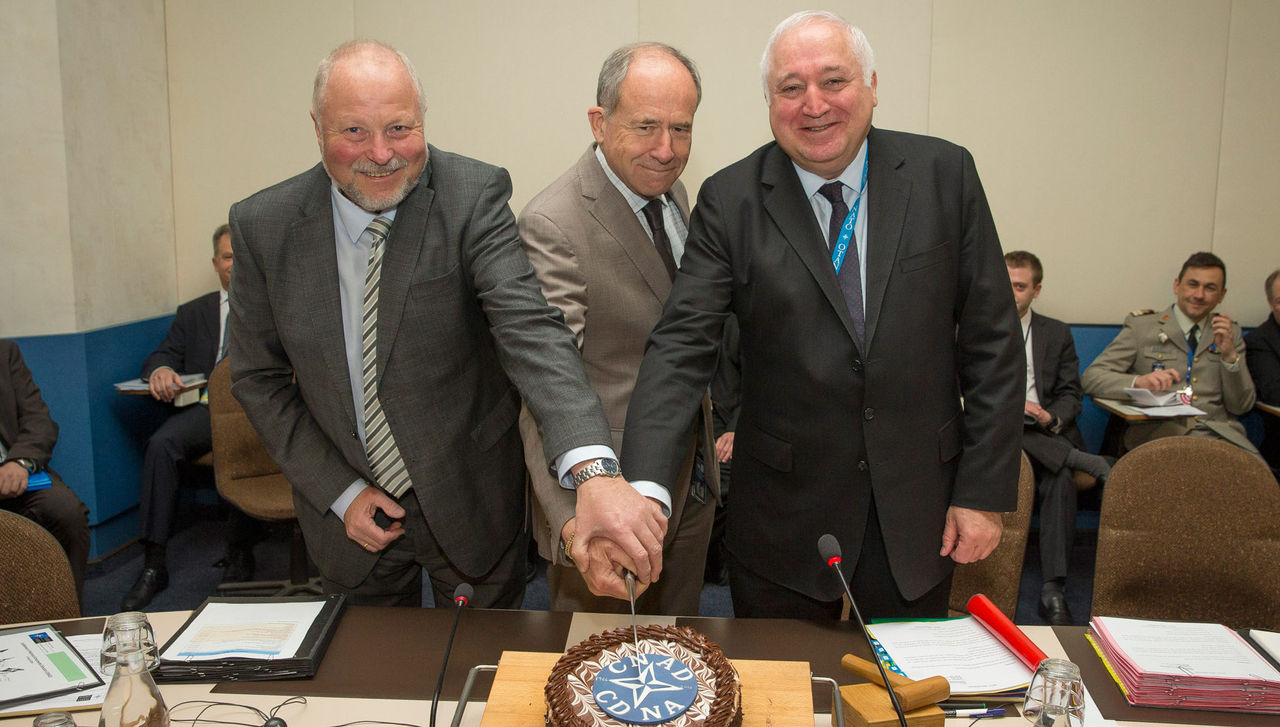
On 14 April 2016, top national defence procurement officials from NATO countries gathered in Brussels for the 50th anniversary of the Conference of National Armaments Directors (CNAD) and took note of progress made in different key capability areas for the Alliance.
“Today we mark 50 years of CNAD service to the Alliance,” stated Mr Patrick Auroy, Assistant Secretary General for Defence Investment and CNAD Permanent Chairman. “In that time we have provided remarkable contributions through flagship programmes like AWACS, Joint Intelligence, Surveillance and Reconnaissance, Alliance Ground Surveillance and Ballistic Missile Defence. We should commit ourselves to an equally ambitious agenda for the next 50 years.”
The mission of the CNAD, established in spring 1966, is to enable multinational cooperation on delivery of interoperable military capabilities to improve NATO forces’ effectiveness over the whole spectrum of current and future operations. The Conference is tasked with identifying collaborative opportunities for research, development and production of military equipment and weapons systems.
National Armaments Directors (NADs) were briefed at NATO Headquarters on progress of the Ballistic Missile Defence (BMD) programme, as well as Joint Intelligence, Surveillance and Reconnaissance (JISR), and Alliance Ground Surveillance (AGS). They held a focus session on Alliance Future Surveillance and Control (AFSC), the follow-on to AWACS, during which they provided direction in view of a possible launch for the initiative.
Enhancing cooperation with partners
In the afternoon, the Conference welcomed Australia, Finland and Sweden to highlight opportunities for multinational cooperation. Mr Auroy noted that “these partners have made significant contributions to NATO operations and activities earning them a special place at NATO’s table for cooperative dialogue and collaboration.”
NADs received a briefing from the Chief Executive of the European Defence Agency on EU capability developments, as well as NATO presentations on multinational cooperation successes and national defence planning perspectives.
Aligning efforts towards industry
NADs were also briefed on preparations for the 2016 NATO-Industry Forum (NIF). The NIF is the primary venue for strategic dialogue with the defence and security industry on NATO capability planning and development. It provides a platform to share and develop NATO and Industry perspectives on future security challenges of the Alliance. Mr Auroy underlined that “taking place after the Warsaw Summit, the NIF will be well placed to address the Summit declaration and issues such as NATO-EU cooperation in capability development, Alliance innovation, and NATO adaptation.” He encouraged NADs to provide guidance with respect to the configuration of the NIF.
The next meeting of the CNAD will be held in autumn 2016.