
Close
Back


From now on you can download videos from our website
If you would also like to subscribe to the newsletter and receive our latest updates, click on the button below.
Enter the email address you registered with and we will send you a code to reset your password.
The password must be at least 12 characters long, no spaces, include upper/lowercase letters, numbers and symbols.
Click the button to return to the page you were on and log in with your new password.
25 January 2016
1 MIN READ
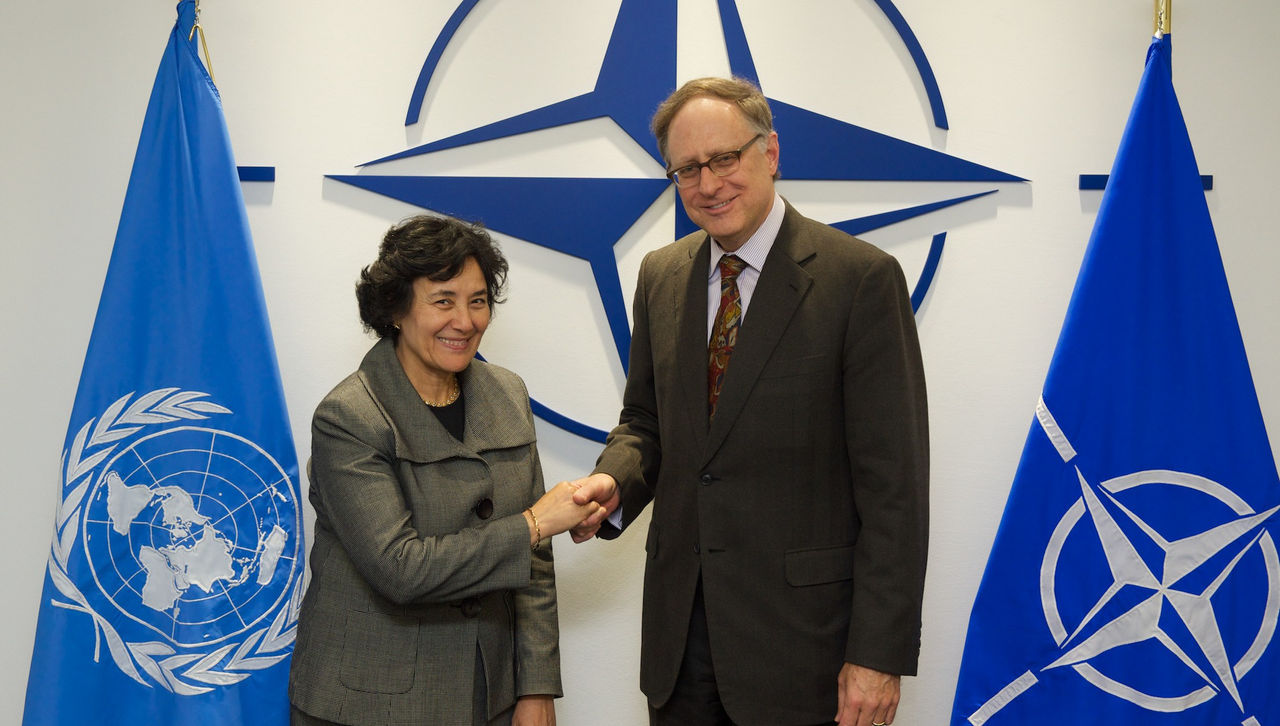
NATO and the United Nations (UN) work together to protect children affected by armed conflict. As part of this ongoing dialogue, Leila Zerrougui, the UN Special Representative for Children and Armed Conflict, visited NATO Headquarters on 25 January to discuss ways to enhance efforts in response to this challenge. She met with NATO Deputy Secretary General Alexander Vershbow and other senior Alliance officials, and briefed the Operations Policy Committee.
“NATO can play an important role to strengthen the protection of children affected by conflict,” said Ms Zerrougui. “I welcome NATO’s commitment to include the issue of children affected by armed conflict in training and capacity-building initiatives. These are essential to efforts to end and prevent grave violations against children.”
Ambassador Vershbow underlined the importance of child protection issues and NATO’s commitment to continue promoting them. “The protection of children during a conflict is not an optional question. It is central to how a government can retain the support of its people."
The North Atlantic Council approved NATO’s policy in this area – entitled “Protection of Children in Armed Conflict – the Way Forward” – in March 2015. The policy streamlined existing guidelines and identified ways to embed child-protection practices in NATO-led operations and missions. The Office of the UN Special Representative provided NATO with invaluable support and advice in developing the policy.
Also in March 2015, NATO Assistant Secretary General for Operations Stephen Evans, the Alliance’s Senior Focal Point for Children and Armed Conflict, briefed the UN Security Council on NATO’s efforts to implement UN Security Council Resolution 1612 and related Resolutions.
NATO also recently approved new military guidelines on sexual and gender-based violence and revised its policy on Women, Peace and Security.
NATO plays a valuable role in training, advising and assisting third parties and has the ability to reach places and people that are out of reach to others. This offers an opportunity for the Alliance, as well as individual member states and partner countries, to make a difference in areas such as child protection.