
Close
Back


From now on you can download videos from our website
If you would also like to subscribe to the newsletter and receive our latest updates, click on the button below.
Enter the email address you registered with and we will send you a code to reset your password.
The password must be at least 12 characters long, no spaces, include upper/lowercase letters, numbers and symbols.
Click the button to return to the page you were on and log in with your new password.
19 November 2015
1 MIN READ
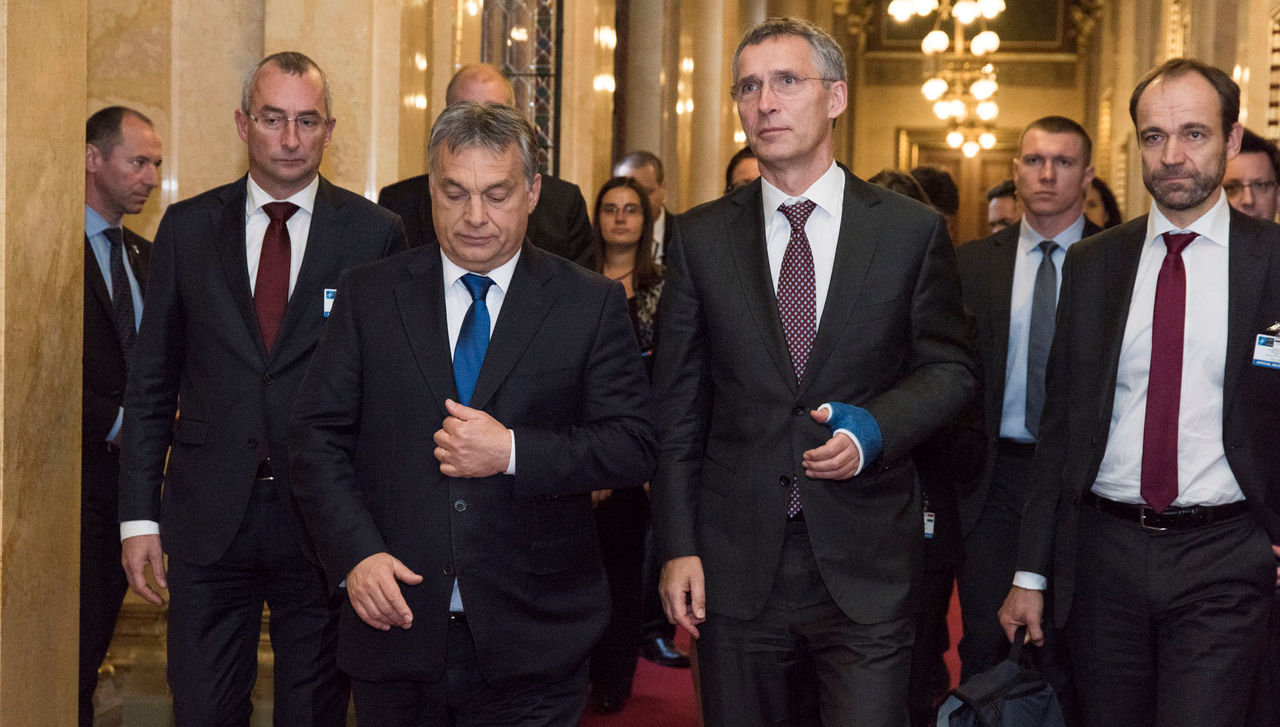
NATO Secretary General Jens Stoltenberg visited Budapest on Thursday (19 November 2015) for talks on current security challenges facing the Alliance, including terrorism, instability to the south, and security challenges to the east. After meeting with Prime Minister Viktor Orbán, Defence Minister István Simicskó, Minister of National Economy Mihaly Varga and other high level officials, Mr Stoltenberg thanked Hungary for its contributions to the Alliance’s shared security.
Speaking of “challenging times for Europe,” Mr Stoltenberg denounced last Friday’s terrorist attacks in Paris, saying they would only strengthen our determination to fight extremism. “We will stand up for our values, and we will answer with an even stronger defence of our open democratic societies,” said the Secretary General. Mr Stoltenberg further noted that instability to the south has created the current refugee crisis, which Allies and other international organisations are working to address.
Mr Stoltenberg also highlighted the crisis in Ukraine, and the challenge posed by a more assertive Russia. While noting that some heavy weapons have been withdrawn from the contact line in eastern Ukraine, he expressed deep concern over a recent increase in ceasefire violations, saying there was a possibility of a resumption in violence. The Secretary General called for full respect for the Minsk agreements.
The leaders discussed NATO’s adaptation in the face of these evolving challenges. Mr Stoltenberg noted that the Alliance has more than doubled the size of the NATO Response Force, which has a new Spearhead Force at its core. The Secretary General further welcomed that Hungary will soon host one of eight small headquarters which will connect NATO and national forces, and contribute to enhanced planning and training.
Mr Stoltenberg began his visit with a wreath-laying ceremony at Heroes’ Square in Budapest. He will also meet with President János Áder before departing for an official visit to Serbia.