
Close
Back


From now on you can download videos from our website
If you would also like to subscribe to the newsletter and receive our latest updates, click on the button below.
Enter the email address you registered with and we will send you a code to reset your password.
The password must be at least 12 characters long, no spaces, include upper/lowercase letters, numbers and symbols.
Click the button to return to the page you were on and log in with your new password.
14 May 2015
1 MIN READ
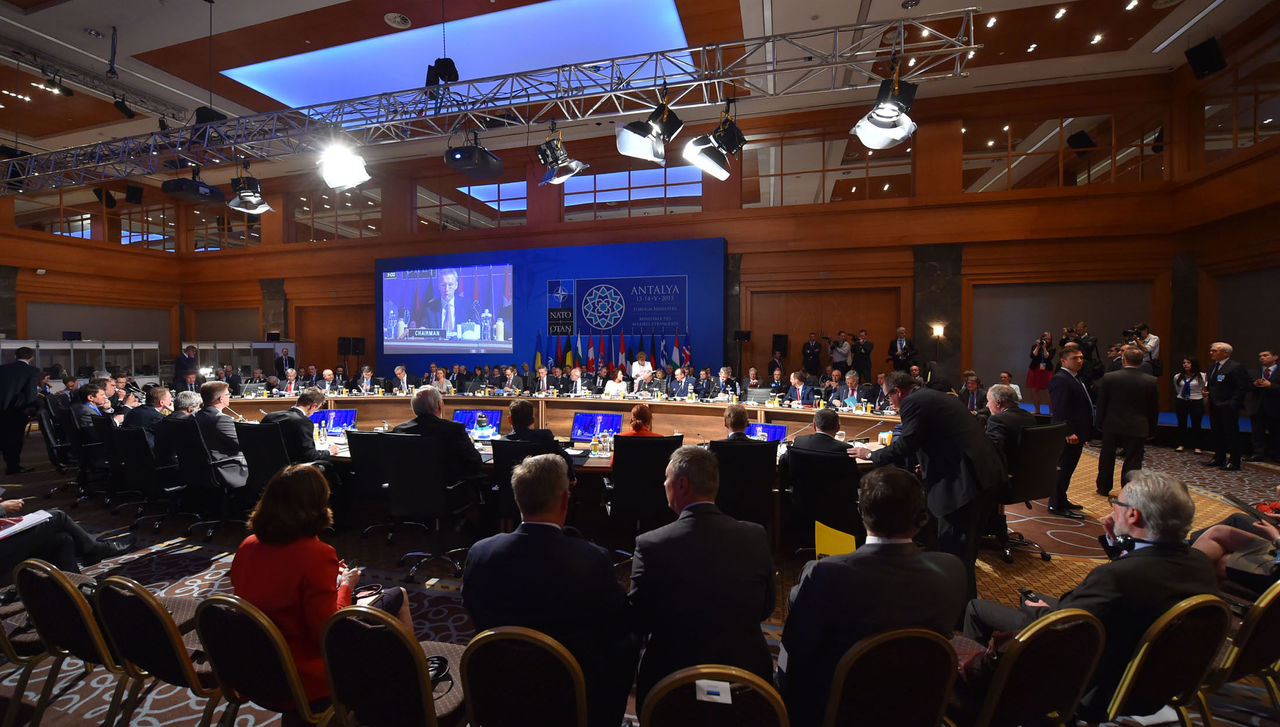
Allies must build closer cooperation with partners and organisations like the European Union, to better address the security challenges to the east and south, NATO Secretary General Jens Stoltenberg said Thursday (14 May 2015). “The challenges we all face demand a comprehensive response, so all of us need to work even closer together,” he said at the end of a two-day meeting of NATO Foreign Ministers in Antalya, Turkey.
The Foreign Ministers were joined by the EU’s High Representative for Foreign Affairs and Security Policy Federica Mogherini to discuss the long-term security implications of a more assertive and unpredictable Russia, as well as the challenges posed by extremism and violence in the Middle East and North Africa. They discussed how NATO and the EU could better cooperate in countering hybrid threats, which combine conventional attacks with subversion, cyber attacks, deception and disinformation. “Both Federica Mogherini and I have decided to task our teams to intensify NATO-EU cooperation in countering hybrid warfare,” the Secretary General said. “We will ensure that the strategies we are developing are complementary, so that we can work together quickly and effectively in case of a hybrid threat against our members,” he added.
Mr. Stoltenberg said that NATO “must continue to adapt” to ensure that it is ready for any challenge. He stressed that the Alliance is already implementing the biggest reinforcement of its collective security since the end of the Cold War, which includes boosting the size and speed of the NATO Response Force with a high readiness Spearhead Force at its core. “We are also speeding up our decision-making, sharpening up our intelligence sharing and strengthening our cyber defence,” said the Secretary General.
The ministers also discussed how to further develop cooperation with partners Finland and Sweden. NATO is looking at how it can hold more consultations and share more information about developments in the Baltic Sea region and beyond. “We will also look at how we can conduct more joint exercises,” said Mr. Stoltenberg.