
Close
Back


From now on you can download videos from our website
If you would also like to subscribe to the newsletter and receive our latest updates, click on the button below.
Enter the email address you registered with and we will send you a code to reset your password.
The password must be at least 12 characters long, no spaces, include upper/lowercase letters, numbers and symbols.
Click the button to return to the page you were on and log in with your new password.
09 December 2014
1 MIN READ
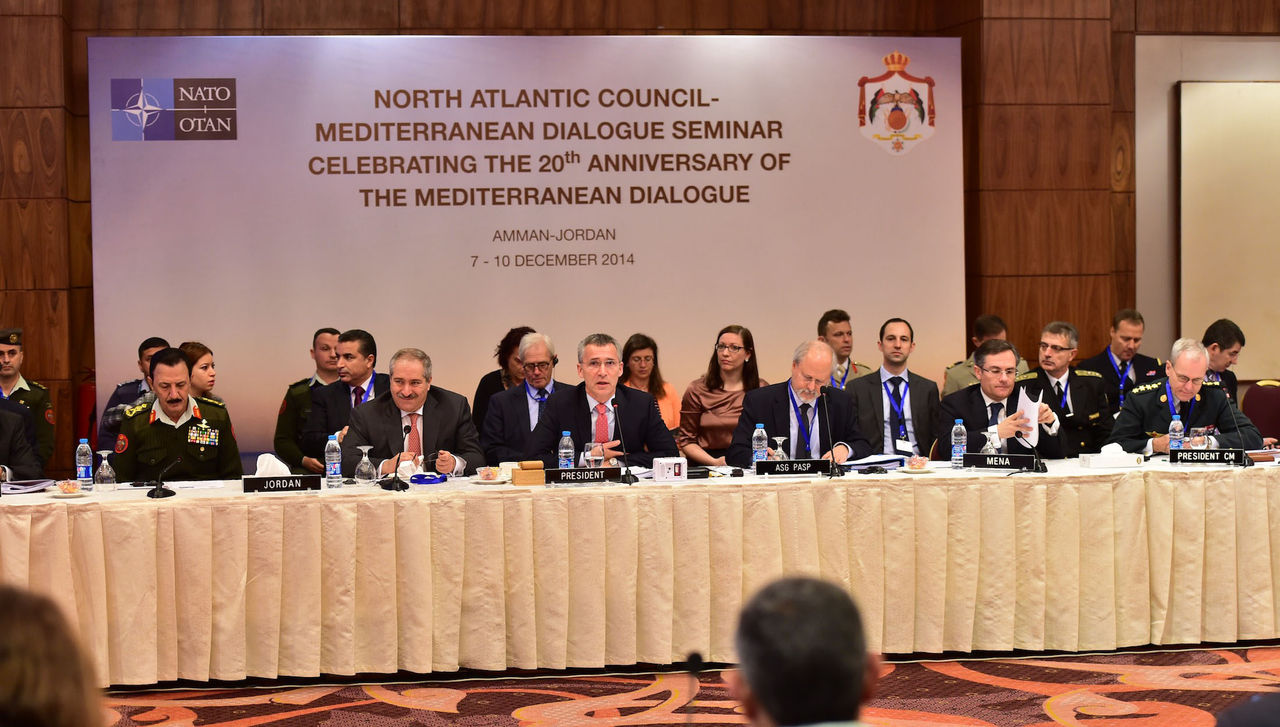
NATO Secretary General Jens Stoltenberg, with the 28 Permanent Representatives of the North Atlantic Council and the Chairman of the Military Committee, Gen. Knud Bartels, marked the 20th anniversary of the Mediterranean Dialogue on Tuesday (9 December 2014) in Amman, Jordan. They were joined by ambassadors of the seven nations (Algeria, Egypt, Israel, Jordan, Mauritania, Morocco and Tunisia) participating in the partnership forum. In an unstable world, “the security of NATO countries is closely linked to the security and the stability in the Mediterranean and the Middle East,” the Secretary General said during a special seminar commemorating the anniversary. “That makes the Mediterranean Dialogue more important than ever.”
During the seminar the Secretary General set out three areas where he saw room for enhancing cooperation with Mediterranean Dialogue partners. He said that NATO could offer partners more assistance on the defence and security sectors, and called for increased ability of armed forces to work together, as well as for deeper political consultations. “Our partnership is strong; let’s make it stronger,” Mr. Stoltenberg said.
The Secretary General also held talks with Jordanian Foreign Minister Nasser Judeh to discuss current security challenges in the Middle East and closer cooperation. He thanked Jordan for hosting the Mediterranean Dialogue meeting. The Secretary General also said the Alliance was grateful for Jordan's decision to be part of the NATO Response Force as a partner nation. He said Allies were grateful for the contributions Jordan has made to regional stability and to the partnership it has with NATO. Mr. Stoltenberg said NATO is ready "to assist Jordan when it comes to, for instance, cyber defence, but also when it comes to different kinds of exercises. And we have agreed to develop that kind of cooperation even closer."
During their visit to Amman, the Secretary General and ambassadors will also have an audience with His Majesty King Abdullah II. Mr. Stoltenberg will separately meet with Jordanian Prime Minister and Minister of Defence Dr. Abdullah Ensour.