
Close
Back


From now on you can download videos from our website
If you would also like to subscribe to the newsletter and receive our latest updates, click on the button below.
Enter the email address you registered with and we will send you a code to reset your password.
The password must be at least 12 characters long, no spaces, include upper/lowercase letters, numbers and symbols.
Click the button to return to the page you were on and log in with your new password.
24 September 2014
1 MIN READ
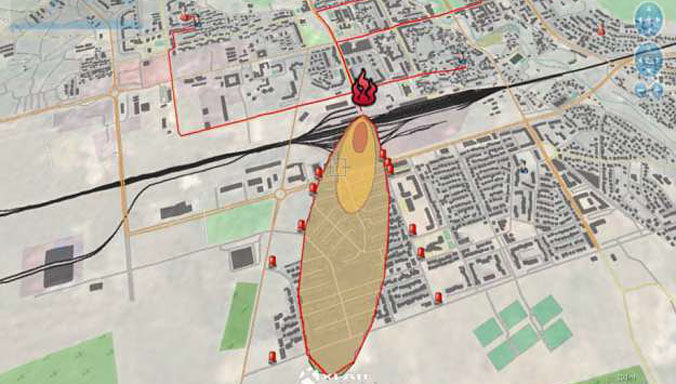
Uncontrolled emission of air polluters and the release of poisonous gasses, especially in the context of a terror attack, pose a significant threat to urban populations. To address this risk, the NATO Science for Peace and Security (SPS) Programme sponsored a project entitled ‘Geographical Information Processing for Environmental Pollution-Related Security within Urban Scale Environments’ (GEPSUS).
Initiated in 2011, the project involved experts and scientists from NATO and partner countries Italy, Israel, Montenegro and Slovenia, who together successfully developed an integrated system to simulate, monitor and forecast air pollution accidents. In the last three years, they have designed new technologies, sophisticated algorithms and advanced mathematical simulation models for the dispersion of poisonous gasses, taking into account real environmental and atmospheric conditions.
Based on this data, the scientists also developed ways to handle urban-scale acute crises caused by exceptional pollution levels or pollutants released during a terrorist attack. The result is an innovative, cost-effective ICT-based system contributing to effective disaster management in or near densely populated areas.
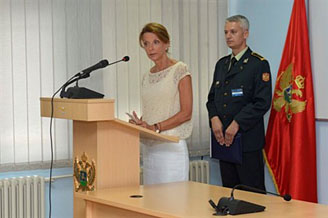
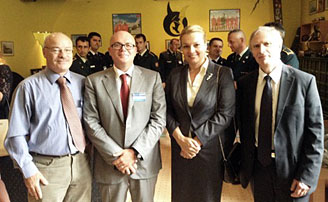
During the closing ceremony for the project, the new GEPSUS education and simulation centre in Podgorica was inaugurated. Defence Minister Milica Pejanović-Đurišić and Minister of Science, Professor Dr Sanja Vlahović attended the event.
Following the ceremony, an exercise to detect pollution in Podgorica demonstrated the work of the new simulation centre. Using cutting-edge technology, this centre will simulate incidents caused by uncontrolled emission of air polluters. The results will help Montenegro to detect and react quickly to dangerous pollution levels in urban centres. The Ministry of Defence of Montenegro is already integrating the data and analyses from the GEPSUS centre into its work.
Dr Philippe Fougerolle from the NATO SPS Programme expressed his satisfaction with the outcome of the three-year project. He praised the good collaboration among all parties, especially between the scientists from different countries and military representatives, as well as the excellence of the scientific work. “The GEPSUS project is an excellent example for the fruitful cooperation between scientists from NATO and partner countries that combines scientific excellence and practical impact,” he said.