
Close
Back


From now on you can download videos from our website
If you would also like to subscribe to the newsletter and receive our latest updates, click on the button below.
Enter the email address you registered with and we will send you a code to reset your password.
The password must be at least 12 characters long, no spaces, include upper/lowercase letters, numbers and symbols.
Click the button to return to the page you were on and log in with your new password.
12 September 2014
2 MIN READ
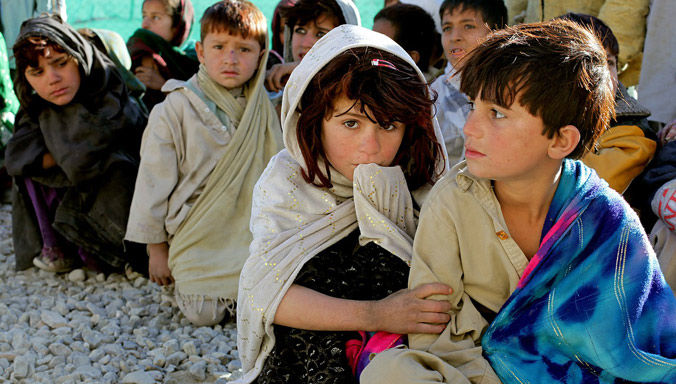
NATO met Thursday [11 September] with senior representatives of the Romeo Dallaire Child Soldiers initiative and the United Nations (UN) Institute for Training and Research to discuss ways of improving the protection of children in armed conflicts.
“The question of Children and Armed Conflict needs to be regarded as a security problem”, Dr. Shelly Whitman, Executive Director of the Romeo Dallaire Child Soldiers Initiative, stressed.
The evolving character and tactics of contemporary warfare create unprecedented threats for children. They are recruited by armed forces and armed groups, become the victims of indiscriminate attacks, or are subjected to sexual violence.
“We all have a role to play and it is important that NATO works closely with the United Nations and civil society as we advance our work in this area”, Mr. Richard Froh, NATO Deputy Assistant Secretary General for Operations, said. “Since the 2012 Chicago Summit, NATO has taken significant steps with the development of military guidelines on Children and Armed Conflict and the launch, in 2013, of a comprehensive and innovative e-learning course to help better prepare Allies and Partner troops ahead of their deployment to NATO-led military operations”.
A positive development is the integration of Children and Armed Conflict into the planning for the Resolute Support Mission to train, advice and assist the Afghan forces as from 2015, and the inclusion, for the first time, of a Child Protection Advisor as part of this mission. At the NATO Wales Summit last week, NATO Allies reaffirmed the Alliance’s commitment to “carrying out its responsibilities as part of the wider international effort and to build on initiatives already taken to properly integrate this issue into the planning and conduct of its operations and missions, as well as its training, monitoring, and reporting”. Future steps will include the adjustment of NATO’s military guidelines on Children and Armed Conflict to better ensure that troops are sufficiently prepared to cope with the issue of Child Soldiers whenever and wherever it arises.
The United Nations Security Council Resolution (UNSCR) 1612 on Children and Armed Conflict was adopted in 2005. According to the 2013 United Nations Secretary General’s annual report on this issue, thousands of children are being recruited and used by armed groups, including in Afghanistan, Iraq and Syria. In 2014, the international community, through the ‘Children, Not Soldiers’ campaign, set the goal to eradicate child recruitment by government forces by 2016.