
Close
Back


From now on you can download videos from our website
If you would also like to subscribe to the newsletter and receive our latest updates, click on the button below.
Enter the email address you registered with and we will send you a code to reset your password.
The password must be at least 12 characters long, no spaces, include upper/lowercase letters, numbers and symbols.
Click the button to return to the page you were on and log in with your new password.
23 June 2014
2 MIN READ
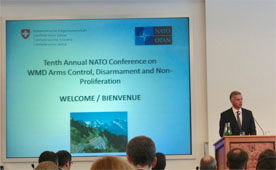
The tenth Annual NATO Conference on Weapons of Mass Destruction (WMD) Arms Control, Disarmament and Non-proliferation, one of NATO’s largest outreach activities involving Alliance member states and partners from around the world, took place in the Swiss town of Interlaken on 23 and 24 June.
Participants from 50 nations on five continents and major international organisations gathered at the event, hosted for the first time by a partner country. President of the Swiss Confederation Didier Burkhalter and NATO Deputy Secretary General Alexander Vershbow opened the conference.
“When it comes to WMD arms control, disarmament and non-proliferation, NATO is not one of the most visible players. But the Alliance does offer a unique forum for informal, off-the-record consultations among officials and experts from Allies, partners, and other nations and organisations,” said Ambassador Vershbow. “I believe it is highly significant that neutral Switzerland is the first of our NATO partner countries to host this annual conference, and that so many nations and organisations are represented here today,” he continued.
NATO Assistant Secretary General for Emerging Security Challenges Ambassador Sorin Ducaru chaired the global forum which provided an opportunity for open and detailed informal dialogue, addressing topical arms control and disarmament issues, such as:
Delegates also reviewed the status of efforts to establish a Middle East zone free of nuclear weapons and all other WMD and examined ways to reinforce the international non-proliferation treaty framework, particularly in the light of the preparations for the 2015 Review Conference of the Nuclear Non-Proliferation Treaty (NPT).
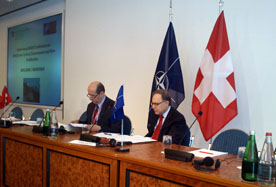
Participants included 21 distinguished speakers from NATO and partner countries and international organisations such as the United Nations and the European Union. Ambassador Ahmet Üzümcü, Director-General of the Organisation for the Prohibition of Chemical Weapons (OPCW) which received the Nobel Peace Prize in 2013 also addressed the conference. Delegates welcomed news confirmed by a representative of the OPCW during the conference of the removal of declared chemical weapons from Syria.
The State of Qatar, one of NATO’s Istanbul Cooperation Initiative partners, declared its willingness to host next year’s conference, which would mark the first time the event would be held outside the European region.
NATO member countries were joined in Interlaken by representatives from partner nations across the globe, including from the Partnership for Peace programme, Mediterranean Dialogue, Istanbul Cooperation Initiative, as well as countries from South and East Asia, Australia and Latin America.
Previous conferences on the challenges of WMD proliferation were held in Rome (2004), Sofia (2005), Vilnius (2007), Berlin (2008), Warsaw (2009), Prague (2010), Bergen (2011), Budapest (2012), and Split (2013).