
Close
Back


From now on you can download videos from our website
If you would also like to subscribe to the newsletter and receive our latest updates, click on the button below.
Enter the email address you registered with and we will send you a code to reset your password.
The password must be at least 12 characters long, no spaces, include upper/lowercase letters, numbers and symbols.
Click the button to return to the page you were on and log in with your new password.
Cyber defence topped the agenda at a NATO Science for Peace and Security (SPS) information day held in Tallinn, Estonia on 3 June. The event provided an opportunity for more than 50 scientists and experts from the region to explore new ways to address emerging security challenges with emphasis on cyber defence.
In 2007, Estonia was victim to a series of cyber attacks. As a result, the country has strengthened its profile in the field of cyber defence and since 2008 has hosted the NATO Cooperative Cyber Defence Centre of Excellence in Tallinn.
Mr Ingvar Pärnamäe, Undersecretary for Defence Investments and Acting Undersecretary for Defence Planning at the Estonian Ministry of Defence, underlined the implications of Estonia’s unique historical experience and international role in the field of cyber defence. “Cyber defence and emerging security challenges have a very important political dimension for NATO requiring nations to work closely with each other better to build a stronger Alliance,” he said.
A member of NATO since 2004, Estonia has played an active part in the NATO SPS Programme. Dr Deniz Beten, Senior SPS and Partnership Cooperation Advisor echoed the need for scientific cooperation and encouraged participants to pursue such projects. “Scientific cooperation is crucial for providing solutions to the new security threats of the 21st century,” she said.
As well as taking stock of ongoing projects, the information day also provided an opportunity to identify future SPS activities with Estonia and regional partners. Scientists discussed a number of ideas in the fields of cyber defence, NATO partnerships and supporting security and defence reform in Ukraine.
One particularly promising field for future scientific collaboration is 3D printing. These printers are evolving towards cloud systems that are potential targets for cyber attacks. In the framework of the SPS Programme, Estonia is now exploring possibilities for 3D printing in a secure environment.
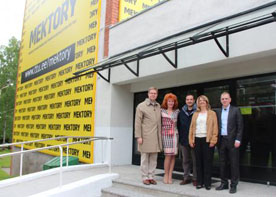
In the margins of the information day, SPS staff also visited the innovation and business centre “Modern Estonian Knowledge Transfer Organization for You” (MEKTORY) at the Tallinn University of Technology.