
Close
Back


From now on you can download videos from our website
If you would also like to subscribe to the newsletter and receive our latest updates, click on the button below.
Enter the email address you registered with and we will send you a code to reset your password.
The password must be at least 12 characters long, no spaces, include upper/lowercase letters, numbers and symbols.
Click the button to return to the page you were on and log in with your new password.
22 May 2014
2 MIN READ
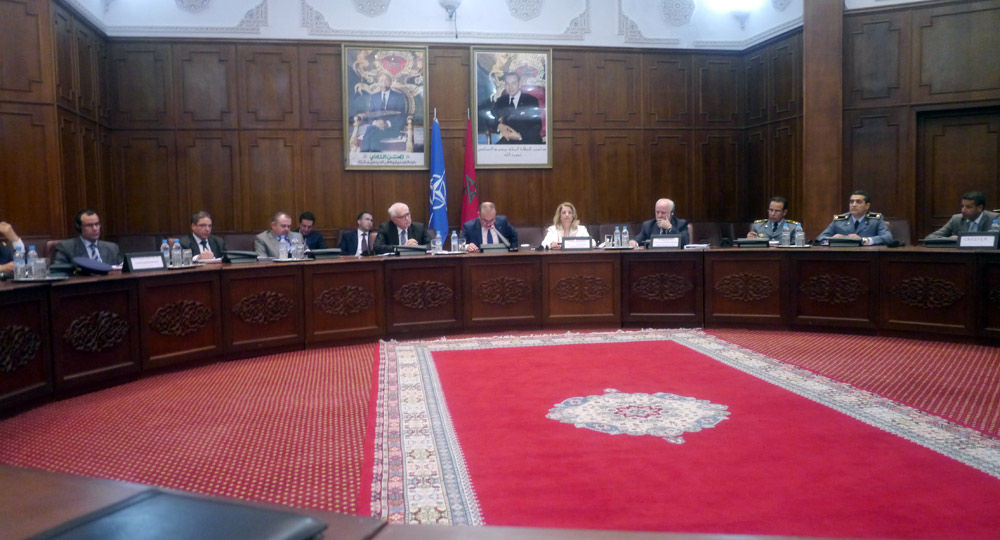
Cyber defence and other global security issues such as chemical, biological, radiological and nuclear (CBRN) resilience and civil emergency were the focus of a NATO Science for Peace and Security information day held in Rabat, Morocco on 19 May.
Around 35 experts, scientists and Moroccan government officials gathered to review existing projects and explore opportunities for further cooperation.
NATO and Morocco already work together on several initiatives to address new security threats in the framework of the NATO Science for Peace and Security (SPS) Programme. SPS Science Advisor Dr Deniz Beten emphasised the importance of the Programme as a partnership tool for NATO.
“I strongly believe that we will use this SPS information day to identify collaboration opportunities, to encourage science and research and to ultimately strengthen the NATO-Morocco partnership,” said Dr Beten.
Morocco and NATO recently signed an Individual Partnership and Cooperation Programme (IPCP), which identified opportunities for collaboration, especially in the fields of cyber defence, CBRN and energy security. Ambassador Alem Menouar, Chief of Mission of Morocco to the European Institutions, emphasised that commitment and ownership were fundamentally important for the successful implementation of these projects.
In the margins of the information day, representatives of NATO’s Emerging Security Challenges Division visited an ongoing cyber defence project in which Morocco is playing a leading role. Experts and scientists from the United States are working with Morocco to develop a new tool to enhance cloud-computing security, providing young Moroccan IT experts with a better understanding of today’s cyber threats.
“Not only are young researchers in Morocco gaining experience with cutting-edge technology in IT, but they are also establishing a network of contacts with experts from several NATO countries,” said Professor Abdelkrim Haqiq from the Hassan 1st University.
Last year, Morocco and Canada held a training workshop to inform participants from NATO and partner countries about new technologies for the detection of CBRN agents in the prevention of terrorism. The NATO delegation also visited the CBRN Centre in Morocco to explore further possible SPS training activities. “One topic for a potential new training course is on nuclear material protection and waste management,” said Dr Eyup Kuntay Turmus, SPS Science Advisor.
Morocco has also worked with scientists from France, Germany, Mauritania and Turkey on an SPS co-funded project, ‘Sahara Trade Winds to Hydrogen’. Participants explored ways to make use of the trade winds over the Sahara Desert to generate hydrogen for sustainable energy systems and integrate renewable energy into the grid infrastructure of the Sahara/Sahel region.