
Close
Back


From now on you can download videos from our website
If you would also like to subscribe to the newsletter and receive our latest updates, click on the button below.
Enter the email address you registered with and we will send you a code to reset your password.
The password must be at least 12 characters long, no spaces, include upper/lowercase letters, numbers and symbols.
Click the button to return to the page you were on and log in with your new password.
18 February 2014
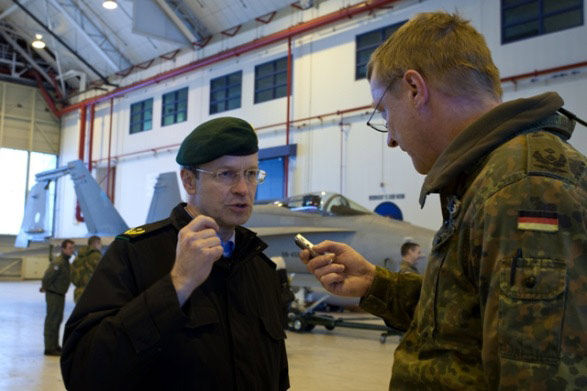
Q : How important is interoperability for NATO – today and tomorrow?
Major General Josef Blotz, Director, Operations Division, International Military Staff : Interoperability has always been a hot issue. It is important for our alliance of 28 member nations, and it is important when we work with our non-NATO Partners. This capability is key during a training event like the Iceland Air Meet 2014 (IAM2014) because it involves close cooperation among NATO and Partnership for Peace (PfP) member nations. The basis for this cooperation is not new; it has already been tested and proven together with our non-NATO Partners over the past 20 years in operations – like the one in Afghanistan. Now we have to maintain this vital capability. The IAM2014 is an excellent opportunity to train this at both the technical and the tactical level.
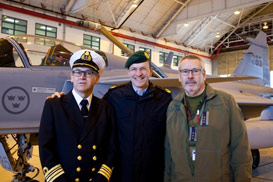
Q : With four participating nations, the IAM2014 is rather a manageable training event. Is such a “small scale” training ideal to practice interoperability?
Major General Josef Blotz : In general we can say that the IAM2014 is a good example for the principle “from small to large“. There are various areas which lend themselves to train this capability. This applies not only to the air forces but also to the army and the navy. The number of participating nations is not what matters; rather it is essential to exploit opportunities like this air meet to continuously train procedures in the field of interoperability. It is true that the four nations participating in the air meet are “just four”, but they are important nations in an important region.
Q : The IAM2014 coincides with the current the Norwegian rotation of the Iceland airborne surveillance on behalf of NATO. Is this constellation a possible option for future training exercises which makes the IAM an interesting event?
Major General Josef Blotz : This joining of forces is an example of smart defence and smart spending. After all there is always the issue of economy of force and smart use of resources. It is also related to NATO’s Connected Forces Initiative (CFI), which is about involving our Partners and exchanging very specific experiences. And when we now see that the Iceland airborne surveillance mission is currently ongoing and it is linked with this air training, then I believe it represents an ideal combination. A combination that saves resources and fits into this thinking of Smart Defence and CFI, that is precisely geared to the future and that takes place with Partner nations which possibly will join us in future missions to deploy with us shoulder-to-shoulder.
Q : Two out of the four IAM2014 nations are PfP members. What does this mean to you?
Major General Josef Blotz : I consider this to be extremely positive and would like to briefly throw in my own experience from two deployments to ISAF. As the Commander of Regional Command North I worked with Swedish and Finnish colleagues. It was very encouraging and constructive to see that, just like the other non-NATO Partners, the Swedish and Finnish are most interested in working alongside NATO to further advance interoperability and standardization. The ability to cooperate on common tactics, techniques and procedures is crucial for these Partner nations. Both for NATO and for our Partners this is a win-win situation.