
Close
Back


From now on you can download videos from our website
If you would also like to subscribe to the newsletter and receive our latest updates, click on the button below.
Enter the email address you registered with and we will send you a code to reset your password.
The password must be at least 12 characters long, no spaces, include upper/lowercase letters, numbers and symbols.
Click the button to return to the page you were on and log in with your new password.
15 January 2013
1 MIN READ
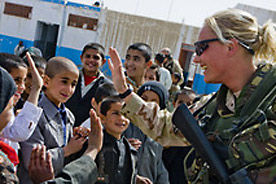
The Secretary General detailed the Alliance’s efforts over the past year to implement United Nations Security Council Resolution (UNSCR) 1325 in its operations and activities in his second annual report on this issue, which was released on Tuesday 15 January. Adopted in 2000, the Resolution recognizes the disproportionate effect of armed conflict on women and children. All NATO Allies and partners are committed to ensuring that gender considerations are integrated into security work.
“Achieving greater empowerment and more effective protection of women against the specific dangers they face in armed conflicts is of benefit not only to women, but to us all,” says Secretary General Anders Fogh Rasmussen.
NATO strengthened its work on these issues during 2012 explains Mari Skåre, who was appointed as the Secretary General’s first Special Representative for Women, Peace and Security in August 2012. “NATO is showing political leadership, and the issue of women, peace and security came to the fore at the NATO Summit in Chicago,” she says.
Skåre’s appointment followed recognition by Allied leaders at the Chicago Summit in May 2012 that “Widespread sexual and gender based violence in conflict situations, the lack of effective institutional arrangements to protect women, and the continued under-representation of women in peace processes, remain serious impediments to building sustainable peace.”
“In our work we are more systematically implementing NATO policy and directives through our planning, exercising and training activities. We are also strengthening our cooperation with partners,” says Skåre.
The report also looks at the way forward for the Alliance during 2013 on the issue. “In the coming year we will continue to strengthen our lessons learnt from operations and training as a tool to enhance competence,” adds Skåre. Raising public awareness of the issue is an important focus of her work.