
Close
Back


From now on you can download videos from our website
If you would also like to subscribe to the newsletter and receive our latest updates, click on the button below.
Enter the email address you registered with and we will send you a code to reset your password.
The password must be at least 12 characters long, no spaces, include upper/lowercase letters, numbers and symbols.
Click the button to return to the page you were on and log in with your new password.
14 February 2012
1 MIN READ
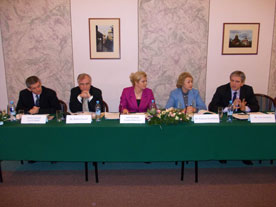
On 13 February, the 14th edition of the Winter Academy opened in Abramtsevo on the outskirts of Moscow. The title of this year’s event is “NATO and partners: searching for common answers to new security challenges”.
The Academy was opened by Dr. Tatiana Parkhalina, Director of the Centre for European Security and Mr. Robert Pszczel, Director of the NATO Information Office (NIO) in Moscow.
Ambassador Kolinda Grabar, Assistant Secretary General for Public Diplomacy at NATO Headquarters delivered the keynote speech. She stressed that, “the challenge in achieving the Lisbon goal of true strategic partnership [between NATO and Russia] consists not only in finding a formula acceptable to both sides. The challenge is also to fight temptation to resort to unhelpful rhetoric which can thwart the effort to understand each other’s anxieties,” she said.
Mr Yuri Gorlatch, Deputy Director of the Department of European Cooperation at the Russian Foreign Ministry, suggested that while the NATO-Russia Council provided a good “hardware” for the reset, equally sophisticated “interfaces and programmes” to make the system work to its full potential were also needed.
Ambassador Ron Keller of the Netherlands offered a comparison between security cooperation – where some trust is still lacking – and economic and trade relations, where old stereotypes have already been overcome. “You cannot just proclaim partnership and trust, you have to implement it,” said Keller.
Ambassador Petr Kolář of the Czech Republic agreed that the problem of mistrust existed but added that, “seeing so many young people from Russia and other countries discussing freely international security issues,” made him “feel optimistic about the future”.
This unique, week-long project was organised by the Centre for European Security and co-sponsored by the NIO and the Embassies of the Czech Republic and the Netherlands. The Winter Academy will continue until 18 February.