
Close
Back


From now on you can download videos from our website
If you would also like to subscribe to the newsletter and receive our latest updates, click on the button below.
Enter the email address you registered with and we will send you a code to reset your password.
The password must be at least 12 characters long, no spaces, include upper/lowercase letters, numbers and symbols.
Click the button to return to the page you were on and log in with your new password.
23 September 2011
3 MIN READ
''In my opinion the man who built it decided to put it beside the hospital to prevent the security building from being attacked,'' says Mahnoud the manager of the Al-Hourok Hospital, which specialises in treating burns, in the Tripoli suburb of Cidi Khaleffa.
From behind his neatly organised desk he can peer out and see a scene of destruction. Fifty metres across the road lies the smashed remains of a building which used to be one of Qadhafi’s intelligence centres, reduced to a ruin by a NATO air strike during one dark June night.
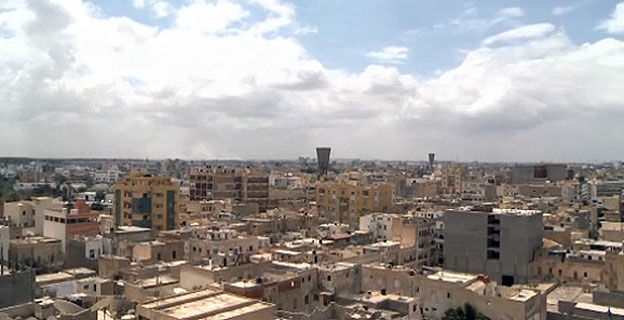
Across Tripoli military installations were interspersed throughout the civilian population. Intelligence headquarters and command centres nestled amongst schools and mosques in the patchwork of concrete buildings that make up the capital’s skyline.
This policy of human shielding writ large didn’t count on the accuracy of modern weaponry.
Fallen panels from the hospital’s suspended ceiling attest to the violence of the event that the building was subject to, but aside from some broken glass and a few bent door hinges it escaped any serious damage. It’s testament to the skill with which NATO aircraft were able to pinpoint a military target in a sea of civilian buildings.
As peace has returned to Tripoli’s streets it’s given an opportunity to assess the effects of the bombing campaign that the city endured since March. As you talk to civilians who witnessed the bombings their opinions are quite surprising.
“We were very happy,” says Omah now a guard at the hospital for the National Transitional Council (NTC) forces. “This building was the second most important place used to torture, to kill, and hit the people who have been arrested. This is the second most important place after Bab al-Aziziya (Qadhafi’s compound), which is the centre of evil,” he explains.
Nadia, a psychology teacher who lives in the area of Ain Zara, tells me that there was appreciation for the way that the strike was carried out. “The strike wasn’t done in a heavy-handed way,” she says. “The first strike gave a warning to the residents, so automatically they left their houses. The result, there is no accidents.”
The residential suburb in the southeast of the city was targeted because of the large weapons dump that Qadafi had established in the area. One of many set up under the old regime to house the glut of munitions and arms on which the oil revenues of the country were squandered.
The air strike in Ain Zara resulted in a large secondary explosion throwing shrapnel out into surrounding shops. Yet despite this the locals don’t feel the blame lies with the Alliance. “I blame the government, I don’t blame NATO,” says 52 year-old Yunis. “NATO was striking military targets so our government should have informed us that this location was a target,” he tells us.
Of course there is widespread acknowledgement of the fear that the bombings brought. Nobody wants their neighbourhood to be subject to such actions. “The children were terrified from the sound of bombing, it was very loud,” says Mahmoud a local resident. “Really this is nothing,” he adds, “as NATO was acting in a positive way to stop Qadhafi’s forces, who were actually bombing the civilians.”
NATO Secretary General Anders Fogh Rasmussen has spoken of this being the most accurate and careful bombing campaign of its kind ever. Pilots have sought to use the smallest possible weapon to achieve the desired effect and a rigorous chain of command has been put in place to ensure mistakes are not made.
The use of precision and accuracy of modern weapons guided by laser and satellite has proved critical to minimise collateral damage, in some cases only targeting the most threatening sections of military infrastructures.
Of course any war brings with its mistakes, and the claims of the Qadhafi regime of civilian casualties, although widely acknowledged to be extremely unreliable, have to be carefully looked at. NATO acknowledged back in June that a weapons system failure might have caused a bomb to go astray. Yet, NATO's actions seem to have widespread support amongst the people of Tripoli.
The NATO mission to protect civilians in Libya goes on, and was recently extended by up to 90 days by the North Atlantic Council. The Alliance will look to continue the careful use of military power as the NTC battles for the towns of Sirte and Bani Walid , whose population remains under the threat of the Qadhafi forces .