
Close
Back


From now on you can download videos from our website
If you would also like to subscribe to the newsletter and receive our latest updates, click on the button below.
Enter the email address you registered with and we will send you a code to reset your password.
The password must be at least 12 characters long, no spaces, include upper/lowercase letters, numbers and symbols.
Click the button to return to the page you were on and log in with your new password.
22 March 2010
1 MIN READ
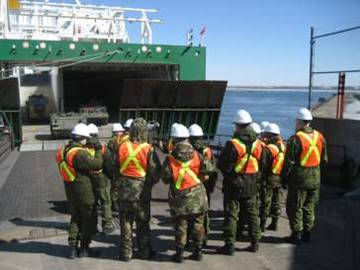
NATO members Bulgaria, Canada, Croatia, Hungary, Lithuania and Slovakia will sign a Memorandum of Understanding in the margins of the Senior NATO Logisticians' Conference on 23 March 2010, committing their national support to the Movement Control Multinational Integrated Logistic Unit (Mov Con MILU).
This unit will coordinate and control the various transport elements used in the movement of designated force elements during the deployment, sustainment, and redeployment stages of a NATO-led operation.
Canada took the initiative in 2007 to form this unit in order to overcome an Alliance capability shortfall. The Mov Con MILU has a Commanding Officer, currently provided by Canada as the lead participant, and consists of an operations centre and a number of movement detachments. The Unit will deploy as ordered to operational theatres where it will be largely self-sufficient and capable of operating at multimodal ports of debarkation/embarkation simultaneously, 24 hours a day over an extended period.
Following two training events in 2008, MILU personnel attended an exercise in Canada in March 2009, during which they reviewed and revised their standard operating procedures. Personnel also received movements training at the Norwegian Movements School. Further training will take place during Exercise MILU MUSTER in Belgium, the Netherlands and Germany in April 2010, as the next stage towards the declaration of a Full Operational Capability in 2010.
The Mov Con MILU will provide an important capability in support of NATO operations. Membership remains open to other NATO and Partner states who would like to join this multinational collaborative logistic effort.