
Close
Back


From now on you can download videos from our website
If you would also like to subscribe to the newsletter and receive our latest updates, click on the button below.
Enter the email address you registered with and we will send you a code to reset your password.
The password must be at least 12 characters long, no spaces, include upper/lowercase letters, numbers and symbols.
Click the button to return to the page you were on and log in with your new password.
17 March 2010
1 MIN READ
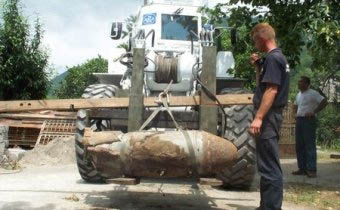
Key agreements to begin a Partnership for Peace Trust Fund project that will help Georgia safely dispose of explosive remnants of war (ERW) were signed on 12 March.The war remnants, which include unexploded ordnance, improvised explosive devices and landmine contamination, pose a deadly threat to local residents.
The signatories to the agreements were the Permanent Representatives of the CzechRepublic, Estoniaand Lithuania, the NATO Maintenance and Supply Agency (NAMSA) and Georgia.
The signing ceremony was attended by NATO Deputy Secretary General, Ambassador Claudio Bisogniero, Georgian Deputy Prime Minister and State Minister for European and Euro-Atlantic Integration Giorgi Baramidze, NAMSA General Manager Antonios Chatzidakis, and the Permanent Representatives of the project's lead nations, the Czech Republic, Estonia and Lithuania.
The project will help Georgia dispose of explosive ordnance by providing specialized equipment and training a Georgian team that will in turn train a company of specialists. The project will also offer support in establishing a physical rehabilitation centre for people wounded by ERW at the Military Hospital in Gori.
Managed by NAMSA, the project will be implemented over a 15-month period with a budget of 2.87 million euros. It will contribute significantly to security and stability in the region and is an example of the practical capacity-building that Trust Funds provide NATO Partner countries.