
Close
Back


From now on you can download videos from our website
If you would also like to subscribe to the newsletter and receive our latest updates, click on the button below.
Enter the email address you registered with and we will send you a code to reset your password.
The password must be at least 12 characters long, no spaces, include upper/lowercase letters, numbers and symbols.
Click the button to return to the page you were on and log in with your new password.
14 July 2009
2 MIN READ
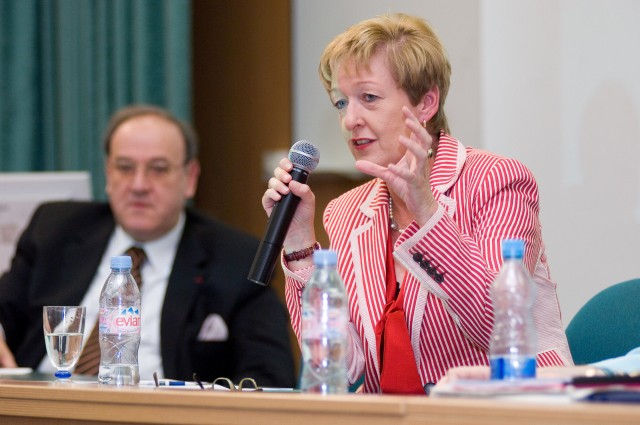
More than 200 graduate students from across the Euro-Atlantic area gathered at the Charles University in Prague on 13 July 2009 to discuss the future of the transatlantic partnership. Organised by the Greek Association for Atlantic and European Cooperation and the Fund for American Studies, the event allowed students to debate current transatlantic issues including NATO’s operation in Afghanistan, the impact of security challenges such as cyber attacks, energy security, terrorism, and the Alliance’s new Strategic Concept.
A special highlight of the conference was the “Robin Beard Lecture” delivered by Dr Stefanie Babst, NATO’s Deputy Assistant Secretary General for Public Diplomacy. Dr Babst called upon conference participants to join the discussion on NATO’s new Strategic Concept. Heads of State and Government are expected to approve the new Concept at the next NATO Summit.
“I am sure that Robin would have been right in the midst of the debate about the new Strategic Concept,” she said. “I am equally confident that he would have wanted you to join him. We want what I call the ‘Next Generation NATO’ to voice their proper ideas on how we can make the Alliance fit for the 21st century. It is up to you to ensure that the transatlantic story continues.”
This special lecture series is devoted to the former US Congressman from Tennessee, who died from brain cancer at age 67 in 2007. Beard was widely known as an accomplished public servant and skilled advocate in international relations. Twice in the course of his career, Robin Beard served as NATO Assistant Secretary General for defence matters (1984-87 and 1992-95).
“Undoubtedly, Robin was a staunch supporter of NATO throughout his distinguished political career,” Dr Babst noted. “But as much as any other aspect, he is fondly remembered as a fun guy to be around with. He loved to be surrounded by people, especially young people, and they loved to be around him. He would manage to bring everyone around him in a good mood no matter what their day had been like.”
Last year’s “Robin Beard Lecture” was delivered by Daniel Speckhard, US Ambassador to Greece.