
Close
Back


From now on you can download videos from our website
If you would also like to subscribe to the newsletter and receive our latest updates, click on the button below.
Enter the email address you registered with and we will send you a code to reset your password.
The password must be at least 12 characters long, no spaces, include upper/lowercase letters, numbers and symbols.
Click the button to return to the page you were on and log in with your new password.
06 March 2009
1 MIN READ
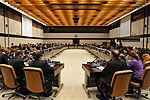
Senior representatives from NATO met with their counterparts from 41 partner countries and non-NATO troop contributing nations at the Alliance's headquarters in Brussels on 6 March, to discuss how NATO contributes to a Comprehensive Approach, namely how to improve the coherent application of its crisis management instruments and better cooperate with other actors in order to complement and mutually reinforce each others’ efforts.
Experience in Afghanistan and Kosovo demonstrates that meeting today’s security challenges requires a wide spectrum of civil and military instruments. It is acknowledged that a successful response to a given crisis requires political, economic, and social engagement. This can only be provided through a coordinated and coherent response by, and regular consultations and interaction among, all the actors involved.
NATO partners (Partnership for Peace, Mediterranean Dialogue, Istanbul Cooperation Initiative and partners around the globe) and non-NATO troop-contributing nations have an important role in the implementation and further development of the Action Plan on the Comprehensive Approach. In this context, the participants exchanged views on progress made so far, as well as on ways in which NATO and partners countries can further strengthen their cooperation in this context.
At the Bucharest Summit in April 2008, Allied leaders endorsed an action plan for the development and implementation of NATO’s contribution to a Comprehensive Approach. Since then, NATO has been seeking to improve its own crisis-management instruments and to strengthen its ability to work with partner countries, international organizations, non-governmental organizations and local authorities.