
Close
Back


From now on you can download videos from our website
If you would also like to subscribe to the newsletter and receive our latest updates, click on the button below.
Enter the email address you registered with and we will send you a code to reset your password.
The password must be at least 12 characters long, no spaces, include upper/lowercase letters, numbers and symbols.
Click the button to return to the page you were on and log in with your new password.
05 February 2009
1 MIN READ
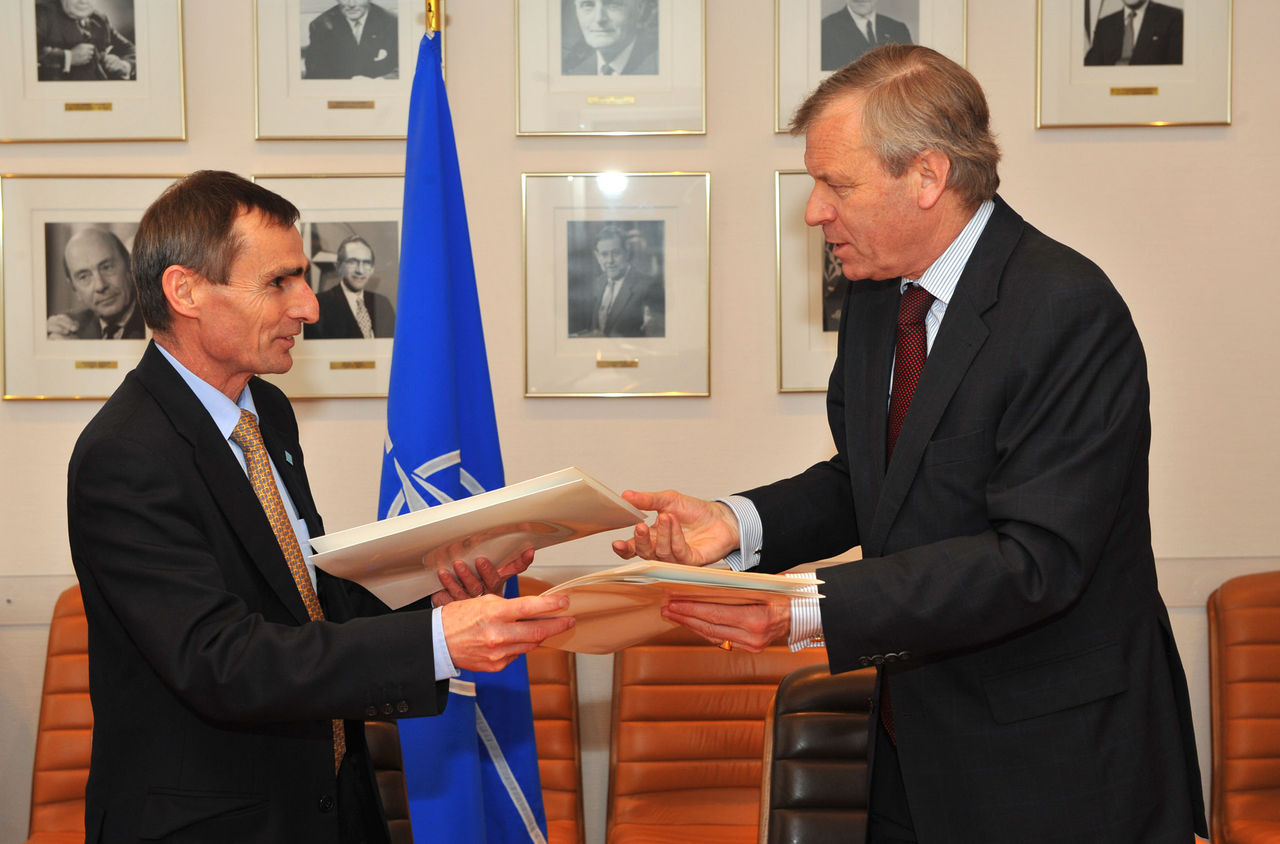
NATO Secretary General, Jaap de Hoop Scheffer, and Patrick Bellouard, Director of the “Organisation Conjointe de Coopération en Matière d’Armement” (OCCAR) met at the Alliance’s headquarters on 5 February to sign an agreement on security of information.
OCCAR is an international procurement agency for the managing of armament programmes. It is formed by Belgium, France, Germany, Italy, Spain and the United Kingdom. Other NATO countries like Luxembourg, The Netherlands, and Turkey are also participating in certain OCCAR programmes without being members of the organization.
NATO currently takes part in three programmes managed by OCCAR: the COBRA Target Locating Radar, the A400M Military Transport Aircraft and the TIGER helicopter programmes.
The agreement between both organizations ensures the protection of classified NATO information released to OCCAR in order to meet the Alliance’s requirements and ensure conformity with NATO standardisation agreements (STANAGS).