
Close
Back


From now on you can download videos from our website
If you would also like to subscribe to the newsletter and receive our latest updates, click on the button below.
Enter the email address you registered with and we will send you a code to reset your password.
The password must be at least 12 characters long, no spaces, include upper/lowercase letters, numbers and symbols.
Click the button to return to the page you were on and log in with your new password.
28 January 2009
1 MIN READ
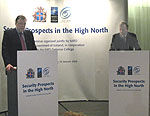
The Seminar on Security Prospects in the High North, hosted by the Icelandic Government, took place in Reykjavik on 28 -29 January to address emerging challenges as global warming affects the Arctic region.
The seminar brought together NATO Secretary General, a number of Allied Ministers and Ambassadors, the Chairman of the Military Committee, the two Strategic Commanders, as well as many other decision-makers and experts from Allied countries.
Addressing the seminar, NATO Secretary General said: “we are here today, not in response to a specific threat, but in response to a change, and with a view to developing a better understanding of that change”.
He further added: “The changes caused by the progressive melting of the ice cap are of concern to many countries beyond those of the Arctic Council and NATO. Indeed, the whole of the international community stands to be affected by many of the changes that are already taking place. In this situation, NATO needs to identify where the Alliance, with its unique competencies, can add value.”
In his presentation, Mr. De Hoop Scheffer pointed to a number of contributions that NATO could make in this respect, including relief operations, search and rescue missions, as well as serving as a forum of discussion and utilizing the opportunities inherent to the NATO-Russia Council.
In his turn, the Prime Minister of Iceland, Mr. Geir Haarde, addressed the guests: “I believe that this relatively modest seminar in Reykjavik can make a major contribution towards promoting greater understanding of security prospects in the High North and, thereby, enhance security and stability in the region.”