
Close
Back


From now on you can download videos from our website
If you would also like to subscribe to the newsletter and receive our latest updates, click on the button below.
Enter the email address you registered with and we will send you a code to reset your password.
The password must be at least 12 characters long, no spaces, include upper/lowercase letters, numbers and symbols.
Click the button to return to the page you were on and log in with your new password.
07 July 2008
2 MIN READ
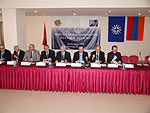
Armenia hosted a Euro-Atlantic Partnership Council (EAPC) seminar on cyber defence in Yerevan, from 23 to 25 June. The aim was to develop a common understanding of cyber attacks, share best practices and suggest practical cooperation on preventing and responding to such attacks.
Representatives of governments and scientific and academic communities of 18 EAPC countries, two Mediterranean Dialogue countries and four countries participating in the Istanbul Cooperation Initiative gathered for the seminar. Officials from the European Union and the Organization for Security and Cooperation in Europe also participated.
The event followed up on an seminar held in Armenia last year, which focused on the Partnership Action Plan against Terrorism. The need for increased cooperation between NATO and its Partners in the area of cyber defence was highlighted on that occasion.
Modern industrialized societies are increasingly dependent on a wide variety of national and international information infrastructures.
"Communication and Information systems of critical importance for the nations rely on the safety and integrity of electronic information systems," said Klaus Kleffner of NATO's Defence Policy and Planning Division, who chaired the seminar. "These systems are increasingly vulnerable to cyber attacks and need to be adequately protected."
More and more countries are developing policies and protective measures to address the perceived vulnerability of these critical information infrastructures. The global nature of telecommunications and online systems also require greater levels of international, scientific and legal cooperation.
NATO adopted earlier this year a policy on cyber defence and is currently developing the technical and procedural instruments to implement it. A NATO Centre of Excellence on Cyber Defence was recently established in Estonia.
NATO's Science for Peace and Security (SPS) Programme has already helped establish Computer Emergency Response Teams in 15 countries.The Alliance is currently considering in which way it can share its expertise with Partners.
The seminar provided a useful forum for relevant policy makers, technical experts and scientists to make presentations and exchange views on best practices at national level and on practical steps that could be taken to strengthen international cooperation.
The seminar was co-sponsored by NATO's Defence Policy and Planning Division and the NATO SPS Programme, as well as the Armenian foreign ministry.
It was part of Armenia's Individual Partnership Action Plan (IPAP) in the area of the fight against terrorism. The IPAP is a programme jointly developed by a number of individual Partner countries with NATO, which supports defence and security sector reforms and, more broadly, strengthens Euro-Atlantic integration.
The seminar was also a key event during "NATO Week in Armenia", which aims to raise public awareness in Armenia about its cooperation with NATO.