
Close
Back


From now on you can download videos from our website
If you would also like to subscribe to the newsletter and receive our latest updates, click on the button below.
Enter the email address you registered with and we will send you a code to reset your password.
The password must be at least 12 characters long, no spaces, include upper/lowercase letters, numbers and symbols.
Click the button to return to the page you were on and log in with your new password.
03 April 2008
1 MIN READ
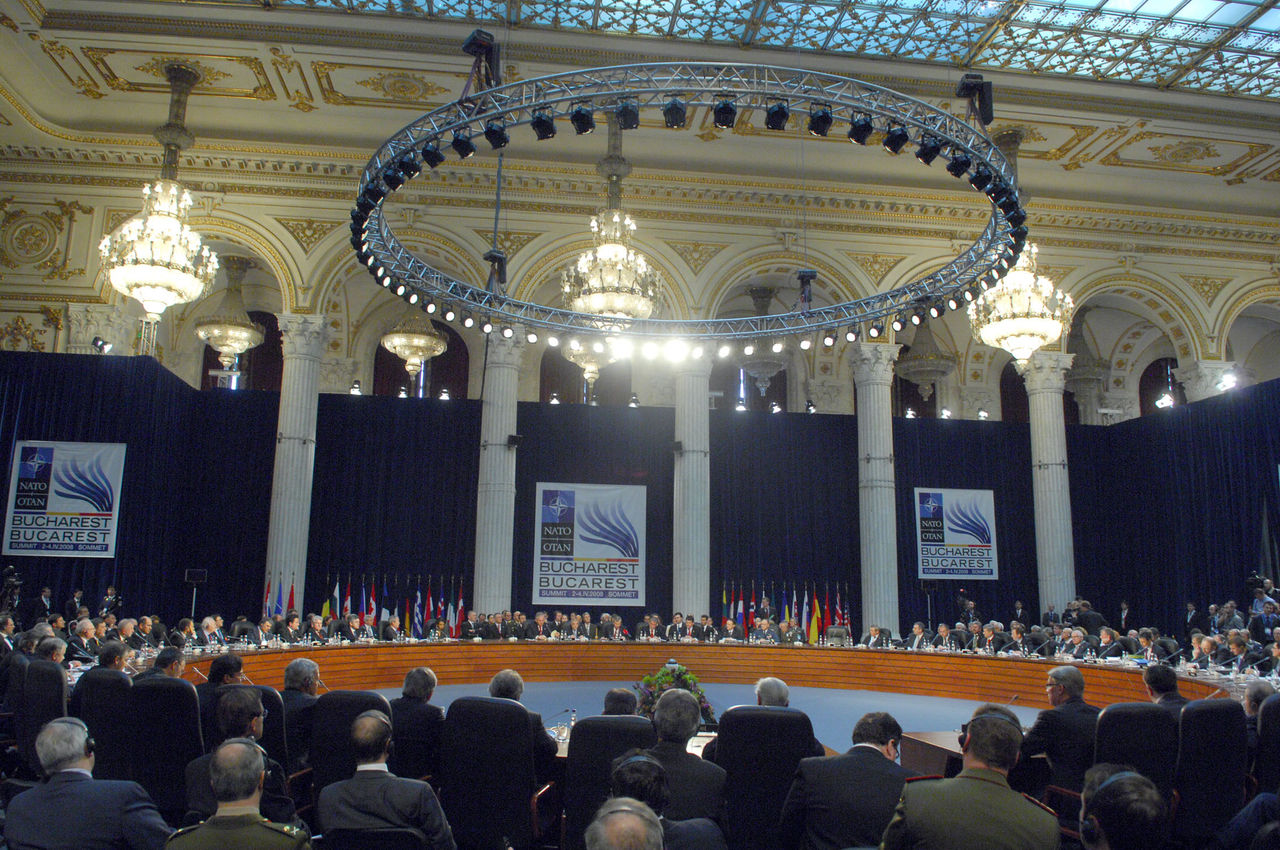
Allied leaders spent the first formal day of the Summit in Bucharest discussing key issues on NATO’s political and security agenda. A Summit Communiqué was issued at the end of this first day.
The Communiqué reflects the broad and shared commitment of all Allies to NATO’s open door policy and the importance of continuing the essential contribution to international security in the 21st century.
NATO leaders reaffirmed their determination and solidarity to fulfill operational responsibilities, in particular in Afghanistan. They also pledged to continue support to the African Union peacekeeping missions and assistance with the development of Iraqi Security Forces.
Allies reaffirmed their commitment to stability throughout the Balkans and reiterated that KFOR will remain in Kosovo on the basis of United Nations Security Council Resolution (UNSCR) 1244. In Kosovo, NATO and KFOR will continue to work with the authorities. Bearing in mind its operational mandate, KFOR will cooperate with and assist the United Nations, the European Union and other international actors to support the development of a stable, democratic, multi-ethnic and peaceful Kosovo.
NATO agreed on the need to implement a comprehensive approach to international security challenges. In this context, development of closer relations with the United Nations and the European Union was stressed.
Allies reiterated the enduring value of the Euro-Atlantic Partnership Council and other partnership arrangements, including Mediterranean Dialogue, Istanbul Cooperation Initiative and global partners.
They looked forward to the meetings to be held on 4 April – the NATO-Ukraine Commission and the NATO-Russia Council with the participation of, respectively, the Presidents of Ukraine and Russia.
The NATO transformation process has been described as a key ingredient for providing better responses to diverse security challenges, including the achievement of more deployable capabilities.
The Communiqué covers such issues as: an agreement to work on the development of options for comprehensive missile defence architecture, the role of arms control, disarmament and non-proliferation, the importance of the NATO Response Force, the Alliance Ground Surveillance capability, a new policy on cyber defence, principles of the Allied approach to energy security and many others.
Allied leaders decided to meet again next year in Strasbourg, France and Kehl, Germany to celebrate NATO’s 60th anniversary.