
Close
Back


From now on you can download videos from our website
If you would also like to subscribe to the newsletter and receive our latest updates, click on the button below.
Enter the email address you registered with and we will send you a code to reset your password.
The password must be at least 12 characters long, no spaces, include upper/lowercase letters, numbers and symbols.
Click the button to return to the page you were on and log in with your new password.
09 October 2007
1 MIN READ
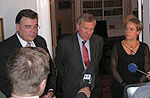
NATO Secretary General Jaap de Hoop Scheffer met in Reykjavik with the Icelandic Prime Minister Geir H. Haarde and Foreign Minister Ingibjorg Solrun Gisladottir. They discussed NATO’s current operations, the upcoming Bucharest summit and a wide range of security issues.
De Hoop Scheffer and Haarde outlined the need to discuss within the Alliance the new security environment in the Northern Atlantic and the strategic prospects of the Nordic Dimension of NATO.
The Secretary General underscored the importance of the Icelandic support to the rehabilitation of the Afghan aviation sector and said that Reykjavik can add value in this area in different theatres of operations.
The also mentioned the subjects that the Alliance leaders are expected to discuss at the Bucharest Summit (Spring 2008) with regards to NATO enlargement, missile defence, military capabilities, energy security, maritime situation awareness, cyber defence and other new security threats.