
Close
Back


From now on you can download videos from our website
If you would also like to subscribe to the newsletter and receive our latest updates, click on the button below.
Enter the email address you registered with and we will send you a code to reset your password.
The password must be at least 12 characters long, no spaces, include upper/lowercase letters, numbers and symbols.
Click the button to return to the page you were on and log in with your new password.
23 April 2007
2 MIN READ
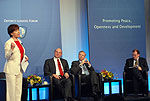
The growing interdependencies between international security and defence, media and technology was the focus of the Defence Leaders Forum jointly hosted by NATO, Microsoft and the BBC in Noordwijk aan Zee, the Netherlands, on 23 April.
“Our security environment is now influenced not just by traditional military powers and nation states, but more and more by non-state actors, individuals, technology and the media,” said NATO Secretary General Jaap de Hoop Scheffer in his address.
“A comprehensive approach is one that fosters cooperation and coordination between international organizations, individuals, agencies and NGOs, as well as the private sector,” he stressed.
NATO’s operation in Afghanistan was discussed as an example of a mission where a truly comprehensive approach is needed to succeed.
“The dangers of just considering this to be a war that’s being fought, and not a massive humanitarian and social effort on the part of our countries, if we consider that it’s a war and not these other things, then I think the danger for Afghanistan is quite considerable,” warned John Simpson, the BBC’s world affairs editor.
In this context, participants discussed the opportunities for and limits of private sector and media engagement.
Private enterprise could help stimulate economic growth and transfer technology, Microsoft’s Chief Executive Officer, Steve Ballmer said, citing Microsoft training in Afghanistan as an example.
Media training and journalistic capacity-building by well-respected media organizations like the BBC is helping to build civil society, said Richard Sambrook, Director of Global News at the BBC.
But he stressed that media must remain independent if it is to be effective, saying that “the stakes for broadcasters like the BBC is to remain trusted as a key source of comprehensive information delivered with the sole objective of allowing people to make their own judgement”.
All participants agreed that the current technology and information revolution posed an equal challenge to the defence, media and the private sector.
This included providing decision-makers and the public with an accurate picture of developments in crisis-areas in a cacophony of 24-hour, always-on news.
The conference, the first joint effort between NATO and the private sector, is an acknowledgement of the importance of building new partnerships to comprehensively address today’s and tomorrow’s security challenges.
“The challenges we face today are increasingly relevant to both the private and public spheres, and dealing with these challenges offers potential for finding common, or coordinated solutions,” the Secretary General concluded.