
Close
Back


From now on you can download videos from our website
If you would also like to subscribe to the newsletter and receive our latest updates, click on the button below.
Enter the email address you registered with and we will send you a code to reset your password.
The password must be at least 12 characters long, no spaces, include upper/lowercase letters, numbers and symbols.
Click the button to return to the page you were on and log in with your new password.
18 October 2006
1 MIN READ
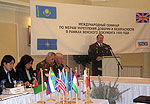
Transparency of arms control, particularly in Central Asia, was the focus of a NATO-supported seminar, hosted by Kazakhstan in Almaty, 18 and 19 October.
The seminar on “International Arms Control on Confidence and Security Building Measures in the Modern Context” attracted a broad range of participants, including NATO officials and representatives of NATO and Partner countries, notably from Kyrgyzstan, Tajikistan, Kazakhstan as well as from Afghanistan and Russia.

The presentations and discussions emphasised the goal of full implementation of the Vienna Document 1999, a politically binding instrument on security and confidence building measures within the Organization for Security and Co-operation in Europe (OSCE), as well as the benefits of practical implementation of the measures outlined in the document.
NATO and its Partner countries consider confidence and security-building measures as an essential instrument for enhancing peace and stability, security and transparency within the Euro-Atlantic area.
The seminar was organised by the United Kingdom on behalf of NATO Allies, in cooperation with Kazakh authorities. It had the support of the OSCE, the Stockholm International Peace Research Institute (SIPRI) and of several NATO countries - Canada, Denmark, Germany, Luxembourg and the Netherlands.
Keynote speakers included: Professor Adam Daniel Rotfeld, former Minister of Foreign Affairs of Poland; Dr. Pal Dunay, Senior Researcher SIPRI; Dr Andrei Zagorski Deputy Director of the Moscow Centre of the Carnegie Foundation and Mr. Michael Biontino, Head of Division, Directorate-General for Disarmament and Arms Control, German Ministry of Foreign Affairs.