
Close
Back


From now on you can download videos from our website
If you would also like to subscribe to the newsletter and receive our latest updates, click on the button below.
Enter the email address you registered with and we will send you a code to reset your password.
The password must be at least 12 characters long, no spaces, include upper/lowercase letters, numbers and symbols.
Click the button to return to the page you were on and log in with your new password.
22 August 2006
2 MIN READ
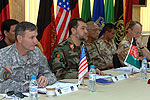
On 22 August, the Tripartite Commission held its 18th meeting in Kabul to discuss increasing coordination of patrols on both sides of the Afghan-Pakistani border. The tripartite is composed of senior military and diplomatic representatives from Afghanistan, Pakistan, the Coalition Forces in Afghanistan, and NATO’s International Security Assistance Force (ISAF).
Attending the meeting were Gen. Ahsan Saleem Hayat, the Vice Chief of Army Staff of the Pakistani Army; Gen. Bismullah Khan Mohammedi, the Chief of Staff of the Afghan National Army; Lt. Gen. Karl Eikenberry, the commander of Combined Forces Command – Afghanistan and Lt. Gen. David Richards, the commander of NATO-ISAF.
The border security subcommittee discussed progress being made in Regional Command East and Regional Command South. The focus of this subcommittee, which held its first-ever meeting in May for operations in Regional Command South, has been on better coordination of security operations along the border.
The Afghan and Pakistani militaries have improved their ability to conduct operations against their common enemy through better communication, enabled by the use of a geospatial database and high-frequency radios, provided by the United States. In order to coordinate the movements along the border areas, the participants discussed and agreed to a proposal to conduct coordinated patrols by the Afghan National Army, Pakistan Army, Coalition Forces and NATO-ISAF forces based in Afghanistan, on their respective sides of the border, simultaneously.
The Military Intelligence-Sharing Working Group briefed about the latest efforts to form a three-way Joint Information Operations Centre with Afghan and Pakistani liaison officers and the Coalition Forces in Afghanistan. The group also discussed the use of secure mobile telephones for intelligence coordination between the Afghan National Army, the Directorate General of (Pakistani) Military Intelligence, the Coalition and NATO-ISAF.
The Coalition’s Counter-Improvised Explosive Devices Working Group discussed a recent counter-IED information exchange at the US Army National Training Center at Fort Irwin, California, which included Afghan and Pakistani military representatives. The working group also reviewed the progress being made on developing a common database to aid in the fight against IEDs.
The Afghan, Pakistani, and Coalition delegations each presented after-action reports from recent operations to deny sanctuary and safe haven to their common enemy, and to improve the lives of the Afghan people through various reconstruction projects and humanitarian assistance. The delegations also discussed future operations and how they can better shape the security environment along the border area. Finally, representatives of NATO-ISAF briefed on their plan for continuing expansion of ISAF’s mission into Regional Command East later this year.
The Tripartite Commission will meet again in October in Afghanistan.