
Close
Back


From now on you can download videos from our website
If you would also like to subscribe to the newsletter and receive our latest updates, click on the button below.
Enter the email address you registered with and we will send you a code to reset your password.
The password must be at least 12 characters long, no spaces, include upper/lowercase letters, numbers and symbols.
Click the button to return to the page you were on and log in with your new password.
07 July 2006
1 MIN READ
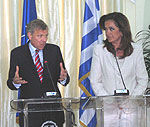
The political preparations for the November NATO Summit in Riga, Latvia, were the focus of a visit by NATO Secretary General Jaap de Hoop Scheffer to Athens on 7 July.
The visit is part of a round of trips that the Secretary General is making to all NATO member countries ahead of the Summit.
Mr. De Hoop Scheffer met with Prime Minister Konstantinos Karamanlis, Foreign Minister Theodora Bakoyannis and Defence Minister Evangelos Meimarakis.
The discussions focused on the key elements of the Riga agenda, including the transformation of NATO’s mission-critical capabilities, strengthening NATO’s partnerships, and the way ahead for the Alliance’s operations and missions in Afghanistan, Kosovo, Iraq and Darfur.
The Secretary General also took part in a conference on “NATO, European Security and Greece in the 21st century” at the Foreign Ministry.