
Close
Back


From now on you can download videos from our website
If you would also like to subscribe to the newsletter and receive our latest updates, click on the button below.
Enter the email address you registered with and we will send you a code to reset your password.
The password must be at least 12 characters long, no spaces, include upper/lowercase letters, numbers and symbols.
Click the button to return to the page you were on and log in with your new password.
19 June 2006
1 MIN READ
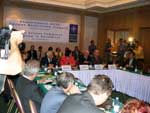
NATO’s Science Committee (SCOM) held its summer meeting in Almaty, Kazakhstan, on 19 June 2006. The meeting followed an invitation from the Kazakh government and kicked off a week of NATO-related events in the country.
NATO’s Science Committee (SCOM) held its summer meeting in Almaty, Kazakhstan, on 19 June 2006. The meeting followed an invitation from the Kazakh government and kicked off a week of NATO-related events in the country.
The meeting, chaired by NATO Assistant Secretary General for Public Diplomacy Jean Fournet, opened with welcome addresses from representatives of the Kazakh Academy of Sciences and the Ministry of Energy and National Resources.
Committee members explored ways for the NATO Programme for Security through Science (STS) to cooperate more effectively with Kazakhstan and its Central Asian neighbours. Among other measures, the Committee decided to establish expert groups on explosives detection and radiological issues.
Other issues discussed included plans for the next Security Science Forum, scheduled for mid-2007, and contacts with other international organisations.
NATO staff also reported on the status and direction of the Environment and Security Initiative (ENVSEC), a joint project combining the efforts of NATO, the Organization for Security and Co-operation in Europe, the United Nations Environment Programme, and the United Nations Development Programme. ENVSEC aims to use environmental cooperation as a confidence-building exercise in vulnerable regions by working with regional stakeholders to identify environmental issues that are a threat to stability and peace.