
Close
Back


From now on you can download videos from our website
If you would also like to subscribe to the newsletter and receive our latest updates, click on the button below.
Enter the email address you registered with and we will send you a code to reset your password.
The password must be at least 12 characters long, no spaces, include upper/lowercase letters, numbers and symbols.
Click the button to return to the page you were on and log in with your new password.
22 December 2005
1 MIN READ
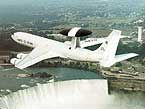
On 22 December 2005, Hungary formally joined 14 other NATO countries that contribute to and manage NATO’s fleet of NATO Airborne Early Warning and Control (AEW&C) radar aircraft, also known as AWACS.
On 22 December 2005, Hungary formally joined 14 other NATO countries that contribute to and manage NATO’s fleet of NATO Airborne Early Warning and Control (AEW&C) radar aircraft, also known as AWACS.
The ceremony marking Hungary’s accession to the NATO AEW&C Programme Management Organisation (NAPMO) was held in Budapest, with Hungarian Defence Minister Ferenc Juhász and NAPMO representative Brigadier General Berndt Glowacki as signatories.
NATO’s eyes in the sky
The AWACS aircraft are equipped with special radar capabilities, including detecting air traffic over large distances and at low altitudes. They can transmit data directly to command and control centers on the ground, sea or in the air.
The fleet has been used in peace-support operations in the Balkans, to guard the skies over the United States after September 11, and to protect major public events, such as the 2004 Olympic Games in Athens.
Pooling resources
The total cost of the programme, since its launch in 1978, amounts to approximately $6.5 billion USD. It is one of the Alliance’s largest multinational projects and an example of what NATO member countries achieve by pooling resources.
The Hungarian delegation, under the leadership of Major General László Tömböl, secured support and budgetary funding to join the NAPMO during its $1.6 billion USD Mid-term Modernisation Programme, and in December 2005, the NATO Council accepted the Secretary General’s proposal that Hungary be included in the list of participating nations.
Throughout 2006, personnel from the Hungarian Air Force will take up ground and flying positions at the Force Command HQ in Mons, Belgium, the fleet’s homebase at Geilenkirchen, Germany and with the Programme Management Agency at Brunssum, The Netherlands.