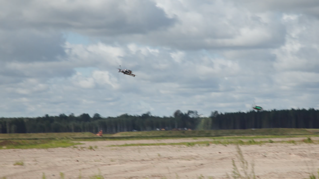
(00:00) VARIOUS SHOTS – DRONES FLYING DURING EXERCISE BALTIC TRUST 25
(00:17) VARIOUS SHOTS – COUNTER-DRONE JAMMING DEVICES ON DISPLAY DURING EXERCISE BALTIC TRUST 25
(01:08) VARIOUS SHOTS – GERMAN CG20+ MOBILE COUNTER-UAS ON DISPLAY DURING EXERCISE BALTIC TRUST 25
(01:24) VARIOUS SHOTS – UKRAINIAN FIBRE-OPTIC DRONE
(01:55) VARIOUS SHOTS – UKRAINIAN DRONE ON DISPLAY DURING EXERCISE BALTIC TRUST 25
(02:04) SLOW MOTION CLOSE SHOT – UKRAINIAN AND NATO FLAGS
(02:14) SOUNDBITE (ENGLISH) – CRISTIAN COMAN, SENIOR SCIENTIST, NATO COMMUNICATIONS AND INFORMATION AGENCY
“Drone technology and counter-drone technology is evolving extremely rapidly. You can say that, for example, the information we have from Ukraine is that maybe every two weeks new changes are identified in the battlefield, in the sense that the drones will start flying at different frequencies or there are different ways of flying those drones, different models of drones, and you can also see here the evolution of modularity that is required in the battlefield. This evolution, definitely we need to track it as close as possible and in our experience that in any exercise that we do, every time we do an exercise, we see a new set of drones is brought up. So the evolution is there and we see it and we need to be able to track it. “
(03:15) SOUNDBITE (ENGLISH) – CRISTIAN COMAN, SENIOR SCIENTIST, NATO COMMUNICATIONS AND INFORMATION AGENCY
“From a capability development perspective, we have recently realised that if we come with a massive order to the industry, industry does not have capability to produce this very quick. Now, so through the defence investment processes that we have in NATO, we are trying to make sure that the industry is ready, if the need is there, to provide the counter-UAS capabilities to defend our countries.”
(03:44) SOUNDBITE (ENGLISH) – CRISTIAN COMAN, SENIOR SCIENTIST, NATO COMMUNICATIONS AND INFORMATION AGENCY
“The first objective was to train military units on UAS and counter-UAS activities, including the full kill chain from the detection to engagement and various scenarios which are highly relevant at the tactical level, including trench warfare, and everything was done in this training range where we have great possibilities in terms of distances, possibilities to fly drones, and also the possibility to use engagement techniques as electronic warfare. The second objective here was more on the technical interoperability side, when we invited industry to partake into this exercise and demonstrate their capability. So basically what we have done, we have assembled very quick, in a matter of two days, two platoons with equipment provided from the industry.”
(04:44) SOUNDBITE (ENGLISH) – CRISTIAN COMAN, SENIOR SCIENTIST, NATO COMMUNICATIONS AND INFORMATION AGENCY
“In this war between drones and counter-drone technology, the drones will always have some advantages because they have the initiative, they can change quickly. The counter-drone technology, they will have to wait for that change to happen so then they can change as well.
So the evolution of the counter-drone technology is probably more costly than the evolution of the drone because you always have to catch up with these threats in a very short period of time.”