
Close
Back


From now on you can download videos from our website
If you would also like to subscribe to the newsletter and receive our latest updates, click on the button below.
Enter the email address you registered with and we will send you a code to reset your password.
The password must be at least 12 characters long, no spaces, include upper/lowercase letters, numbers and symbols.
Click the button to return to the page you were on and log in with your new password.
09 November 2023
1 MIN READ
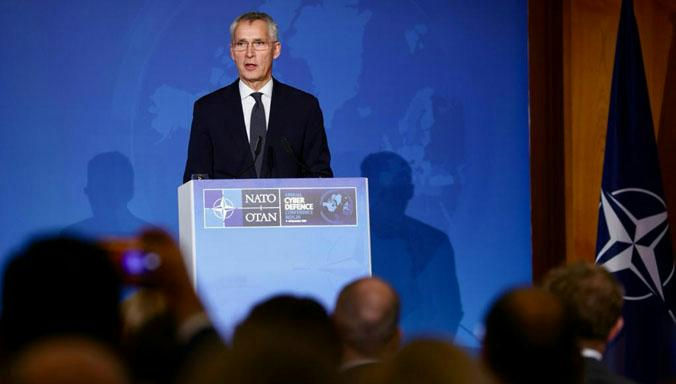
Secretary General Jens Stoltenberg addressed the first annual NATO Cyber Defence Conference in Berlin, Germany on Thursday (9 November 2023). He stressed the importance of bringing together senior Allied political, military and technical decision-makers: “NATO is perfectly positioned to share information, to spread innovation, and to coordinate our collective defence in cyberspace.”
The Secretary General emphasised that cyber is driving strategic competition and that authoritarian regimes, including China and Russia, are: “challenging our interests, our values and our security.” He said they are: “determined to shape the future of cyberspace in [their] own image with little transparency and no regard for human rights.” At the Vilnius Summit this year, Allies agreed to enhance NATO’s cyber defence politically, militarily, and technically. To “avoid relying on equipment supplied by authoritarian regimes to build our digital backbone for the future,” the Secretary General said NATO must collaborate with the private sector to build resilience. Mr Stoltenberg reiterated that “without industry, there is no defence, no deterrence and no security.” He thanked Germany for its leadership on cyber issues and for hosting the conference.
Cyber is part of NATO's core task of deterrence and defence and Russia’s war against Ukraine has highlighted the use of cyber in modern conflict. The Alliance works to protect its own networks, operates in cyberspace, helps Allies to enhance their resilience, and provides a platform for political consultation and collective action. NATO has a Cyberspace Operations Centre, as well as rapid reaction teams on standby to help Allies facing cyber threats.