
Close
Back


From now on you can download videos from our website
If you would also like to subscribe to the newsletter and receive our latest updates, click on the button below.
Enter the email address you registered with and we will send you a code to reset your password.
The password must be at least 12 characters long, no spaces, include upper/lowercase letters, numbers and symbols.
Click the button to return to the page you were on and log in with your new password.
FROM THIS GALLERY


A line up of US Army vehicles equipped with counter-drone systems prepare to engage in a counter-drone exercise. NATO and its Allies are boosting our defence against the threat posed by drones with various initiatives. Part of these efforts is Project Flytrap 4.5, a US-led initiative designed to test and evaluate off-the-shelf, scalable, cutting-edge counter-drone technologies, for possible fast procurement and future integration into Allied air defence systems. These tested systems can help Allies to detect and destroy drones at a lower cost and higher efficiency.
A US Army soldier participating to counter-drone technology tests poses for a portrait in front a US Army vehicle. NATO and its Allies are boosting our defence against the threat posed by drones with various initiatives. Part of these efforts is Project Flytrap 4.5, a US-led initiative designed to test and evaluate off-the-shelf, scalable, cutting-edge counter-drone technologies, for possible fast procurement and future integration into Allied air defence systems. These tested systems can help Allies to detect and destroy drones at a lower cost and higher efficiency.
A US Army soldier poses for the camera in front of a US Army vehicle participating in a counter-drone exercise. NATO and its Allies are boosting our defence against the threat posed by drones with various initiatives. Part of these efforts is Project Flytrap 4.5, a US-led initiative designed to test and evaluate off-the-shelf, scalable, cutting-edge counter-drone technologies, for possible fast procurement and future integration into Allied air defence systems. These tested systems can help Allies to detect and destroy drones at a lower cost and higher efficiency.
A US Army soldier smiles at the camera. NATO and its Allies are boosting our defence against the threat posed by drones with various initiatives. Part of these efforts is Project Flytrap 4.5, a US-led initiative designed to test and evaluate off-the-shelf, scalable, cutting-edge counter-drone technologies, for possible fast procurement and future integration into Allied air defence systems. These tested systems can help Allies to detect and destroy drones at a lower cost and higher efficiency.
Allied soldiers and industry representatives engage in a discussion on counter-drone technology. NATO and its Allies are boosting our defence against the threat posed by drones with various initiatives. Part of these efforts is Project Flytrap 4.5, a US-led initiative designed to test and evaluate off-the-shelf, scalable, cutting-edge counter-drone technologies, for possible fast procurement and future integration into Allied air defence systems. These tested systems can help Allies to detect and destroy drones at a lower cost and higher efficiency.
A German Army officer and a US Army officer engage in discussion in front of a US Army vehicle equipped with C-UAS (Counter-Unmanned Aerial Systems). NATO and its Allies are boosting our defence against the threat posed by drones with various initiatives. Part of these efforts is Project Flytrap 4.5, a US-led initiative designed to test and evaluate off-the-shelf, scalable, cutting-edge counter-drone technologies, for possible fast procurement and future integration into Allied air defence systems. These tested systems can help Allies to detect and destroy drones at a lower cost and higher efficiency.
A US Army vehicle equipped with counter-drone technology engages in a counter-drone exercise. NATO and its Allies are boosting our defence against the threat posed by drones with various initiatives. Part of these efforts is Project Flytrap 4.5, a US-led initiative designed to test and evaluate off-the-shelf, scalable, cutting-edge counter-drone technologies, for possible fast procurement and future integration into Allied air defence systems. These tested systems can help Allies to detect and destroy drones at a lower cost and higher efficiency.
US Army soldiers discuss the innovative technology behind a Humvee-mounted C-UAS (Counter-Uncrewed Aerial Systems). NATO and its Allies are boosting our defence against the threat posed by drones with various initiatives. Part of these efforts is Project Flytrap 4.5, a US-led initiative designed to test and evaluate off-the-shelf, scalable, cutting-edge counter-drone technologies, for possible fast procurement and future integration into Allied air defence systems. These tested systems can help Allies to detect and destroy drones at a lower cost and higher efficiency.
US Army soldiers reload the machine gun on a Humvee-mounted C-UAS (Counter-Unmanned Aerial Systems). NATO and its Allies are boosting our defence against the threat posed by drones with various initiatives. Part of these efforts is Project Flytrap 4.5, a US-led initiative designed to test and evaluate off-the-shelf, scalable, cutting-edge counter-drone technologies, for possible fast procurement and future integration into Allied air defence systems. These tested systems can help Allies to detect and destroy drones at a lower cost and higher efficiency.
US soldiers stand nearby a US Army vehicle equipped with counter-drone technology as a small drone flies above the training ground as part of counter-drone tests. NATO and its Allies are boosting our defence against the threat posed by drones with various initiatives. Part of these efforts is Project Flytrap 4.5, a US-led initiative designed to test and evaluate off-the-shelf, scalable, cutting-edge counter-drone technologies, for possible fast procurement and future integration into Allied air defence systems. These tested systems can help Allies to detect and destroy drones at a lower cost and higher efficiency.
US Army vehicles equipped with counter-drone systems engage in a counter-drone exercise. NATO and its Allies are boosting our defence against the threat posed by drones with various initiatives. Part of these efforts is Project Flytrap 4.5, a US-led initiative designed to test and evaluate off-the-shelf, scalable, cutting-edge counter-drone technologies, for possible fast procurement and future integration into Allied air defence systems. These tested systems can help Allies to detect and destroy drones at a lower cost and higher efficiency.
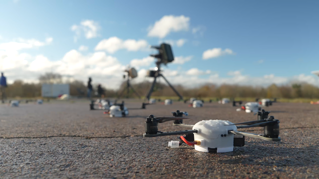
A drone swarm positioned and ready to participate in a counter-drone exercise. NATO and its Allies are boosting our defence against the threat posed by drones with various initiatives. Part of these efforts is Project Flytrap 4.5, a US-led initiative designed to test and evaluate off-the-shelf, scalable, cutting-edge counter-drone technologies, for possible fast procurement and future integration into Allied air defence systems. These tested systems can help Allies to detect and destroy drones at a lower cost and higher efficiency.
A drone swarm rests on the ground ready to take off as part of a counter-drone exercise. NATO and its Allies are boosting our defence against the threat posed by drones with various initiatives. Part of these efforts is Project Flytrap 4.5, a US-led initiative designed to test and evaluate off-the-shelf, scalable, cutting-edge counter-drone technologies, for possible fast procurement and future integration into Allied air defence systems. These tested systems can help Allies to detect and destroy drones at a lower cost and higher efficiency.