Close
Back


From now on you can download videos from our website
If you would also like to subscribe to the newsletter and receive our latest updates, click on the button below.
Enter the email address you registered with and we will send you a code to reset your password.
The password must be at least 12 characters long, no spaces, include upper/lowercase letters, numbers and symbols.
Click the button to return to the page you were on and log in with your new password.
Updated: 29 June 2026
The Comprehensive Assistance Package (CAP) for Ukraine is the overarching framework through which NATO provides non-lethal support to Ukraine. It covers two main areas of work: urgently needed, practical military assistance based on Ukraine’s requests for support, and longer-term capacity-building projects designed to assist Ukraine with its reforms in the defence and security sector and post-war recovery.
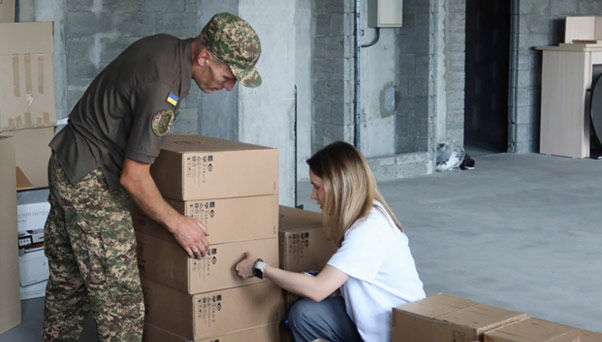
The NATO Representation to Ukraine donates computer equipment to the National Guard of Ukraine as part of the non-lethal support delivered through NATO’s Comprehensive Assistance Package.
Since February 2022, NATO has developed a wide range of projects providing short-term, non-lethal military assistance to meet Ukraine’s immediate needs in its defence against Russia’s war of aggression.
These short-term support projects have covered multiple areas, for example:
The Alliance continues to develop new short-term support projects in a variety of areas, in close coordination with Ukrainian authorities based on Ukraine’s most urgent needs.
Russia first launched its war of aggression in eastern Ukraine and illegally annexed Crimea in 2014. Since then, Ukraine has been forced to defend against military action in the Donbas and hybrid attacks across the country.
In this context, NATO launched the CAP in 2016 as a key mechanism to help Ukraine transform its security and defence sector. This has included strategic-level advice via the NATO Representation to Ukraine as well as NATO Headquarters in Belgium, and practical support through a range of capacity-building programmes and initiatives.
In the years before Russia’s full-scale invasion in 2022, these reforms helped strengthen Ukraine’s ability to defend itself. Through CAP initiatives, NATO Allies helped Ukraine strengthen its defence capabilities in many areas, including cyber defence, logistics, explosive ordnance disposal, military training and education, and countering hybrid threats like critical infrastructure sabotage and disinformation campaigns. All of this increased Ukraine’s capacity to fight back against Russia’s aggression when it launched its full-scale invasion in February 2022.
At the 2023 Vilnius Summit, Allies agreed to further develop the CAP into a multi-year programme of assistance for Ukraine, based on sustained and predictable funding. Longer-term support is organised through three principal lines of effort: recovery and reconstruction, institutional transformation, and transition towards NATO interoperability.
Specific activities under these lines of effort include:
More information on a number of these activities can be found below.
In September 2023, Ukraine and NATO jointly agreed a concept for interoperability, whereby Ukrainian defence planners would incorporate interoperability requirements into their Long-Term Capability Development Plans for their defence and security sector.
In November 2023, as part of the Interoperability Roadmap, NATO defence planners advised Ukrainian officials on the requirements for NATO interoperability, and assisted Ukraine in the development of a set of initial Interoperability Requirements, which were presented at the 2024 Washington Summit. Throughout this effort, NATO has ensured that the interoperability work is coherent with other non-NATO support efforts, such as those undertaken by the Ukraine Defense Contact Group, the European Union and the G7 group, and is synchronised with Ukraine’s wider reform priorities and the support provided by the Alliance through NATO Security Assistance and Training for Ukraine (NSATU).
The NATO-Ukraine Joint Analysis, Training and Education Centre (JATEC) is the first joint NATO-Ukraine organisation and an important pillar of NATO-Ukraine relations. At the Centre, Ukrainian and NATO personnel work hand-in-hand to identify and apply lessons learned from Russia’s war against Ukraine, and embed these lessons into NATO and Ukrainian strategies, policies and operations. This helps strengthen Ukraine’s armed forces and build interoperability with NATO.
In February 2024, Defence Ministers from NATO and Ukraine agreed to create the JATEC. At the Washington Summit in July 2024, NATO Leaders further endorsed its establishment as a civil-military centre with NATO Military Headquarters status. In February 2025, the JATEC officially opened in Bydgoszcz, Poland.
Together with Ukraine, NATO has successfully conducted a joint Strategic Defence Procurement Review to bring Ukraine’s defence procurement in line with Euro-Atlantic best practices. The objective is to help Ukraine improve its defence procurement system and promote greater effectiveness, accountability and transparency. The high-level strategic policy recommendations were endorsed at the 2024 Washington Summit. Recommendations were translated into a work programme for further NATO support on ongoing reforms and capacity-building in the defence procurement area. Allies and the NATO Support and Procurement Agency (NSPA) will play a central role in providing this support to Ukraine.
The Human Centric Framework (HCF) is one of the key components of the CAP, reflecting NATO's holistic approach to security by focusing on human capital as a core element of security and defence capabilities. The HCF is built on the principle of continuum of care and covers areas such as medical evacuation, psychological and medical rehabilitation, human resource management within the defence forces, veterans’ reintegration, and Women, Peace and Security (WPS) as a cross-cutting issue within the defence and security sector.
The current focus of the HCF is Renovator – a project to establish a network of five medical rehabilitation centres across Ukraine, one of which will act as a Medical Rehabilitation Centre of Excellence. Other HCF projects have included:
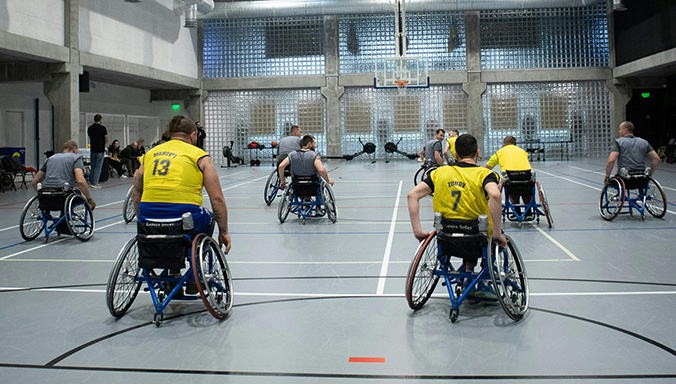
Athletes from the Ukrainian National Team play basketball in the lead-up to the 2025 Invictus Games in Vancouver and Whistler, Canada.
The Defence Education Enhancement Programme (DEEP) is a multi-year programme focused on developing and reforming professional military education institutions. Ukraine has participated in DEEP since 2013. The primary objective of Ukraine’s participation has been to support interoperability through the replacement of the former Soviet education and training system by a system in accordance with NATO standards.
The NATO Building Integrity (BI) Programme is a multi-year programme that supports countries in strengthening good governance, transparency and accountability in their defence and security institutions. Ukraine has participated in the BI Programme since 2007. NATO BI activities assist the Ukrainian defence and related security sector by reinforcing the culture of integrity and providing tailored support to enhance sustainable long-term good governance and corruption prevention reforms.
The Ukraine CAP Trust Fund, to which Allies and partners provide both financial and in-kind contributions, is a significant source of funding for the CAP. As of October 2026, Allies and partners have contributed over EUR 1.4 billion (approximately USD 1.6 billion) to the Ukraine CAP Trust Fund.
Following Russia’s illegal annexation of Crimea in 2014, several Trust Funds were launched to assist Ukraine, providing resources to support capability development and sustainable capacity-building in key areas. In 2021, NATO consolidated and transitioned all pre-existing Trust Funds supporting Ukraine into a single Ukraine CAP Trust Fund.
The Ukraine CAP Trust Fund enables resourcing for Ukraine-related activities within a single dedicated instrument – a flexible and scalable fund to provide Ukraine with urgently needed non-lethal military assistance (sustainment) as well as long-term capacity-building support. It supports more than 70 short-term and long-term projects.
Policy and implementation oversight of the CAP is conducted through the NATO-Ukraine Council (NUC) – the joint body where Allies and Ukraine sit as equal participants to advance political dialogue, engagement, cooperation and Ukraine’s aspirations for membership in NATO. Under the NUC’s Defence and Security Sector Committee, NATO and Ukraine work together to identify and prioritise the key areas for NATO support to Ukraine’s defence and security sector under the CAP.
The NATO-Ukraine CAP Joint Management Board supports the implementation of the CAP. The Board works under the joint guidance of NATO’s Assistant Secretary General for Operations and Ukraine’s Deputy Prime Minister for European and Euro-Atlantic Integration. It consists of representatives from NATO and several Ukrainian government agencies and institutions. They work together to identify the Ukrainian assistance requirements, as well as to consider priorities and agree on the potential provision and facilitation of NATO support to Ukraine.
NATO’s cooperation with Ukraine began in the early 1990s. Over the decades, it has covered a wide range of activities – from building Ukraine's capabilities and interoperability with NATO forces, to promoting reforms in Ukraine's defence and related security sector, to supporting non-military activities like collaborative scientific research and public diplomacy. Ukraine has been a close NATO partner for more than 30 years. In 2008, NATO Allies agreed that Ukraine will become a member of NATO.
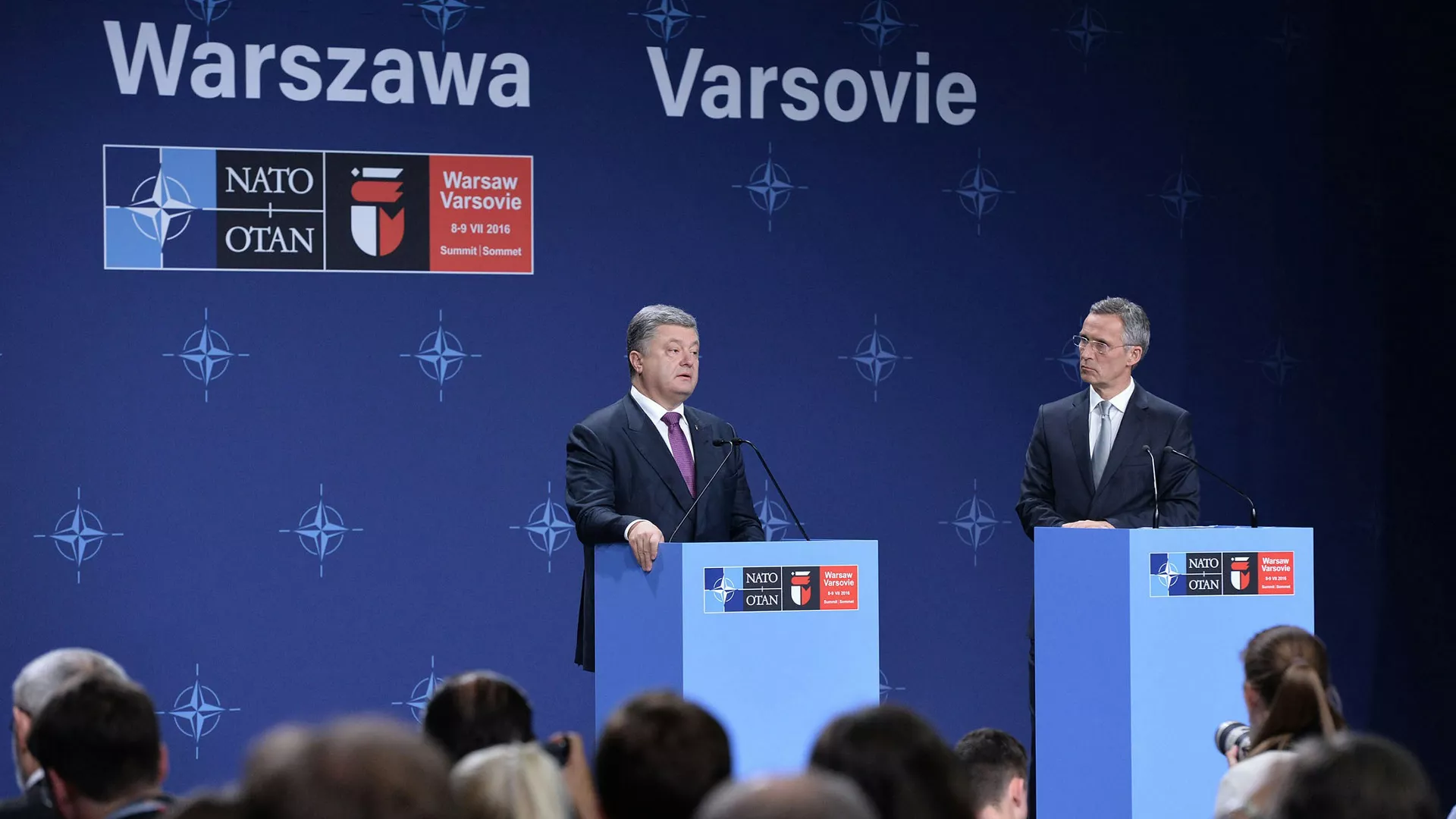
Following Russia’s illegal annexation of Crimea in 2014, NATO-Ukraine cooperation was intensified in critical areas. At the 2016 Warsaw Summit, Allied Leaders agreed to consolidate NATO’s support to Ukraine into a single Comprehensive Assistance Package (CAP), designed to support Ukraine's ability to provide for its own security and to implement wide-ranging reforms based on NATO standards, principles and best practices.
Under the CAP, NATO has helped Ukraine transform its security and defence sector for many years. Through capacity-building programmes and tailored support, NATO has significantly strengthened the capacity and resilience of Ukraine's security and defence sector, as well as its ability to counter hybrid threats. NATO and Allies have also provided extensive support to capability development, including through training and education and the provision of equipment.
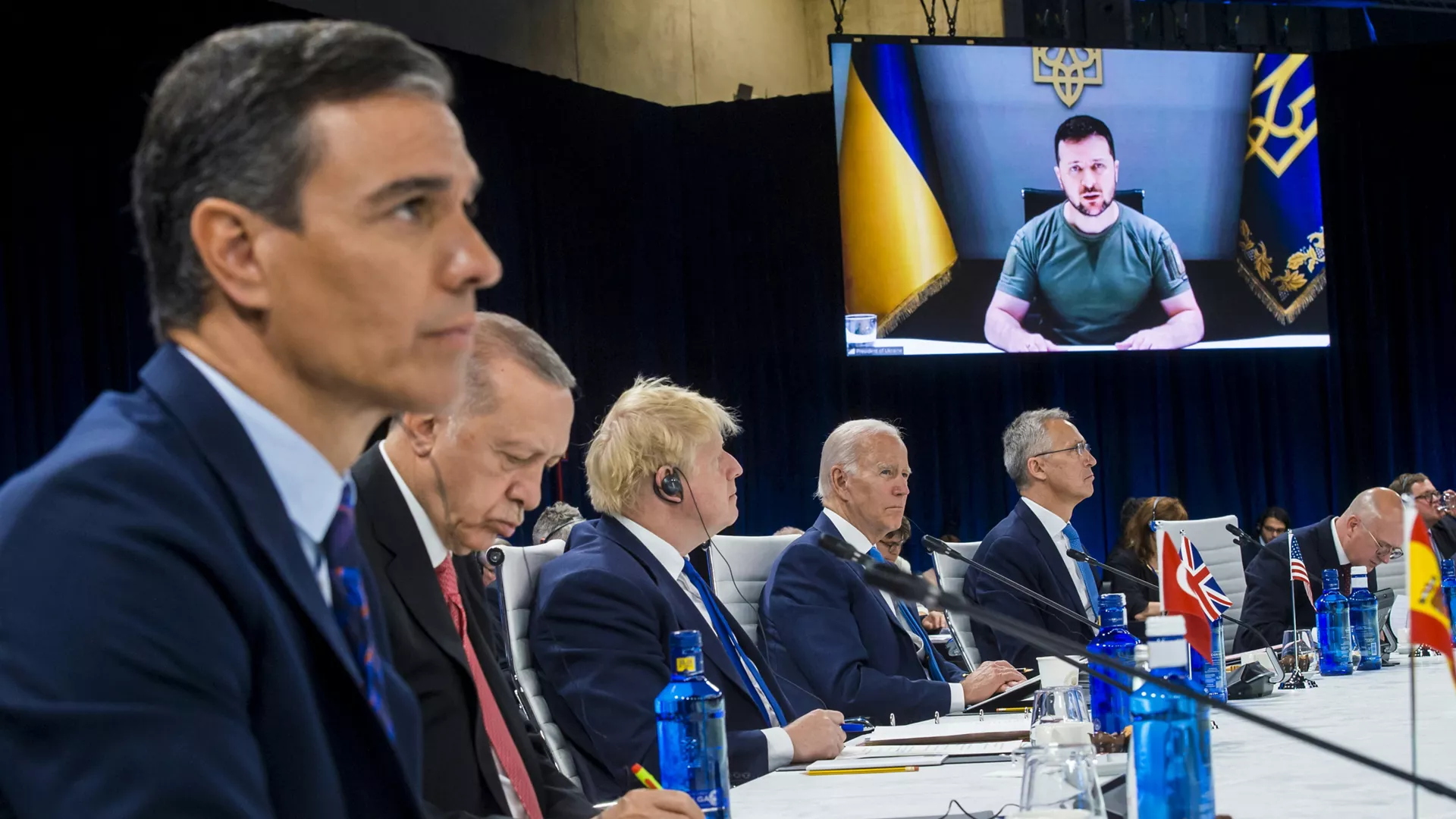
Following Russia’s full-scale invasion of Ukraine in February 2022, Allies agreed at the 2022 Madrid Summit to step up political and practical support to Ukraine, including a strengthened CAP.
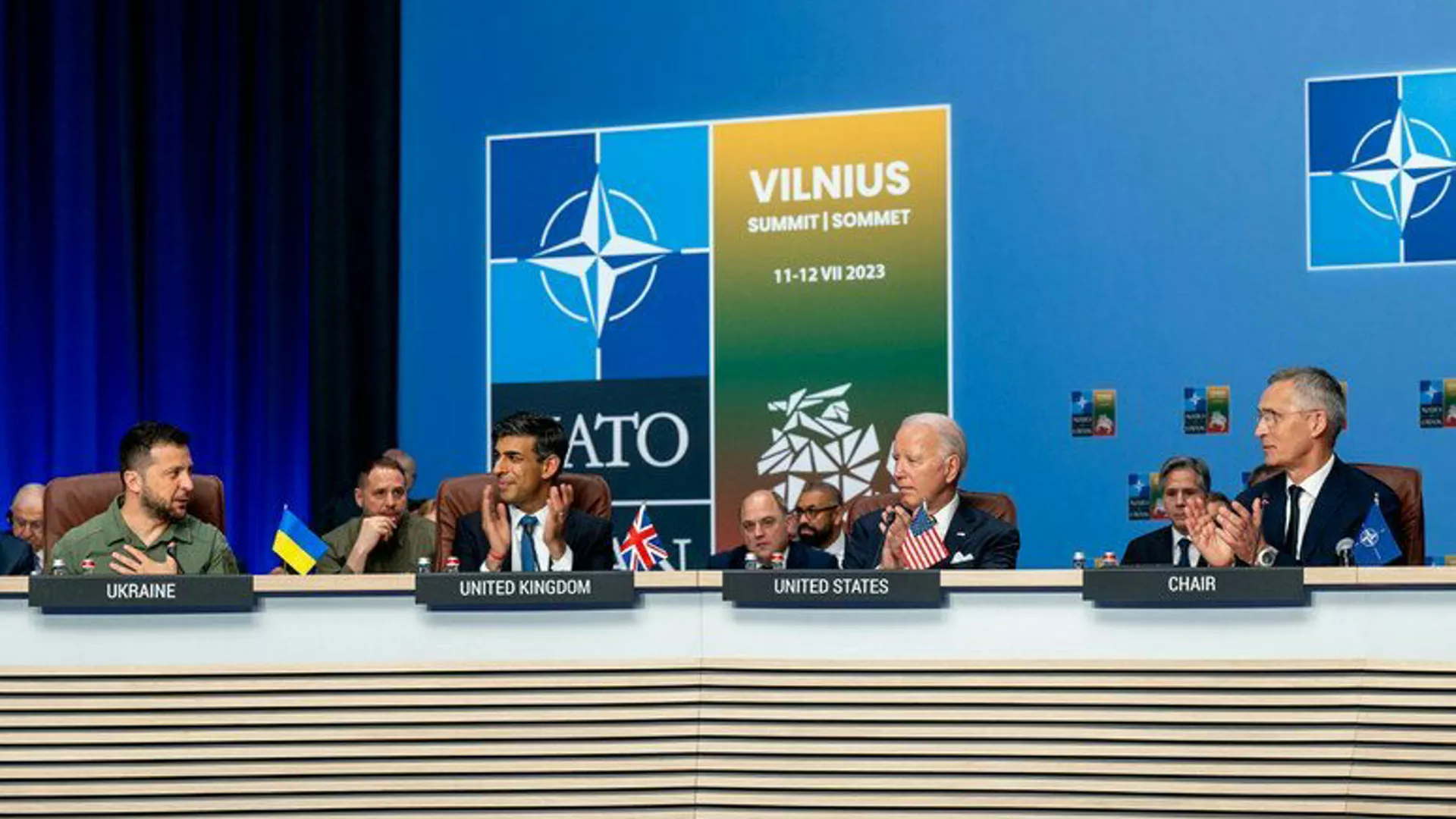
At the 2023 Vilnius Summit, Allies agreed to further develop the CAP into a multi-year programme of assistance for Ukraine, based on sustained and predictable funding.
At the 2024 Washington Summit, NATO further consolidated Allied support to Ukraine through CAP deliverables in the areas of procurement, interoperability and lessons learned from Russia’s war.
NATO continues to develop projects under the CAP to meet Ukraine’s immediate needs and to support long-term reforms.
Ukraine’s independence
On 24 August 1991, the Act of Declaration of Independence of Ukraine is adopted. Ukraine re-establishes its independence from the Soviet Union.
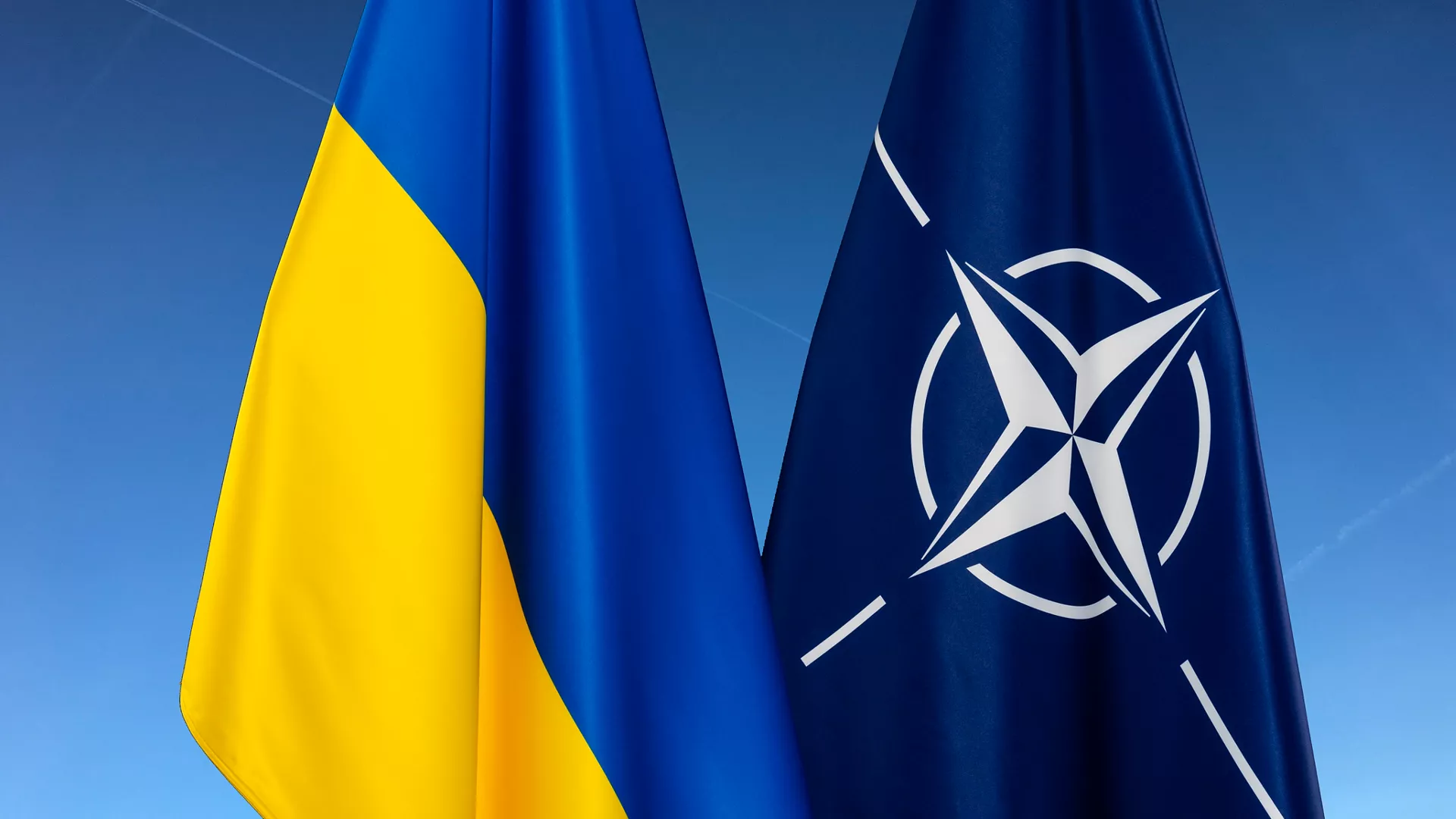
Ukraine joins the North Atlantic Cooperation Council
Newly independent Ukraine establishes formal relations with NATO, joining the North Atlantic Cooperation Council (NACC) in December 1991. A forum for dialogue and cooperation, the NACC brings together NATO Allies and their former Warsaw Pact adversaries in Central and Eastern Europe, including Ukraine and Russia. It is succeeded by the Euro-Atlantic Partnership Council (EAPC) in May 1997.
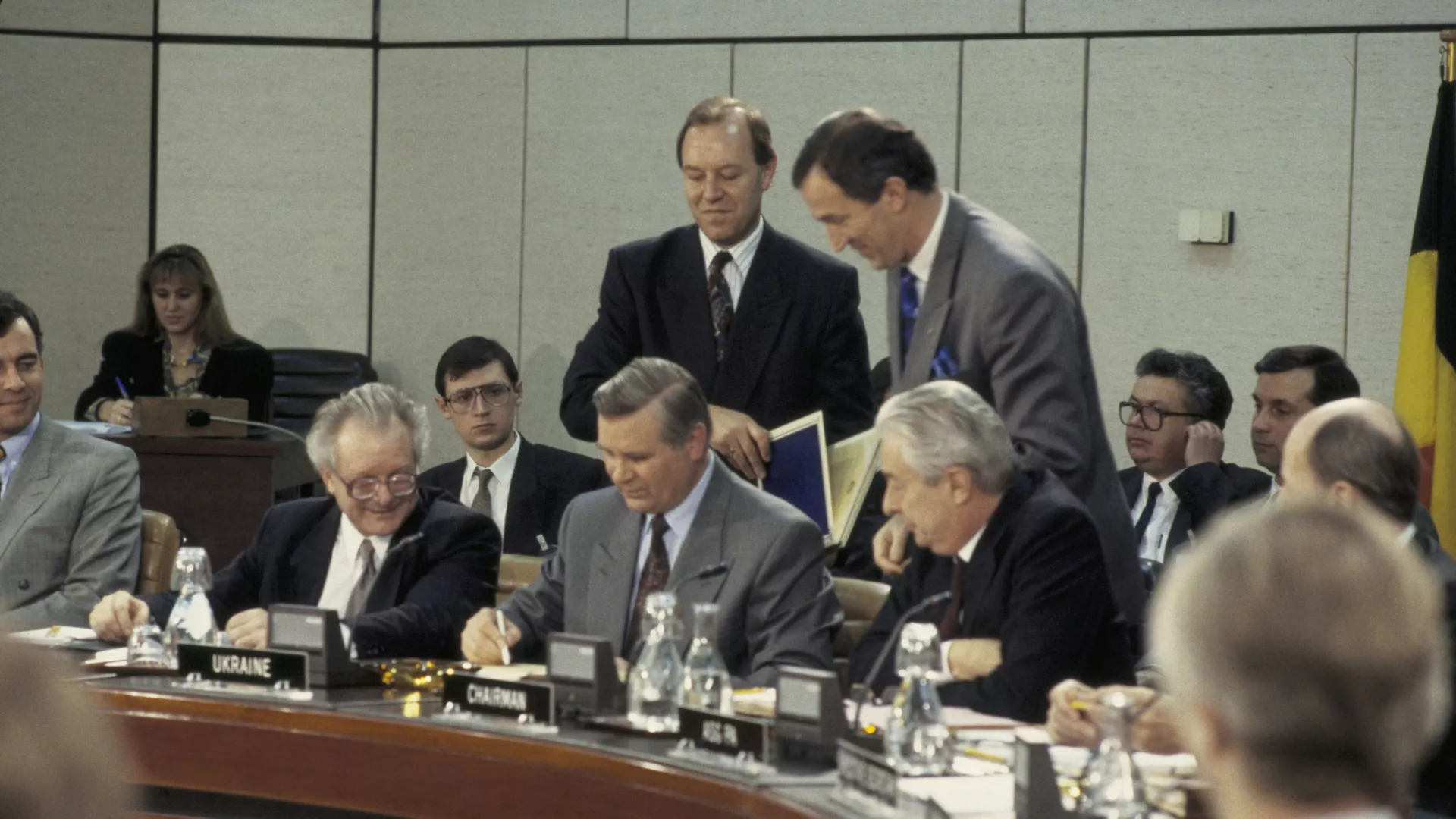
Ukraine joins the Partnership for Peace (PfP) programme
Ukraine expands its practical cooperation with NATO by joining the Partnership for Peace (PfP) programme in 1994. The PfP is a programme of bilateral cooperation between individual Euro-Atlantic partner countries and NATO. It allows partners to build up an individual relationship with NATO, choosing their own priorities for cooperation.
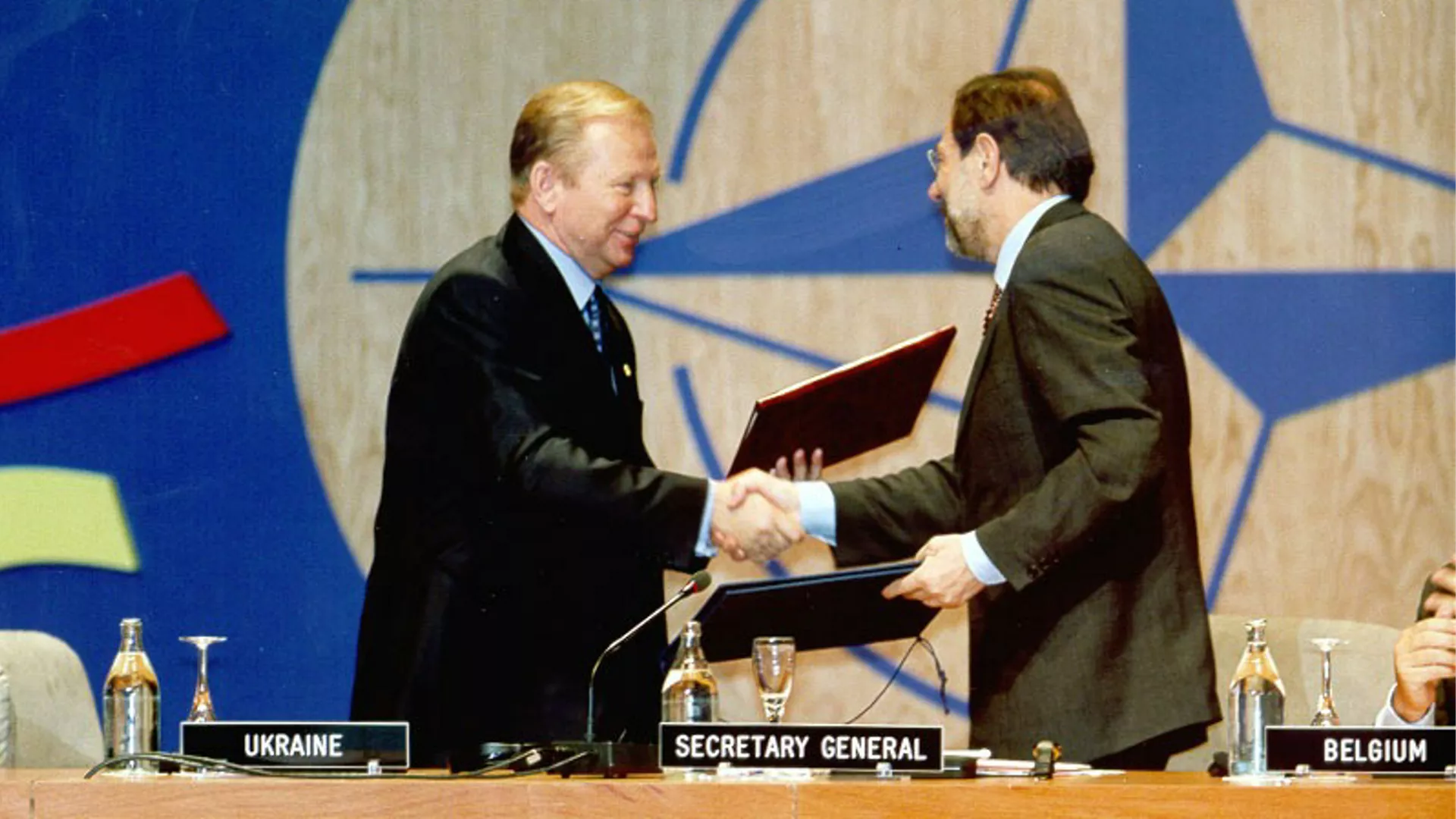
NATO and Ukraine sign the Charter on a Distinctive Partnership
The Alliance and Ukraine sign the Charter on a Distinctive Partnership, which remains the basic foundation underpinning NATO-Ukraine relations. Their mutual goal is to strengthen ties and increase cooperation across a range of areas, including political, military, civil emergency and environmental activities.
Establishment of the NATO-Ukraine Commission
The Charter establishes the NATO-Ukraine Commission as the main body responsible for advancing NATO-Ukraine relations. From 1997-2023 (when it is replaced by the NATO-Ukraine Council), the Commission directs cooperative activities and provided a forum for consultation between the Allies and Ukraine on security issues of common concern (including extraordinary meetings following Russia’s illegal annexation of Crimea in 2014, its use of military force against Ukrainian ships near the Kerch Strait in 2018, its military build-up in 2021 and its full-scale invasion in 2022).
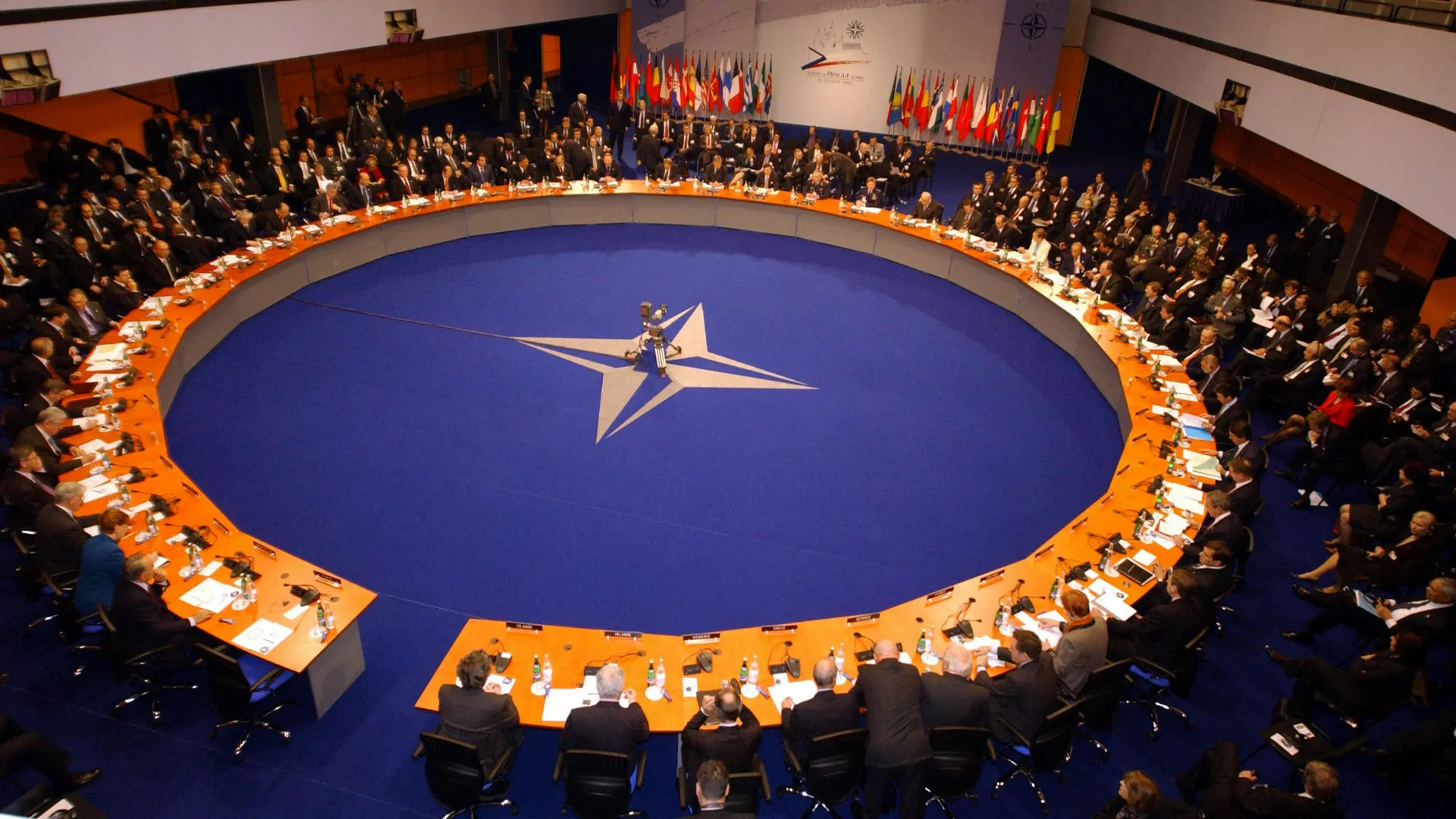
At the NATO-Ukraine Commission meeting in Iceland in May 2002, Foreign Ministers underline their desire to take the NATO-Ukraine relationship to a new level. This leads to the development of a NATO-Ukraine Action Plan, adopted at the NATO-Ukraine Commission meeting of Foreign Ministers in November 2002 during the 2002 Prague Summit in Czechia.
Bucharest Summit – NATO Allies agree that Ukraine will become a NATO member
At the 2008 Bucharest Summit, Allies welcome Ukraine’s Euro-Atlantic aspirations for membership and agree that Ukraine will become a member of NATO. To that end, Allies support Ukraine’s application to the Membership Action Plan (MAP) – NATO’s programme of political, economic, defence, resource, security and legal reforms for aspirant countries.
:16x9?fmt=webp-alpha&qlt=80)
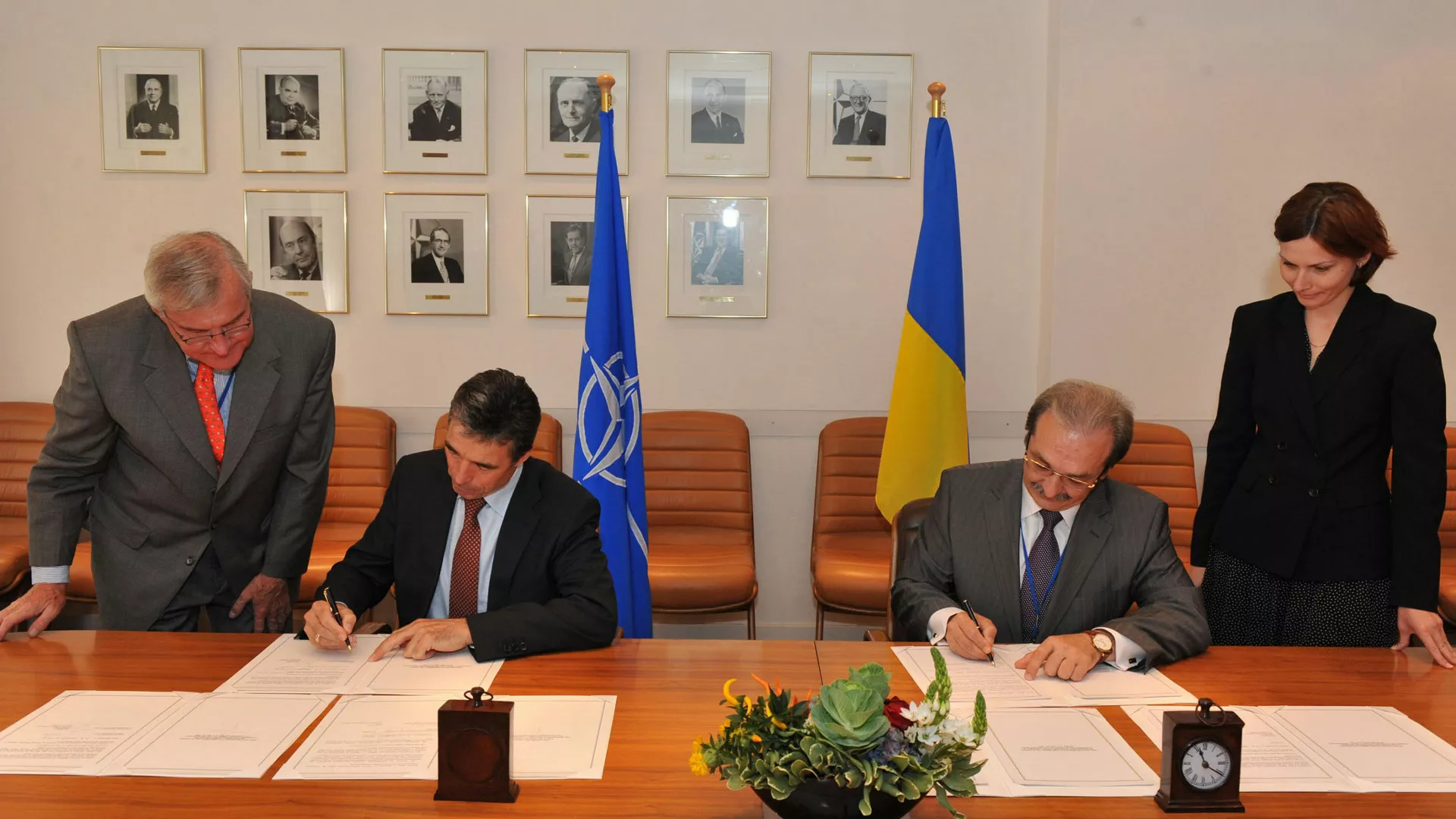
NATO and Ukraine enhance the 1997 Charter on a Distinctive Partnership by signing the 2009 Declaration to Complement the Charter. Following up on the decisions taken at the 2008 Bucharest Summit, the 2009 Declaration gives the NATO-Ukraine Commission a key role in strengthening Ukraine's reform efforts, which have been central to its aspirations for membership in NATO.
Russia illegally annexes Crimea and begins its aggression in eastern Ukraine
Between February and March 2014, Russia invades the Crimean Peninsula, part of Ukraine, before illegally annexing it. NATO strongly condemns Russia’s illegal and illegitimate annexation of Crimea.
%20(Anton%20Holoborodko):16x9?fmt=webp-alpha&qlt=80)
Warsaw Summit – NATO establishes the Comprehensive Assistance Package (CAP) to provide Ukraine with practical non-lethal support
The CAP consolidates and enhances NATO’s support to Ukraine, including by tailored capability development and capacity-building measures for the security and defence sector, which contribute to enhancing Ukraine’s resilience against a wide array of threats.
The Warsaw Summit Communiqué, paragraph 118, 9 July 2016.
24 February 2022 – Russia launches its full-scale invasion of Ukraine
On 24 February 2022, Russia launches its full-scale invasion of Ukraine. Allies immediately condemn Russia’s invasion of Ukraine in the strongest possible terms, calling on Russia to cease its attack and withdraw its forces from Ukraine.
Statement by the North Atlantic Council on Russia's attack on Ukraine, 24 February 2022.
Madrid Summit – NATO and Ukraine strengthen the Comprehensive Assistance Package (CAP) for Ukraine
NATO and Ukraine jointly agree to strengthen the CAP. This includes accelerating the delivery of non-lethal defence equipment, improving Ukraine’s cyber defences and resilience, and supporting activities to modernise its defence and security sector, speeding up its transition to long-term interoperability with NATO.
The Madrid Summit Declaration, paragraph 8, 29 June 2022.
The NATO-Ukraine Council replaces the NATO-Ukraine Commission
The NATO-Ukraine Commission guided relations and practical cooperation since 1997. In 2023, the Commission is replaced by the NATO-Ukraine Council, where Allies and Ukraine sit as equals. This change demonstrates the strengthening of political ties and Ukraine’s increasing integration with NATO. The Council can be convened by the Secretary General as well as by its individual participants, including Ukraine, for crisis consultations. The inaugural meeting of the NATO-Ukraine Council took place at the Vilnius Summit on 12 July 2023.
Vilnius Summit – NATO develops the Comprehensive Assistance Package (CAP) for Ukraine into a multi-year programme of assistance
To support Ukraine’s deterrence and defence in the short, medium and long term, NATO Allies agree to further develop the CAP into a multi-year programme of assistance for Ukraine. The assistance provided will help rebuild the Ukrainian security and defence sector and transition Ukraine towards full interoperability with NATO.
The Vilnius Summit Communiqué, paragraph 13, 11 July 2023.
Washington Summit – Allies endorse long-term CAP projects
NATO Allies endorse long-term CAP projects for recovery and reconstruction, institutional transformation, and transition towards NATO interoperability. These include:
The Washington Summit Declaration, 10 July 2024.
Establishment of NATO Security Assistance and Training for Ukraine (NSATU)
In December 2024, Allies establish NSATU, a NATO command that coordinates the provision of military equipment and training to Ukraine by NATO member and partner countries. NSATU places security assistance to Ukraine on an enduring footing, ensuring enhanced, predictable and coherent support for the long term. It brings together much of the security support being provided by the international community to Ukraine under one overarching framework, improving coordination, accountability and burden-sharing among Allies. NSATU HQ is based in Wiesbaden, Germany, with logistical hubs in the eastern part of the Alliance.
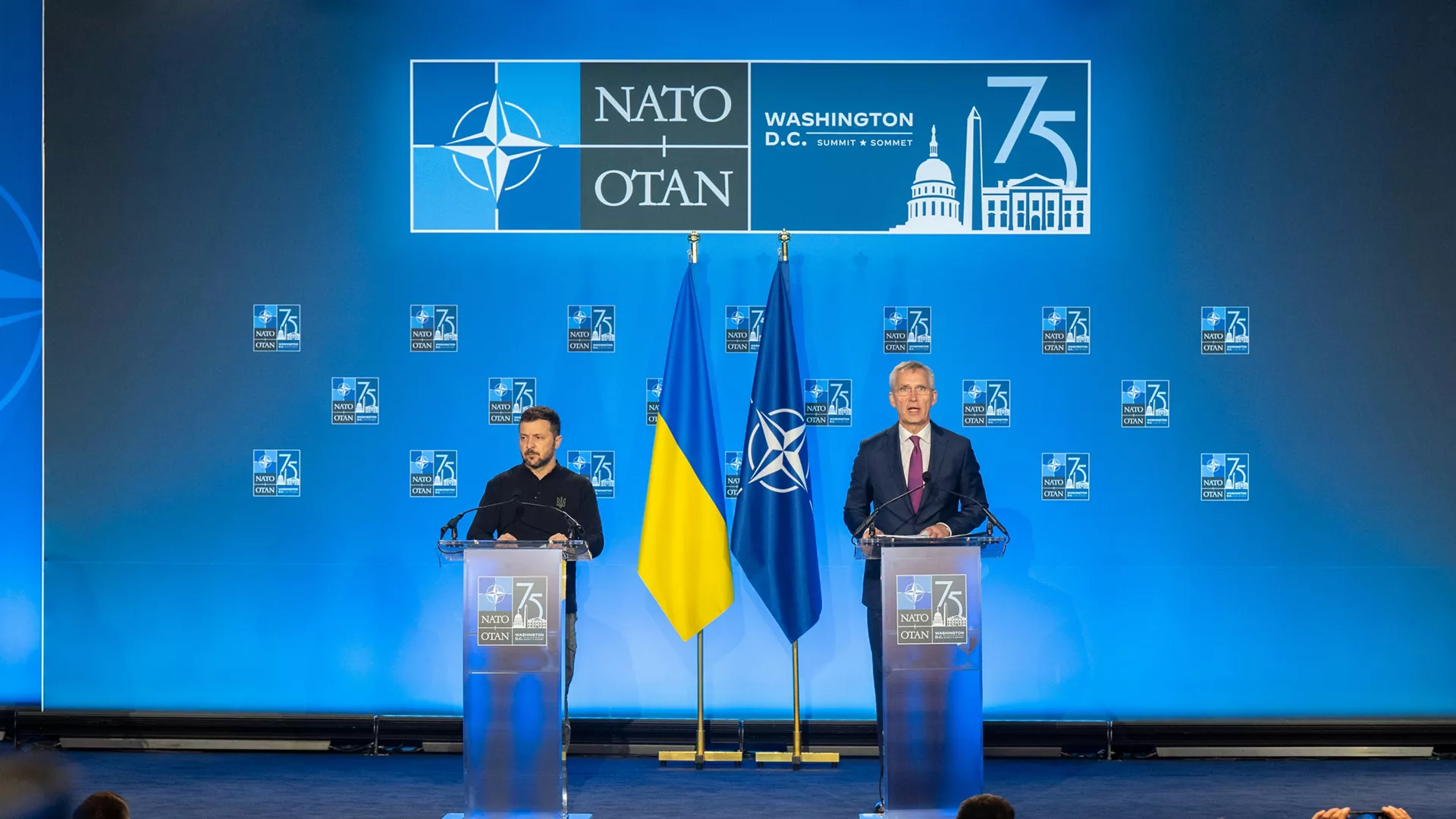
Opening of the NATO-Ukraine Joint Analysis, Training and Education Centre (JATEC) in February 2025
NATO and Ukraine establish the NATO-Ukraine Joint Analysis, Training and Education Centre (JATEC) in Bydgoszcz, Poland, to identify and apply lessons learned from Russia’s war against Ukraine and increase interoperability. The Centre is established under the CAP framework and is now a joint civil-military centre subordinate to Allied Command Transformation (ACT) as decided by Allies at the 2024 Washington Summit.
Launch of the Prioritised Ukraine Requirements List (PURL) in July 2025
NATO and the United States launch PURL – a mechanism that allows NATO Allies and partners to contribute funds for military equipment and munitions, sourced from the United States and identified by Ukraine as operational priorities. PURL aims to ensure a steady flow of critical US equipment to Ukraine, including life-saving air defence.
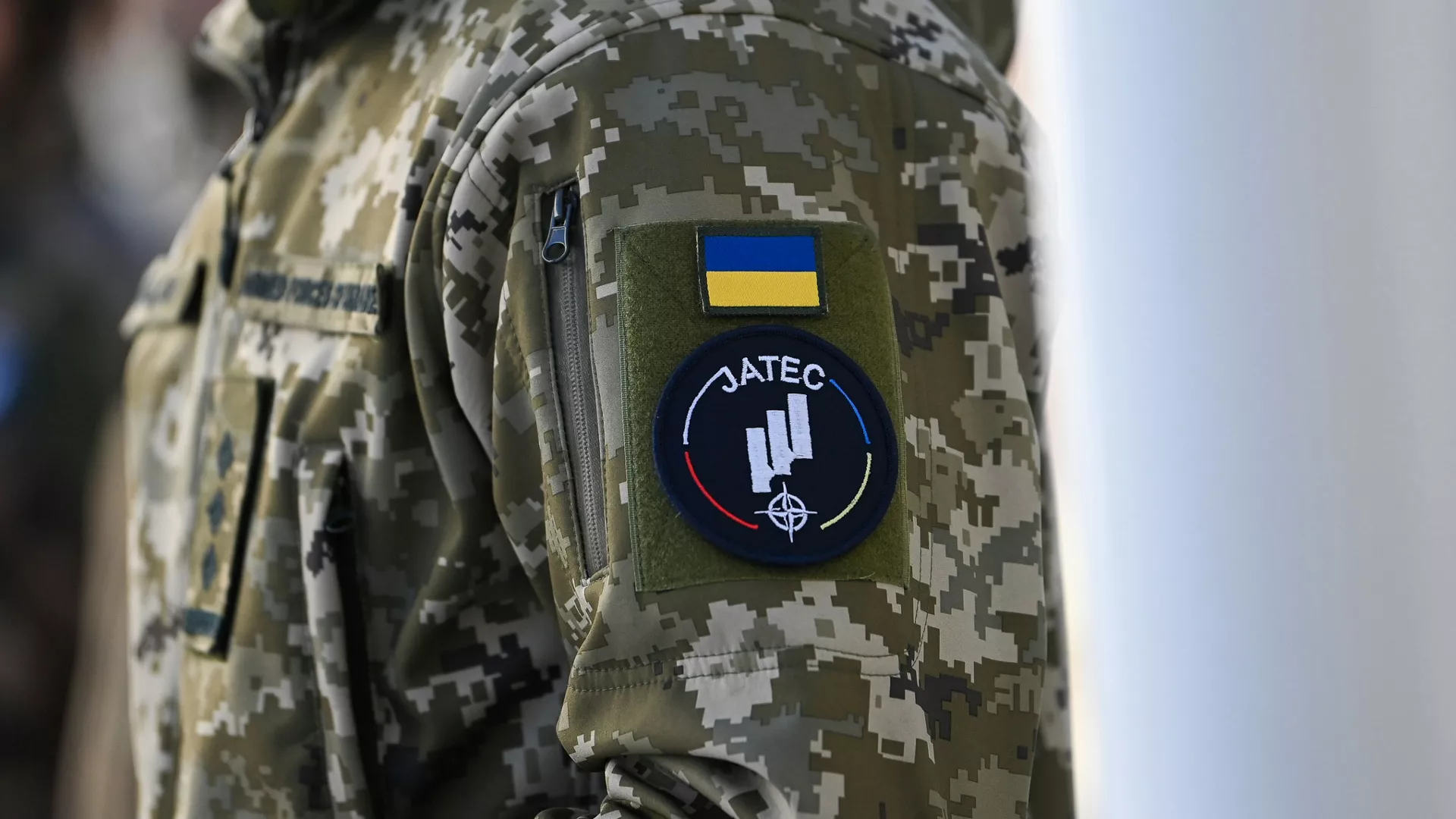
Historic meeting of the NATO-Ukraine Council in Kyiv – the first NUC to take place in Ukraine
On 3 June 2026, NATO Secretary General Mark Rutte, Chair of the NATO Military Committee Admiral Giuseppe Cavo Dragone and the Ambassadors of the North Atlantic Council gather in Kyiv. Ukrainian President Volodymyr Zelenskyy joins for a historic meeting of the NATO-Ukraine Council (NUC) – the first NUC to take place in Ukraine since it was established in 2023. The meeting sends a strong message, showing the enduring bond between NATO and Ukraine, and Allies’ unwavering commitment to Ukraine. The Ukrainian President, the NATO Secretary General, the Chair of the Military Committee and the Ambassadors also pay their respect to Ukraine’s fallen defenders at a ceremony.
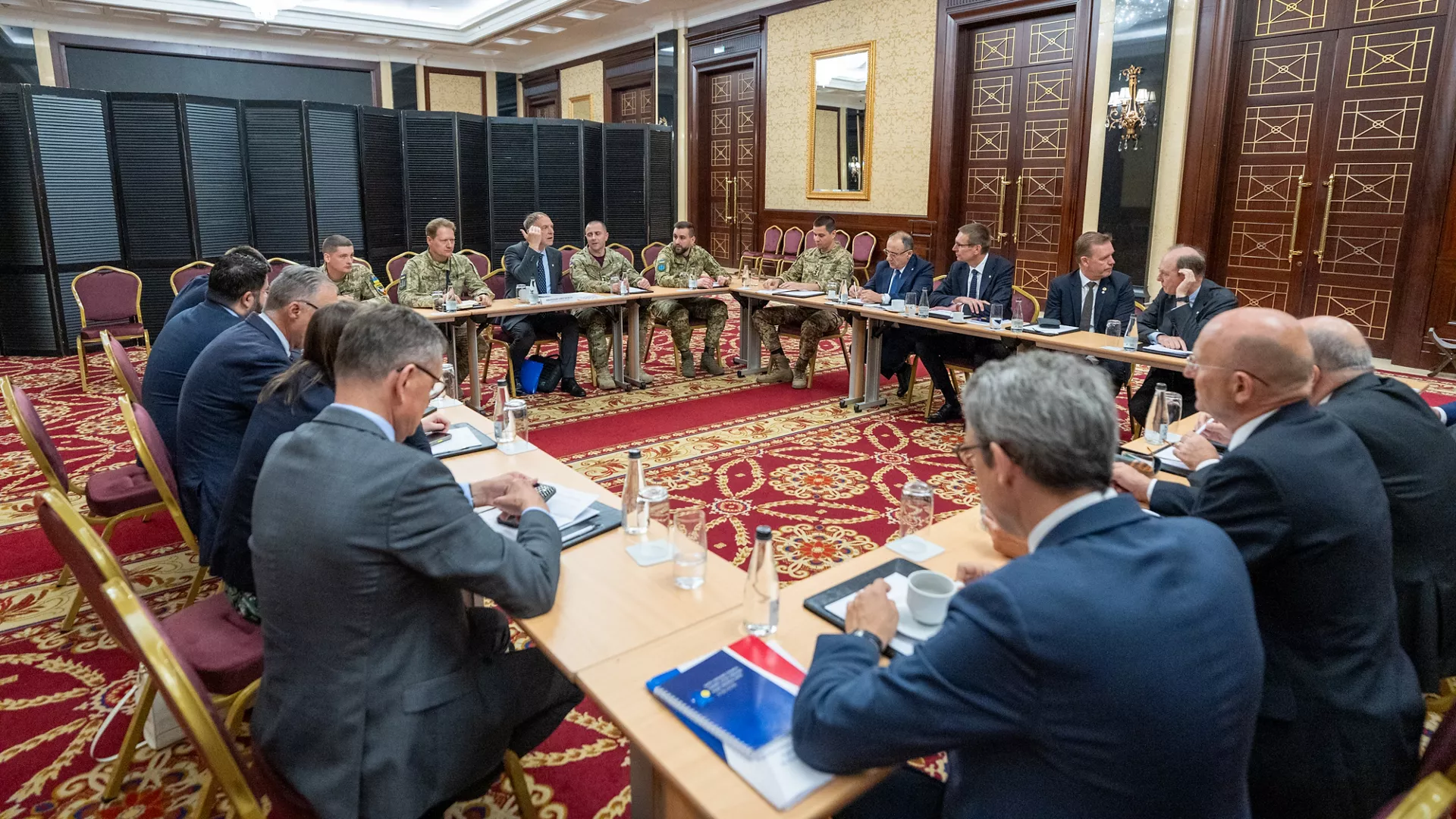
In addition to the CAP, NATO and Allies have supported Ukraine through many other means.
For example, following Russia’s invasion in February 2022, the Euro-Atlantic Disaster Response Coordination Centre (EADRCC) – NATO’s principal civil emergency response mechanism – coordinated assistance to Ukraine’s civilian population, as well as to neighbouring countries hosting millions of Ukrainian refugees. The EADRCC arranged training in emergency medicine for some 200 Ukrainian paramedics, with funding donated by NATO Allies. Ambulance busses and hospital equipment worth more than EUR 5 million were also provided to Ukrainian hospitals through this NATO mechanism. Allies also used the EADRCC to channel in-kind medical support to Ukraine, including ventilators and disinfectant. Finally, the Centre supported Allies’ response to the humanitarian, environmental and economic consequences of Russia’s destruction of the Nova Kakhovka dam in June 2023. Allies provided Ukraine with critical aid, including water filters, pumps, generators and shelters.
Other key initiatives include NATO Security Assistance and Training for Ukraine (NSATU), a Pledge of Long-Term Security Assistance, and a wide range of bilateral security commitments between individual NATO Allies and Ukraine.
Learn more: Relations with Ukraine

23 October 2026
29 September 2026
15 September 2026
13 July 2026
8 July 2026