Close
Back


From now on you can download videos from our website
If you would also like to subscribe to the newsletter and receive our latest updates, click on the button below.
Enter the email address you registered with and we will send you a code to reset your password.
The password must be at least 12 characters long, no spaces, include upper/lowercase letters, numbers and symbols.
Click the button to return to the page you were on and log in with your new password.
Prime Minister Ruginienė,
Dear Inga,
I want to welcome you again to NATO Headquarters; it is great to have you here.
Since 2004, Lithuania has been a valued member of NATO, making important contributions to our shared security.
Lithuania serves as a role model for NATO Allies. You just approved your state budget for 2026, aiming for a record-high 5.38% of GDP on defence spending, already exceeding The Hague Defence Investment Plan.
Lithuania is also one of the top supporters of Ukraine. When measured against GDP, you are the third largest contributor of aid to Ukraine worldwide.
Lithuania is also a welcoming host for many important NATO installations. Our NATO Air Policing has a home at the Šiauliai Air Base. Lithuania permanently hosts a German armoured brigade as part of the NATO Forward Land Forces. And you foster expertise on energy security through the NATO Centre of Excellence in Vilnius.
Lithuania clearly understands that freedom and security demand serious investment. Lithuanians remember suffering under Russian occupation. And know what it means to live with an aggressive Russia as a neighbour.
Prime Minister, I know your own experiences reflect those of your country. Your grandmother lived in Ukraine; your grandfather was deported to Siberia. You spent your childhood holidays in Eastern Ukraine, in a city now destroyed by the Russian full-scale invasion.
Lithuania is shaping its future and leading the way on defence investment, working closely with Allies to ensure our shared readiness, and consistently supporting Ukraine.
As Lithuania continues to play its part, NATO does too. Through our Forward Land Forces, led by Germany. Through Baltic Sentry, helping to protect undersea infrastructure. And through Eastern Sentry, ensuring robust deterrence and defence along the whole of our eastern flank. And most recently through the deployment of a NATO Counter-Hybrid Support Team to support you in dealing with challenges posed by smuggling balloons from Belarus – impacting the security of air traffic along your border and also in your capital.
NATO makes Lithuania safer. And Lithuania makes NATO stronger.
So I want to thank you for your personal leadership. And I look forward to working with you, to keep our deterrence and defence strong and address any challenges we might face.
Again, Inga, thank you so much. Over to you.
NATO Spokesperson Allison Hart
We now have time for a few questions. Let's start with DPA.
Ansgar Haase, DPA
Ansgar Haase, the German Press Agency DPA. Secretary General, I would like to ask what you make of the fact that Hungary, a NATO Ally, is currently blocking an important loan to Ukraine, and also new sanctions against Russia. Have you already spoken to Viktor Orbán on this issue? And if not, do you see a possibility for you to mediate in this conflict? And for sure, Prime Minister, I would also like to hear your view on this issue. Thank you.
NATO Secretary General Mark Rutte
Well, let me start by saying that Hungary has been a valued NATO Ally for more than 25 years now. And it makes really important contributions to our shared security. So that's the first remark I want to make. And then, as you know, when there are discussions ongoing between Allies, always my role is not to comment, but to try to be helpful wherever I can. And what that is, I cannot tell you till it has been successful.
NATO Spokesperson Allison Hart
Okay, let's come to the Lithuanian public broadcaster in the third row, please.
Milda Vilikanskytė, LRT
Thank you. Lithuanian public broadcaster, Milda Vilikanskytė. I would love to speak in Lithuanian, but unfortunately, I will ask in English. I have two questions. One is for both of you, about air defence, it is still an issue in Lithuania, in other also Baltic countries. Are there any plans to strengthen this area in the near future? Or maybe you mentioned Mr. Secretary, air police missions, maybe there can be changes in that way on some level. And the next question for Mr. Mark Rutte about United States troops and presence in Europe. Many countries have their concerns. Lithuania as well, our Prime Minister speaks about the necessity to have a plan B if United States would decide to withdraw its troops from Europe. Would you say that such Plan B is necessary for Europe? And maybe you have any newest information about United States plans? Thank you.
NATO Secretary General Mark Rutte
Thank you so much. On the first question on air defence, obviously, this is an issue which we are working day in, day out on this issue. And when you look at the capability targets for our Allies, it's clear that this is an absolute priority. I've spoken a lot about this, that we need to basically ramp up by 400%, so five times what we have currently in terms of air defence. And that will, of course, take some time, but I can assure you, we will get there. And we can defend ourselves today, but we want to be sure that also in 2, 4, 6 years from now, we are able to defend every inch of NATO territory. And therefore, this is such a priority. And air policing, of course, is very important. We have the air policing missions ongoing. We are constantly evaluating with all the Allies where we can do more, where we can do better. At the same time, you understand this is not something I can talk about in public, but you can be assured that we are constantly — and primarily of course, our military leaders, the Allied Commander and Joint Force Commands are constantly looking into how we can make sure, together with AIRCOM, that we do the max here. But clearly, we need more investments on this. We have taken those decisions. This is why The Hague was so important.
And this brings me to the second question, because there is no doubt that the United States is completely committed to NATO, completely committed to Article Five. Not only because there is an historical reason for the US to be involved in the defence of Europe, but because the United States very much feels, understands, and realises that for the defence of the United States, it's crucial to have a safe and secure Europe, a safe and secure Arctic, and a safe and secure Atlantic.
And you have heard the speech of Bridge Colby, the senior policy Undersecretary of State for Defense at the Pentagon, at the Department of War in Washington, speaking here during the Defence Ministers meeting. He published his text. This was absolutely clear, appreciating the immense hundreds of billions extra coming in Europe now in terms of defence spending. And Lithuania is a case in point, leading the pack now with the almost 5.4% of GDP spent on core defence. But many other countries, the Germans doubling their defence spending in ‘29 compared to ’21, over 150 billion euros each year spent on defence. This is what the US wanted. This is why the US was irritated with Europe, because we were not spending the same as they were spending. We are now equalising, not only to equalise with the US because that's fair, but also because we have to defend ourselves against our adversaries, particularly of course, our long-term threat: the Russians. This is why we are doing this.
So, I would really encourage Europeans to stop worrying about United States and do as much as they can in implementing, like Lithuania is doing. And luckily, most Allies are doing that as we speak, implementing the commitments we made in The Hague. Because that makes us strong, and it anchors the United States even more into NATO. And that's why I said in Munich, I believe NATO is stronger now than ever since the fall of the Berlin Wall. Because we now are back on our core mission, which is defending, NATO 3.0 as Bridge Colby said, our territory, NATO territory, the NATO Allies, but also making sure that there is the money, the men and women in uniform, the defence industrial base, the enablers, everything in place, the logistics, to do that.
NATO Spokesperson Allison Hart
All right, we have time for one last question. Reuters, please.
Andrew Gray, Reuters
Andrew Gray from Reuters. Secretary General, you mentioned the Arctic. Could you just give us an update on Arctic Sentry in terms of, you know, what elements, what forces, what extra resources have been added since you announced the launch of Arctic Sentry? And what kind of a difference, if any, it's actually making? And perhaps you'd like to respond to criticism that this is, in a sense, a rebadging exercise, to placate President Trump given his desire to acquire Greenland. And for the Prime Minister also on Arctic Sentry. Do you have any concerns that activities like that divert away or place a strain on resources intended for the Baltic such as Baltic Sentry? And would you also consider contributing more to Arctic Sentry? Thank you.
NATO Secretary General Mark Rutte
Again, as I said before, this is substantial, Arctic Sentry. And of course, NATO has to defend every inch of NATO, 360 degrees. And I think what President Trump did, this wake-up call to the whole of NATO since Trump 45, but repeating this under Trump 47 since he came back in the US presidency in January last year, and making that case that the Russians and the Chinese are more and more active in the Arctic. This is not only Greenland. This is the whole Arctic. This is why NATO is so important. And by the way, when I say NATO is stronger than ever, it is also because it is more and more a NATO which is European-led. And also, when it comes to Arctic Sentry, you see that the Europeans are doing more and more necessary — not only for Baltic Sentry, Eastern Sentry, and the whole of NATO, but also when it comes to Arctic Sentry.
A couple of facts. Arctic Sentry is led, as you know, by Joint Force Command Norfolk. It’s our newest Joint Force Command. And since December, the area of responsibility of Norfolk now encompasses the North Atlantic, including the Arctic. That means also Denmark. It also means Finland and Sweden. We are taking as NATO a ‘one Arctic approach.’ This is one of the of the big benefits of Arctic Sentry that we now have a one Arctic approach, where Allies synchronise activities, enhance and expand regular presence throughout the region. So, it is bringing together what you already have, and adding on top, based on a gap assessment, what we need to do more. And this is why Arctic Sentry is not only leveraging what we have, but also making sure that we do more, based on that gap analysis in terms of the investments we have to make. Increasing therefore and also modernising our capabilities, and therefore basically enhancing our collective security of the entire Alliance.
When you look at the Allies participating, we have the United States, the US Marines. We have the Royal Marines from the United Kingdom. We have the Dutch and other nations for Exercise Cold Response in Norway. We see the Spanish, the French and the German forces. They participate through the Standing NATO Maritime Group One, conducting air defence and maritime security drills as part of Exercise Dynamic Mariner. And these and other activities are complemented by NATO's ongoing air policing efforts in Iceland, as well as the Danish Joint Arctic command in Greenland.
Of course, I will never go into specific numbers, because we don't want to make the Russians or anyone more knowledgeable of what we are doing. But I can assure you, it is bringing together what we have. Therefore, as a one NATO approach, approaching now the Arctic as one — which was not possible because in the past, it was scattered among many NATO Allies, but not a one NATO approach. That's one. And based on this, we can do now the proper gap analysis. And based on that, see where we need to do more.
So, I would really counter the idea that it's just what we did already. It is much, much more.


NATO Secretary General Mark Rutte meets with the Prime Minister of Lithuania, Inga Ruginienė
NATO Secretary General Mark Rutte meets with the Prime Minister of Lithuania, Inga Ruginienė
NATO Secretary General Mark Rutte meets with the Prime Minister of Lithuania, Inga Ruginienė
NATO Secretary General Mark Rutte meets with the Prime Minister of Lithuania, Inga Ruginienė
NATO Secretary General Mark Rutte meets with the Prime Minister of Lithuania, Inga Ruginienė
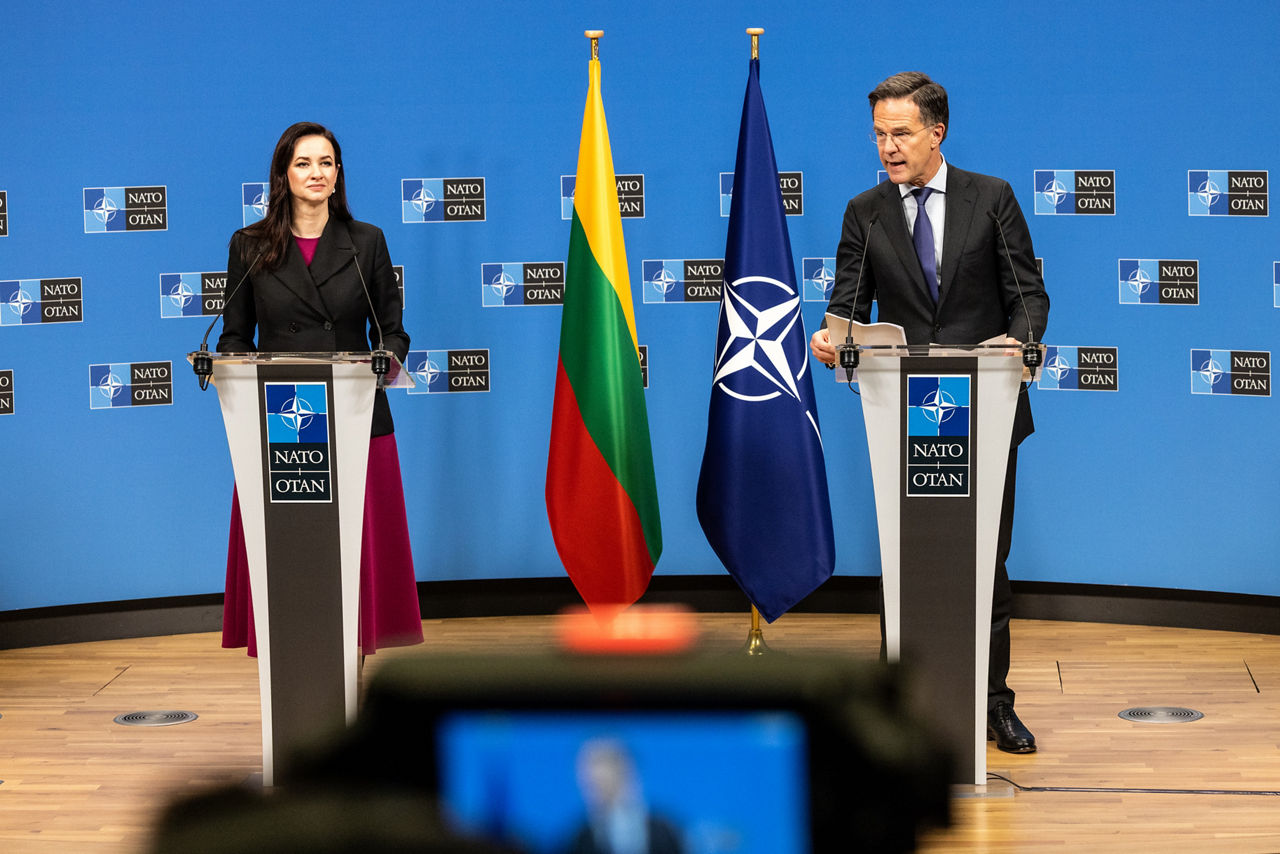
Joint press conference with NATO Secretary General Mark Rutte and the Prime Minister of Lithuania, Inga Ruginienė
Joint press conference with NATO Secretary General Mark Rutte and the Prime Minister of Lithuania, Inga Ruginienė
Joint press conference with NATO Secretary General Mark Rutte and the Prime Minister of Lithuania, Inga Ruginienė
Joint press conference with NATO Secretary General Mark Rutte and the Prime Minister of Lithuania, Inga Ruginienė
NATO Secretary General Mark Rutte with the Prime Minister of Lithuania, Inga Ruginienė
NATO Secretary General Mark Rutte with the Prime Minister of Lithuania, Inga Ruginienė
NATO Secretary General Mark Rutte with the Prime Minister of Lithuania, Inga Ruginienė
NATO Secretary General meets the Prime Minister of Lithuania
26 February 2026