Close
Back


From now on you can download videos from our website
If you would also like to subscribe to the newsletter and receive our latest updates, click on the button below.
Enter the email address you registered with and we will send you a code to reset your password.
The password must be at least 12 characters long, no spaces, include upper/lowercase letters, numbers and symbols.
Click the button to return to the page you were on and log in with your new password.
Thank you. Thank you so much, both of you, to have me back here in European Parliament. Madam Chair, Mr Chair, Marie-Agnes and David, it's great to see you both again, but also to see all of you again.
NATO and the EU are really unique partners. And regular meetings, I strongly believe that regular meetings like we have today are an opportunity to update each other, to discuss the issues of shared interests we have, but also how we can do even more together. Just a couple of introductory remarks - I don't think I will use the full 15 minutes so that we have maximum time for debate - but just a few remarks on starting with Ukraine.
As we all know, we are now coming up to the fourth tragic anniversary of the start of Russia's all out war on Ukraine, and this is now, I would argue, the harshest winter for Ukrainians in over a decade. It is now minus 20 in Kyiv, and people are living there with all the attacks on the civilian infrastructure and innocent civilians, of course the fight on the front line, but also these attacks on the big cities. The Russians really heavily targeting this infrastructure, civilian infrastructure, and therefore leaving Ukrainians, literally in the freezing cold, it's without heat, without light, without water.
Meanwhile, the US-led peace talks are ongoing. President Trump and his team - Jared Kushner, Steve Witkoff, Marco Rubio – they are working hard to end the bloodshed, and this is done with the support of Europeans. The Coalition of the Willing, led by the UK and France, is driving efforts, as you know, to provide robust security guarantees, including forces to Ukraine after a peace deal with Russia. And as you know, Europe, Canada, and the US have affirmed their readiness to provide these guarantees. And they are important to make sure that Putin, after a potential peace deal or a long-term cease fire - and let's pray we have it as soon as possible - that he will never, ever try again to attack Ukraine. Because then he would know, because of the security guarantees, that he has no chance. And of course, there are also important talks going on, as you know, on how to support Ukraine's future prosperity. And here it is the EU who is playing a critical role and a very positive role and I want to thank the European Commission for everything they are doing, the President and the relevant Commissioners, to get that part of the done together with US and others.
In the meantime, as these discussions to secure a long and lasting peace continue, so does NATO's military support, including through the PURL initiative. As we speak, billions of dollars worth of essential American military hardware is flowing into Ukraine, paid for by Allies and partners, and it is absolutely vital, this flow of stuff going into Ukraine to keep Ukraine in the fight and to protect its population. There is simply no alternative. For 2026 Ukraine has forecast military requirements from donors totalling just over $60 billion and PURL also - this flow of American stuff into Ukraine - is one way for Allies to meet these requirements. Others include, as you know, the bilateral support, the multilateral initiatives, like the Czech ammunition initiative, which is very important, and of course, the investments countries are making in the Ukrainian defence industrial base. This was an initiative originally started by the Danes and Lithuanians, which is now mainstreamed with many countries in Europe.
The EU is doing vital work here. The 90-billion-euro loan package, 90 billion which will make a massive difference to Ukraine's security. It will make a massive difference to Ukraine's prosperity. But here, I would really strongly urge you to ensure flexibility in how these funds can be spent, and not to be overly restrictive by EU caveats. Europe is now building its defence industry, and that is vital, but it cannot, at the moment, provide nearly enough of what Ukraine needs to defend itself today and to deter tomorrow. So, as you take this loan forward, please, I encourage you to keep Ukraine's needs first in focus.
So, I could imagine, of course, if they can buy it in Europe, fantastic - priority one. Ukraine defence industry base, great. But we all know that without this flow of weaponry from the US, we cannot keep Ukraine in the fight. Literally not. They now provide essential interceptors, for example, to take down as many missiles as possible going into Kyiv, Kharkiv and other cities, night by night. NATO and the EU are now working hand in hand, both in Brussels and in Kyiv to help Ukraine. Our coordination of military aid, the training of the Ukrainian armed forces, the efforts, of course, to boost the Ukrainian defence industry, they are all very much complementary, and we need to keep it up. It matters for Ukraine’s security and I think we all know it is also our security which is at stake here.
Then, second topic, investing in defence. We had a successful Summit in The Hague in June, where we agreed to invest five per cent of GDP annually in defence by 2035 and to speed up the production and the innovation of our defence production. Five per cent, of course, is a lot, and boosting our industrial base is not easy. But here my simple message is, we need to do it, and we need to do it fast. First, because the security situation demands it. We face, as we speak, real and lasting challenges to our security.
And second because the time when we conveniently let the United States carry much of the burden for our shared security is simply over. It's fair and appropriate that Europe and Canada take more responsibility for their own security, and the good news is they do. Ensuring Allies step up and speed up efforts on defence will, for me, for NATO be our absolute priority as we prepare for the next Summit which will be in Ankara in July. And here a more capable European defence is crucial but it is vital that the EU’s efforts on defence are compatible with NATO, they complement what we already do, and what we already have.
At NATO, we are tried and tested when it comes to standards, structures, procedures, and the contributions and capabilities of NATO's non-EU Allies are indispensable for our collective defence. So, my argument will be, let's be practical, let's be realistic when it comes to our security. We need to leverage our respective strength, NATO-EU even more, use the common pot of money, the single set of forces and the vast amount of industrial and innovation power we have across the Alliance. That's the only way to keep Europe safe.
And that brings me to my final point which is partnerships. Because it is undeniable that as we speak, we know that Russia, China, North Korea and Iran, they are aligning more and more. And they are challenging us, but their partnership is not yet well developed. And at NATO and the EU, we are miles ahead of Iran, China, North Korea and Russia. We are really miles ahead. Our nations know well what cooperation means and what it can achieve. This is true of NATO, it is true of the EU, it is also true of our work with partners across the world, close by in the Western Balkans and on the southern flank and further away in the Indo-Pacific, with Korea - South Korea, with Japan, Australia, New Zealand. So, I think it is really in our shared interest at NATO and the EU to build on these partnerships, learn from one another and truly make our shared security a joint endeavour.
And one final word on this, when I had my first lunch with Ursula von der Leyen in October ‘24 after I came in as new Secretary General of NATO, we basically said it is simple. NATO is good at standards, NATO is good at capability targets, NATO is strong when it comes to command and control. The EU has its strength in the internal market, and therefore in building the defence industrial base. The EU is great when it comes to bringing together the money needed, the EU is great in resilience, but the EU is also great when it comes to regulation - and here we need particularly deregulation - I know you are working on it.
So, my plea is, let's really focus on that division of labour so that collectively we can be as strong as possible and you know that 23 countries in the EU are also in NATO, and that represents 96% of the EU's population is in NATO. And of course, there are nine other NATO countries, a lot of them in Europe, who are not in the EU, but there is a large overlap between the EU and NATO. And I think, with thay division of labour, we can be stronger than ever. So, with that, and five minutes still left for me to speak…thank you.
David McAllister, MEP
Thank you. Dear Secretary General, these were 25 questions and comments, and I now give you amazing 15 minutes to answer them all. The floor is yours, sir.
NATO Secretary General Mark Rutte
I'm not sure I can answer them all, but I'll do my best. So, let me delve into the questions and take them one by one, but then also clustering them a little bit. European architecture, how to avoid when there are political differences, was the question, how to prevent disunity. I would say it is our strength that we have our political differences, and the fact that we have these political differences means that we are democracies with free press, with demonstrations on the street, if necessary, with various parties forming governments. And I would say it is the strength of this organisation, of NATO and also of the EU, that we are based on this principle of democracy. So, I would respectfully disagree, and I think it is the unity which is stronger because of our diversity.
Then on Greenland, there were many questions on Greenland, and basically what was discussed last week, and of course in the run up to the debate many phone calls have taken place, also from European leaders. But in the end, what we agreed is, I think, two workstreams going forward. One workstream is for NATO collectively to take more responsibility for the defence of the Arctic. As you know, there are seven countries in the Arctic. There's the US through Alaska, and, of course, Canada, Denmark, because of Greenland. And then we have Iceland, Norway, Finland, Sweden. Yes, these are the seven countries bordering on the Arctic. The eighth one is Russia, obviously not in NATO. So, one workstream will be to see how best, collectively, we can prevent the Russians and the Chinese getting more access to the Arctic region, becoming also militarily more of an adversary there. How to prevent that also from them gaining access to the economy here and there. And there's one workstream, NATO clearly being in charge here.
The second workstream is that what was agreed a week before I met with the President on Wednesday, there was the meeting in Washington between the Foreign Ministers of Denmark and, of course, the foreign minister of Greenland with the Secretary of State of the US Marco Rubio and the Vice President JD Vance, and they agreed to continue their discussions in this trilateral setting. And basically, what they probably will focus on - but now it is up to the Danes, Greenland and the US to do that, I will not be involved in that workstream - but clearly, what came out of the meeting on Wednesday is at least two issues to address.
And issue one is Russia. Issue second is China. How to prevent these two countries from gaining access in a military sense or an economic sense to the Arctic. Of course, I have no mandate to negotiate. The previous Foreign Minister of Denmark asked that question. Of course, I have no mandate to negotiate on behalf of Denmark, so I didn't and I will not. Of course, that's up to Denmark to do. I will be very much involved as NATO Secretary General in the first workstream. How can we best, as NATO collectively, take the defence of the Arctic forward. And indeed, it is also an issue, I think, when the Arctic becomes more of an issue, and President Trump, by the way, and I will defend him now and then this afternoon, just to irritate you - no, because I really feel that he deserves some defence - he was the one during Trump 45 who already said there is an issue with Arctic security. And again, he did so when he came back into office in January. And I think he's right. There is an issue with the Arctic region.
There is an issue of collective security, because these sea lanes are opening up, and because the Chinese and the Russians are more and more active. China, of course, not bordering on the Arctic, but as you know very much being involved there together with the Russians. So clearly, we have to address that, and that means that when it comes to this question of capabilities, we will see in NATO how we tackle this. We have a well-established process of capability targeting. So now we will look into - within the system of the capability targets, the Danes have made this point, Prime Minister Frederiksen visited me on Friday. She very much stressed that point rightly. I think others are stressing that point. So, we now look into how we can best do that, taking that issue forward that the capabilities we need also to defend the Arctic are also, step by step, becoming part of the overall capability targeting process.
Then on the Ukraine peace agreement. Obviously, the security guarantees are extremely important. And as you know, there are three layers. One layer is the Ukrainian Armed Forces. Going forward, they will be the first line of defence. The second line of defence being the Coalition of the Willing, providing training, providing, for example, also support in terms of the military buildup of Ukraine Armed Forces. So, this is led by the French and the Brits, as you know. And, of course, the US becoming more and more involved, as you know, since last summer. And as the President of Ukraine said yesterday - and I think he is right - these security guarantees are close to being agreed upon. But then, of course, there is the other issue, which is the rebuilding of Ukraine.
And the third issue is the very sensitive issue of territory. In the end, it is only the Ukrainian government who can decide on territory. But for the Ukrainian government to get its head around what they can accept in terms of a compromise on territory, it is crucial for them to know that going forward, the Russians will not try to attack Ukraine again. Preferably, of course, they would love for Ukraine to be in NATO but as you know, various NATO nations are at the moment blocking that. There is this irreversible path into NATO that will still be there, but at the short term, it's politically, it's practically now not on the cards, and that means that the security guarantees are the more crucial to prevent the Russians from ever attacking again.
No, there is no link between this for the US side. One of you made the point that there was rumour of a link, I understand - I haven't heard it before - between the Greenland discussion and Ukrainian discussion. These are totally separate.
The shadow fleet rightly raised here, crucial because it is a big source of income for the Russian Federation. And I'm extremely happy with the fact that we pose more and more strategic dilemmas to the Russians in terms of Baltic Sentry. And we have seen what the Americans did with the Russian flagged ship close to Iceland, and we have seen many other interventions, also by the French, close to the French coast. And I think when these ships pose a threat to the environment, when there are serious questions about the capability of the ship to continue sailing without cutting undersea infrastructure, critical undersea infrastructure, and obviously within all the legal frameworks - but of course, all the nations are aware of that - within the legal framework, there are ways to intervene, and that already is having an impact and it forces the Russians to more and more protect the shadow fleet, which of course poses a cost on them.
Then, when it comes to the comments on soldiers in Afghanistan, the point I made with President Trump is that Article 5 was used once after 9/11. This was, of course, when the US was under attack. And I made the point that many non-US NATO countries, but also partners like Australia, have helped out in Afghanistan, and that for every two American soldiers who paid the ultimate price, one soldier of an Ally or a partner, a NATO Ally or a partner country, did not return home. And I particularly mentioned Denmark because relatively speaking, they have had many casualties in Afghanistan, the Netherlands, but also of course bigger countries like Italy, UK, Australia and others. And of course, the President already has made the point, I think it was yesterday, praising the United Kingdom for the immense sacrifice they made shoulder to shoulder with the Americans fighting in Afghanistan, and I know that America greatly appreciates all the efforts being made in Afghanistan and acknowledges the fact that many casualties were there, not only Americans but also from, as I said, Allies and NATO partners.
The European pillar. This whole discussion on the European pillar, I think let's focus. The focus should be that we complement each other, exactly as we're doing at the moment. And NATO, as I said, standard setting, capabilities, command and control, and the EU when it comes to resilience, when it comes to the industrial base, when it comes to regulation, when it comes to finding ways of getting the money to pay for our collective defence on top of what, of course, the individual nations are doing. That's how we should go forward. A European pillar is a bit of an empty word. I guess what you mean is a sort of, next to each nation, to have a sort of European Defence Force, but of course that's up to the European countries to decide, but I think there will be a lot of duplication. I wish you luck if you want to do it, because you have to find the men and women in uniform, it will be on top of what is happening already, and it will make things more complicated. I think Putin will love it. So, think again. But if the European pillar means what I just said, this division of labour, you are focusing on where Europe has strength and NATO focusing where NATO has strengths, great.
On my relationship with the President, hey, listen, if somebody is doing good stuff, and President Trump is doing a lot of good stuff, I believe. I know I'm irritating a lot of you again, but I think so, because as I said, also in Davos, the 2% reached by all NATO countries now at the end of 2025 would never, ever, ever have happened without Trump. Do you really think that Spain and Italy and Belgium and Canada would have decided to move from 1.5 to 2%? Italy spending 10 billion more now on defence at the beginning of the year without President Trump? No way. It would not have happened. And do you really think that in The Hague we would have come to the 5% commitment without President Trump? No way. So, I think he is very important to NATO.
He is totally committed to NATO. He had one big irritant, one big pebble in the shoe, which is there since Eisenhower, the fact that the Europeans were not paying up. And with the NATO defence commitment in The Hague, the outcome of The Hague summit on spending, and also on industrial production in Ukraine, but particularly here on spending, we are now equalising with the US. So that irritant is gone. So, there is a total commitment by the US to NATO Article Five, but also an expectation that Europeans and Canadians will pay more. And we are doing so.
Germany is a big example. You spent 70 billion on defence in 2021. You will spend 160 billion, 90 billion more in 2029. You will reach the 3.5% core defence spending as part of the 5% by 2029. This is Germany leading the way, the second biggest economy in NATO. This is crucial, and it is a great example to others. And of course, we have a couple of countries like Poland and Estonia and Lithuania and Latvia already on the 5%. But also, Canada. Can I mention that here? Canada is back, at 2%, committing to the 5%, being a huge supporter for Ukraine, also spending a lot of money on these PURL packages. So, Canada is really back, and I think that's fantastic. Hey, but if so when President Trump is doing good stuff, I will praise him. And I don't mind him publishing text messages.
And if anyone thinks here, again, that the European Union, or Europe as a whole, can defend itself without the US, keep on dreaming. You can't. We can't. We need each other. And why do we need each other? I tell you, first of all, because also the US needs NATO. And the US is not only in NATO to prevent a mistake after the First World War, not to re-engage with Europe, and then again, the long arm of history reaching out to the US again in the Second World War — as Churchill famously said in his speech in 1941 in the US Congress. They are also in NATO because for the US to stay safe, and by the way, Arctic region is evidence here, they need a secure Arctic. They need a secure Euro-Atlantic, and they also need a secure Europe. So, the US has every interest in NATO, as much as Canada and the European NATO Allies. But for Europe, if you really want to go it alone, and those who you are pleading for that, forget that you can never get there with 5%. It will be 10%. You have to build up your own nuclear capability. That costs billions and billions of euros. You will lose then in that scenario, you would lose the ultimate guarantor of our freedom, which is the US nuclear umbrella. So hey, good luck.
Then, on the Board of Peace, I will not comment because when it comes to the Board of Peace, obviously NATO is not directly involved in the Middle East peace efforts. Of course, we welcome all the work to secure peace in Gaza, where Allies are navigating the crisis. But we are not ourselves involved in that sense.
Then bilateral alliances. Well, bilateral cooperation is great. I'm not sure about alliances, what is the difference? But I mean, within NATO, there are many. I mean, we have the Weimar [Triangle] format. We have the E3, we have the E5. We have the A7, that's great. The B9. So, there are many cooperations between countries within NATO which only strengthens NATO. I'm totally in favour.
Then on Iran, we are only involved with Iran when it comes to the fact that Iran and North Korea and Russia and China are working together. But again, if it comes to the situation Iran itself at the moment — and of course, I'm extremely worried about that, we all are — it's not for NATO to get involved. Because NATO has of course, is concentrating on the Euro-Atlantic.
The Russian threat, I think I have mentioned already, it's there. And that's why we have to really ramp up spending — and I also mentioned already this to the Renew questions — that I don't believe in this European pillar, except for if it means within that division of labour.
Then when it comes to the Taurus and other systems being delivered, yes or no to Ukraine, that's up to individual Allies. I will not comment. Sorry, generally, I'm saying if you deliver your systems, please no restrictions on them, so that Ukraine can really use them. But whatever is delivered, of course, is not for me to comment. I can only discreetly work behind the scenes.
When it comes to the defence strategy, which was published last Friday, I think that is a good paper. There are no surprises in it. And what we really see is the US pivoting more towards Asia. But at the same time, [the US is] absolutely with Europe, understanding that Europe will have to build up its own armed forces even further, based on The Hague Defence Investment Pledge. And that will mean, over time, that US can do more in the Indo-Pacific, but there will always be a very strong conventional US presence in Europe. And obviously the nuclear umbrella will be there.
I totally commend everything being done on military mobility. Here, the EU plays a crucial role when it comes to de-regulation, military mobility. It is vital that a bridge not only can hold my Saab car, 20 years old, but also can hold a tank. Saab, yes, but it's a bit old now. The EU-NATO dialogue, I think is better than it ever was. I mean, we work extremely well together. I'm really happy at all levels. I can only say I cannot see how that can improve how the EU and NATO work. And we have to.
The Western Balkan security situation, of course we constantly follow that. As you know, we can never accept a security vacuum to emerge in Bosnia. We will be constantly working on that. I am in close contact with the Troika Presidency there. Then, of course, when it comes to Kosovo, KFOR [is] crucial in Kosovo. And we also make sure that we keep the dialogue going with Serbia. I have my own relationship with Alexander Vučić, the President. We know each other for many years. But of course, we also expect him to come up with accountability for what happened a couple of years ago and on two issues. And on both of them, he promised complete accountability.
Then when it comes to Berlin Plus, I think I should not comment on hypothetical questions. But it is, I think, important to keep focus on reality that NATO-EU cooperation is stronger than ever. I really believe that at the moment. And that the US role in NATO, as I said, remains key, except for if you want to double your defence spending. But even then, I would not do it, because history brought us together. We have the same set of values. We are, we belong to each other. The transatlantic relationship, I think, is crucial.
Then on enlargement, of course, every country in the Euro-Atlantic area can apply for membership, but then we have to agree with 32. And on Ukraine already mentioned, the unanimity is not there at the moment. But we will keep working with Ukraine to keep them as strong as possible. And the irreversible path has been clearly laid out.
Then we have all the lessons we need to capture from Ukraine — I totally agree — from the war. By the way, if Russia would attack NATO, probably that war will not be an exact copy of the now, the war between Russia and Ukraine. But still, we have to capture all the lessons. That's why we have this Ukraine NATO centre now, joint initiative JATEC in Poland, the Joint Analysis, Training and Education Centre, where we capture all the lessons from the war in Ukraine, also to learn from that in terms of NATO going forward.
And then let me see, the Azores. I really have to work on that question, so I will not now free wheel. But maybe if we can get your address, I can give you an answer in writing.
And then when it comes to Ingeborg [Ter Laak], the question on when it comes to Ukraine and scaling up the defence industrial production in Ukraine, that's really happening at the moment. But there is still a big potential untapped in Ukraine — of about 10-15 billion I think it is at the moment. At least these numbers of are two, three months ago, probably not changed a lot. So we can still do more there. This is also what the Danes and Lithuanians, they have led the way here with others. And that's why I'm saying when you speak about the 90 billion, the EU has now provided 60 billion military support for two years. I think it is Europe one, Ukraine two. But then again, I'm afraid that you still need to spend money, also. Not afraid, I hope you still will spend money on other suppliers, but particularly when it comes to the interceptors and defence of Ukraine.
This is my final point here. And a couple of you made that point. As I said again each night now, about 15 to 20 missiles are sent into Kyiv, Lviv, Kharkiv and other big population centres in Ukraine. And hundreds of drones. The interception rate has come down. And the interception rate has come down because some of the NASAMS systems now in Ukraine do not have enough interceptors to fight back. And also, the Patriot systems, of course, need constant supply of PAC missiles for them to intercept these missiles. And I agree with the parliamentarian who said that you also have to dig into your own stockpiles.
There are two ways to do this. One is these PURL packages from the US, because big in that PURL system is the interceptors for NASAMS and Patriot systems, but also what you have in your own national stockpiles. And I'm constantly working with your leaders. Please help me, as Parliamentarians, to work with your leaders. You know which countries in this room. And I could discreetly inform you, but not in the open session, who are sitting on large piles of interceptors. The Supreme Allied Commander has said that he totally accepts that a lot of that stuff will now move into Ukraine. Because that is now clearly the priority.
So, wherever you can help to put some pressure on your governments to do that. And some governments [are] already doing it, Norway announced it, Canada announced it, Türkiye announced it, others have announced it. But there's still more to do, because this is the difference between life and death. Day in, day out. But also, how do we protect the crucial infrastructure, energy infrastructure in Ukraine? So please help there. I think I've almost answered all the questions, but not totally, because one or two I found too difficult. But the Azores questions, I will come back to you in writing.


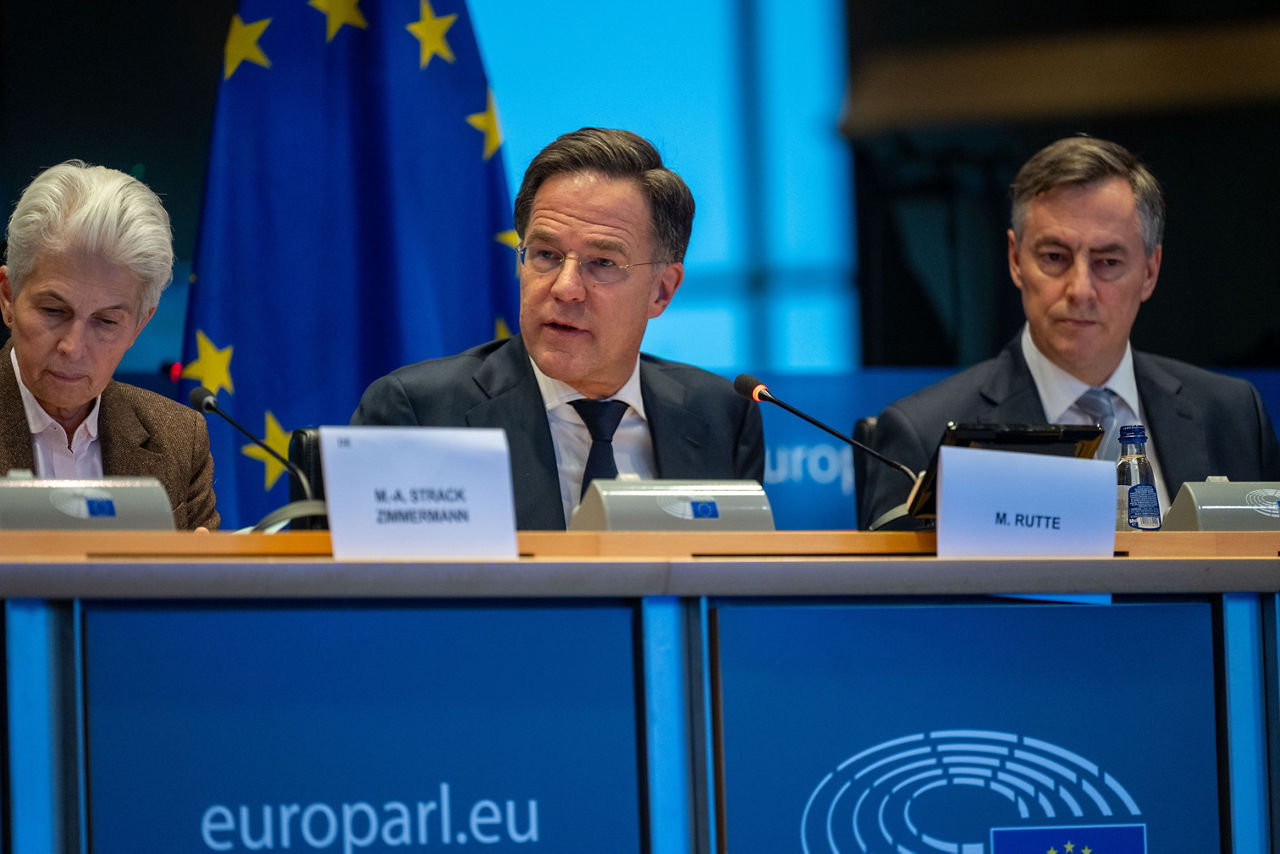
![[from left to right] David McAllister, Member of the European Parliament, NATO Secretary General Mark Rutte and Marie-Agnes Strack-Zimmermann, Member of the European Parliament](https://s7g10.scene7.com/is/image/ncia/20260126_trip-sg-ep_0065:16x9?fmt=webp-alpha&qlt=80 "NATO Secretary General addresses the European Parliament")
NATO Secretary General Mark Rutte meets with Roberta Metsola, President of the European Parliament
NATO Secretary General Mark Rutte addresses the European Parliament´s Committee on Foreign Affairs (AFET) and Committee on Security and Defence (SEDE) in Brussels
NATO Secretary General Mark Rutte addresses the European Parliament´s Committee on Foreign Affairs (AFET) and Committee on Security and Defence (SEDE) in Brussels
NATO Secretary General Mark Rutte addresses the European Parliament´s Committee on Foreign Affairs (AFET) and Committee on Security and Defence (SEDE) in Brussels
NATO Secretary General Mark Rutte addresses the European Parliament´s Committee on Foreign Affairs (AFET) and Committee on Security and Defence (SEDE) in Brussels
[from left to right] David McAllister, Member of the European Parliament, NATO Secretary General Mark Rutte and Marie-Agnes Strack-Zimmermann, Member of the European Parliament